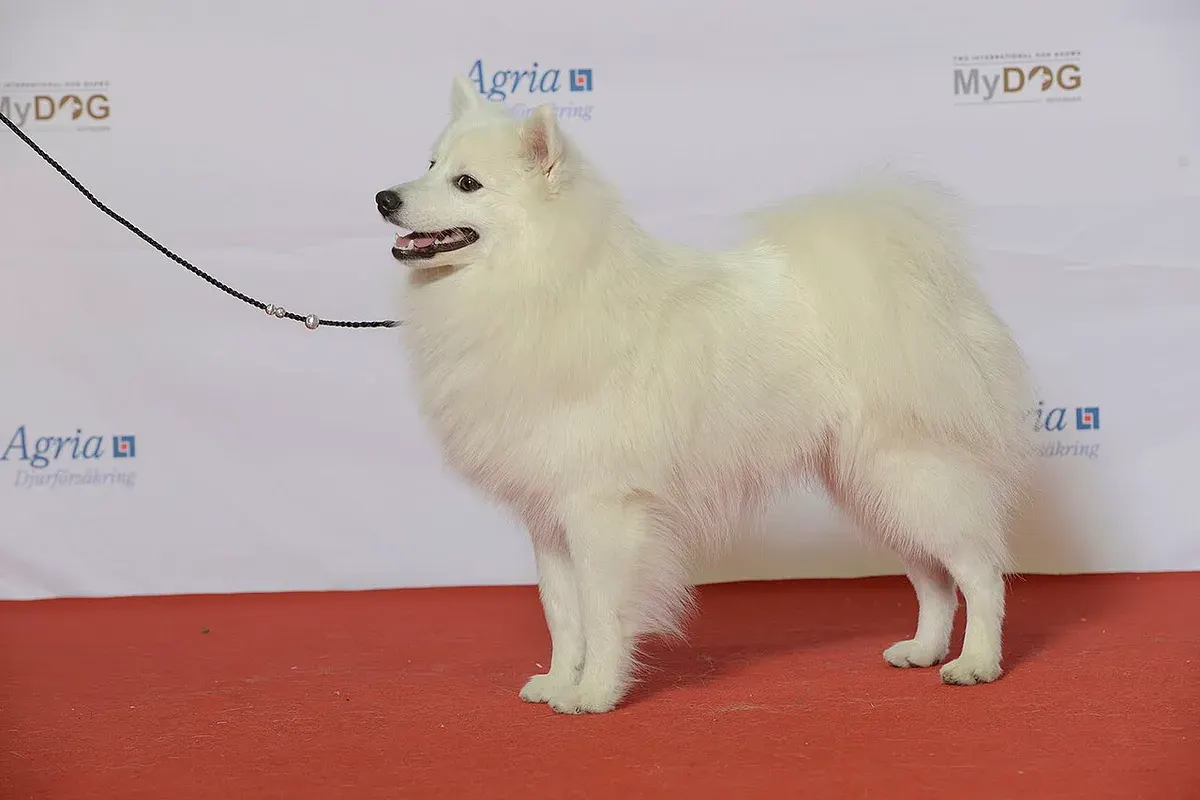
A small, all-white spitz with a bright smile, the Japanese Spitz is cheerful, affectionate and easy to live with.
History and origins
The Japanese Spitz was developed in Japan in the early 20th century, probably from white German Spitz and other imported spitz dogs.
It has become a popular companion dog in many countries.
Appearance and colours
The FCI breed standard describes a dog covered with a profuse pure white coat, with a pointed muzzle, triangular pricked ears and a feathered tail carried over the back; tough in constitution and well balanced, it expresses elegance and dignity. The outer coat is straight and stand-off over a short, soft, dense undercoat, with a beautiful frill on the neck and chest.
The colour is pure white.
- Height at the withers: 30–38 cm for males, females slightly smaller.
Temperament
Cheerful, affectionate and very attached to its family, the Japanese Spitz is sociable with children and other animals. It is alert and may bark when strangers arrive.
It learns well with positive training.
With children and other pets
The standard describes an intelligent, cheerful and keen dog, and states that noisiness is not permitted. It rates 4 out of 5 with children and 4 out of 5 with other dogs in our ratings.
- It is a cheerful family companion.
- It sheds a lot (4 out of 5 in our ratings): brush it regularly.
Training tips
According to the standard, the breed is said to descend from large white German Spitz brought to Japan around 1920 via Siberia and north-east China; further white Spitz were imported from Canada, the USA, Australia and China until about 1936, and the Japan Kennel Club set a unified standard in 1948. The Royal Kennel Club notes that the Samoyed may also have played a part. It rates 4 out of 5 for trainability in our ratings.
- It learns well with reward-based training.
- Avoid exercise in the heat: it rates 2 out of 5 for heat tolerance.
Health
This is a fairly healthy breed. Kneecap luxation and frequent tear staining should be monitored.
Regular veterinary follow-up is recommended.
This is general information. For any question about your dog's health, consult a veterinarian.
Feeding
Small-breed food in measured portions suits it.
Avoid excess weight.
Exercise
Daily walks and play, about an hour a day, are enough.
It enjoys training games.
It lives very well in an apartment if walked daily.
Grooming
Its dense white coat is surprisingly easy to maintain: weekly brushing, more during moults. Dry dirt falls off easily.
Clean around the eyes.
Choosing a puppy
The FCI standard says only healthy dogs with typical breed conformation should be used for breeding.
- Ask what health checks the parents have had.
- Meet the mother: she should be cheerful and confident.
Our guide on how to recognise a responsible breeder explains what to ask.
Similar breeds
The German Spitz and Samoyed are thought to be among its ancestors. The Pomeranian and Shiba Inu are other spitz breeds.