A powerful Arctic sled dog, the Malamute is affectionate and playful but very poorly suited to hot climates.
History and origins
The Alaskan Malamute is named after the Mahlemut people of Alaska, who used it to haul heavy loads over ice and to hunt. It later served on polar expeditions.
It is one of the oldest Arctic sled-dog breeds.
Appearance and colours
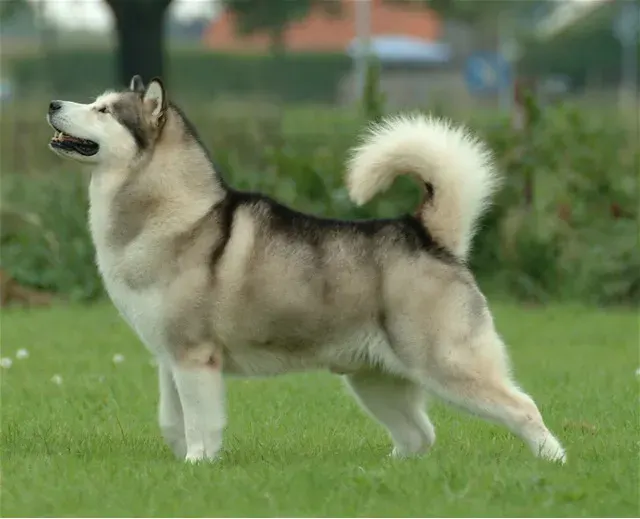
The FCI breed standard describes one of the oldest Arctic sledge dogs: a powerful, substantially built dog with a deep chest, a broad head, erect triangular ears and a well-furred tail carried over the back like a waving plume. The body is longer than the dog is tall, and the legs must show "unusual strength and tremendous propelling power". The Royal Kennel Club calls it the strongest of the sled dogs, named after the Mahlemut people who used it to pull heavy loads over long distances.
The coat combines a thick, coarse guard coat with a dense, oily, woolly undercoat 2.5–5 cm deep, shorter and less dense in summer. Colours range from light grey through shadings to black, sable and red; the only solid colour allowed is white, and white is always predominant on the underbody, legs and face markings (a cap over the head and a white face or a bar or mask). Blue eyes are disqualifying.
- Desirable freighting size: 63.5 cm and about 38 kg for males, 58.5 cm and about 34 kg for females.
Temperament
Friendly, playful and very affectionate with people, the Malamute is no guard dog. It is, however, often dominant with other dogs and has a strong prey drive.
Independent, it needs a patient, firm and experienced owner.
With children and other pets
The standard describes an affectionate, friendly dog, "not a one-man dog": a loyal, devoted, playful companion that becomes impressively dignified with maturity. It rates 4 out of 5 with children but only 2 out of 5 with other dogs in our ratings.
- It is very strong: teach it not to pull or jump up, and supervise it with small children.
- Introduce other dogs carefully, and be cautious with small pets.
Training tips
The standard insists that the Malamute is judged above all as a sledge dog for heavy freighting in the Arctic. It rates 2 out of 5 for trainability in our ratings.
- Give it hard physical work: pulling sports, hiking and long walks in cool weather.
- Use patient, reward-based training; it thinks for itself.
- Keep it on a lead or in a very secure area.
Health
Hip dysplasia, some eye diseases, hypothyroidism and an inherited polyneuropathy have been reported.
In hot countries the main danger is heatstroke.
Common health issues in detail
Polyneuropathy. Alaskan Malamute polyneuropathy is an inherited nerve disease caused by a recessive mutation in the NDRG1 gene. A Scandinavian study found that cases diagnosed 30 to 40 years ago carried the same mutation as recent cases, all traced back to one common ancestor: an example of how recessive disease genes can pass silently through many generations.
Health tests. The Royal Kennel Club recommends for breeding dogs:
- a DNA test for Alaskan Malamute polyneuropathy (AMPN) (minimum)
- a DNA test for cone degeneration (day blindness), eye testing, hip scoring and elbow grading (best practice)
This is general information. For any question about your dog's health, consult a veterinarian.
Feeding
Good-quality food matched to its activity suits it. It can be very greedy and steal food.
Avoid excess weight.
Exercise
It needs a lot of exercise: long walks, pulling and hiking, but only when it is cool.
It digs and may escape, so solid fencing is essential.
It is unsuited to apartments.
Grooming
Its very thick double coat sheds heavily: brush several times a week, daily during the moult.
Never shave it.
Choosing a puppy
Choose a breeder who DNA-tests the parents for polyneuropathy and cone degeneration and scores their hips and elbows.
- Ask to see all the test results for both parents.
- Meet the adult dogs: they should be friendly and calm, as the standard describes.
- Ask how much exercise and grooming the breeder's own dogs get, and whether you can provide the same.
Our guide on how to recognise a responsible breeder explains what to ask.
Similar breeds
The Siberian Husky is a lighter, faster sled dog. The Samoyed is a white Arctic spitz. The Akita and the Norwegian Elkhound are other spitz breeds with dense double coats.