An African dog that hardly barks, the Basenji is elegant, cat-clean, curious and very independent.
History and origins
The Basenji is a very old breed from Central Africa, especially the Congo basin, where it helped hunters by driving game into nets. Dogs of this type appear in ancient Egyptian art.
It does not bark like other dogs but makes a yodel-like sound.
Appearance and colours
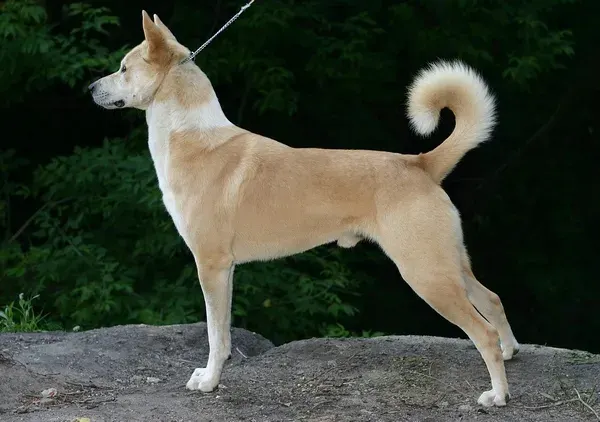
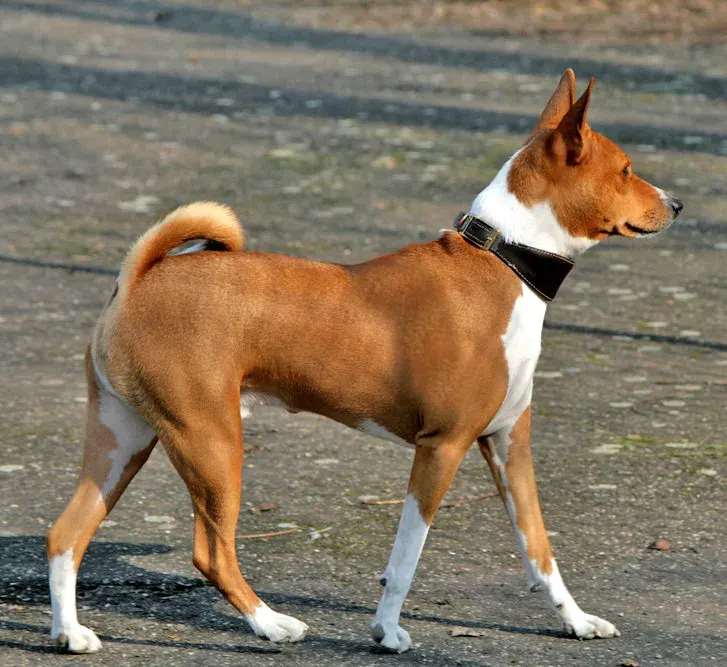
The FCI breed standard describes a lightly built, finely boned, aristocratic-looking dog, high on the legs, always poised and alert. Its head is wrinkled, with pricked ears, carried on a well-arched neck; a deep chest rises to a definite waist, and the tightly curled tail completes a picture of "gazelle-like grace".
The coat is short, sleek, close and very fine. Accepted colours are black and white, red and white, black and tan and white (with "melon pips" and tan markings on the muzzle and cheeks), black, tan and white, and brindle (black stripes on a red background). White should appear on the feet, chest and tail tip.
- Ideal height at the withers: 43 cm for males and 40 cm for females.
- Ideal weight: 11 kg for males and 9.5 kg for females.
Temperament
Curious, alert and independent, the Basenji is affectionate with its family but reserved with strangers. It grooms itself like a cat and dislikes water.
Intelligent but not keen on obedience, it needs patient, creative training. It is known for its escape skills.
With children and other pets
The standard describes an intelligent, independent but affectionate and alert breed, which can be aloof with strangers, and is remarkable for its cleanliness. The Royal Kennel Club calls it the barkless dog of Central Africa. It rates 3 out of 5 with children and 3 out of 5 with other dogs in our ratings.
- It is not silent: the standard describes its call as a mix of a chortle and a yodel.
- It may chase small pets, so introduce them carefully.
Training tips
The FCI classifies the Basenji as a primitive-type hunting dog and companion from Central Africa. It rates 2 out of 5 for trainability in our ratings.
- Keep sessions short, motivating and reward-based.
- Use a lead or a secure area: its hunting instinct can override recall.
Health
The breed is prone to Fanconi syndrome (an inherited kidney disease), progressive retinal atrophy and an inherited anaemia. Genetic tests exist.
Regular veterinary follow-up, including urine tests, is recommended.
Common health issues in detail
Fanconi syndrome. Basenjis can inherit a late-onset form of Fanconi syndrome, a kidney disorder in which the kidney tubules fail to reabsorb nutrients such as glucose and amino acids. First described in the breed in 1976, it has not been eliminated by selective breeding, partly because signs appear late, after dogs may already have been bred. In 2024, researchers identified a deletion in the FAN1 gene that matched the disease status of almost all 78 Basenjis they tested, opening the way to DNA screening before breeding.
Health tests. The Royal Kennel Club recommends eye testing as best practice for breeding dogs.
If your Basenji drinks or urinates much more than usual, see your vet.
This is general information. For any question about your dog's health, consult a veterinarian.
Feeding
Good-quality food in measured portions suits it.
It may steal food, so store it out of reach.
Exercise
It needs an hour or more of daily activity, ideally with runs in a very securely fenced area.
Its sight-hunting instinct means a lead outdoors.
It does, however, feel the cold in winter. Because it barks very little, it can suit an apartment if well exercised; watch balconies and doors, as it escapes easily.
Grooming
Its short, fine coat needs very little care and it has hardly any odour.
A weekly rub with a grooming mitt is enough.
Choosing a puppy
Choose a breeder who eye-tests the parents and can explain how they screen for Fanconi syndrome.
- Ask whether the parents have been DNA-tested for the FAN1 variant, and about kidney problems in older relatives.
- Meet the mother and check that she is alert and friendly.
Our guide on how to recognise a responsible breeder explains what to ask.
Similar breeds
The Pharaoh Hound and Cirneco dell'Etna are other primitive hunting dogs with pricked ears. The Shiba Inu is a small spitz with a curled tail and a similar independence. The Thai Ridgeback is another primitive-type breed.