The world's smallest dog has a big personality: lively, loyal and brave, the Chihuahua is an ideal companion for city life.
History and origins
The Chihuahua is named after a state in northern Mexico, where the breed was discovered and popularised in the 19th century. Its exact origins are still debated, but it is often linked to the small companion dogs of pre-Columbian civilisations.
Today it is one of the most widespread companion breeds in the world, in both smooth and long coats.
Appearance and colours
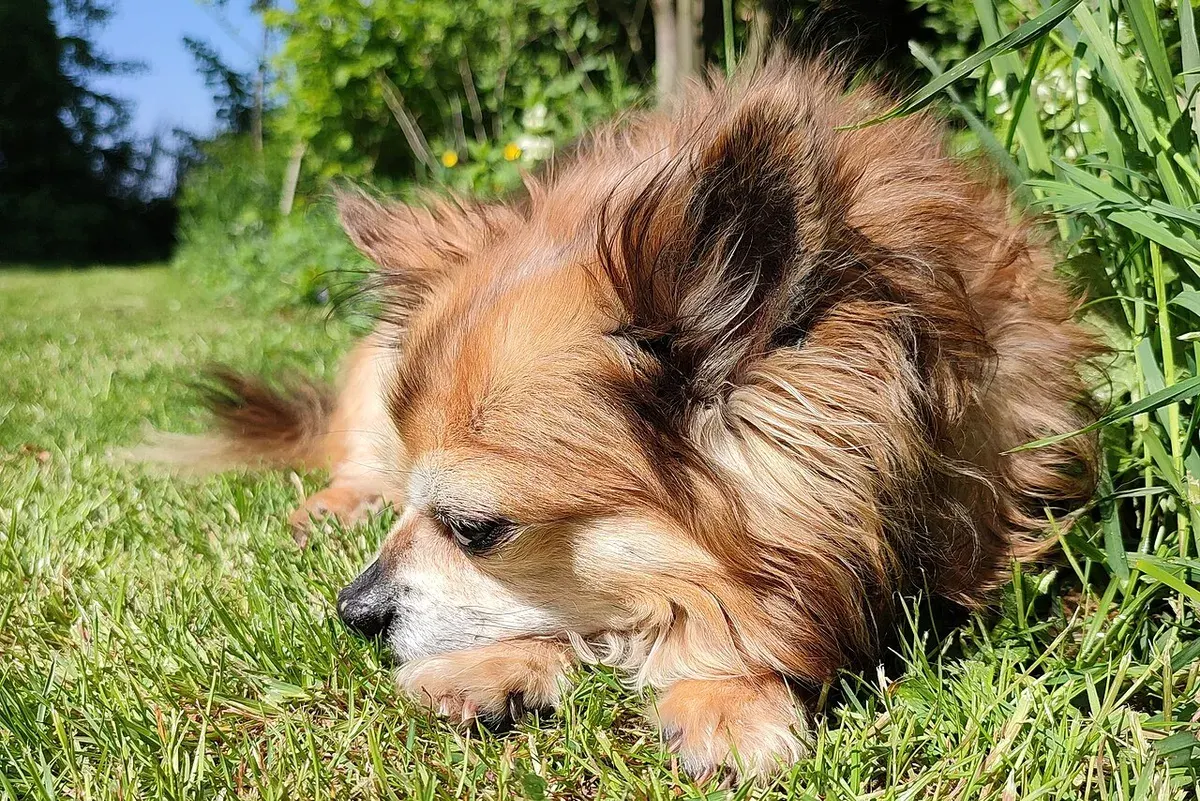
The FCI breed standard regards the Chihuahua as the smallest pedigree dog in the world. It has a compact body, slightly longer than tall, though an almost square body is preferred in males. The standard stresses two features: an apple-shaped skull, and a moderately long tail carried high, curved or in a semicircle with the tip pointing towards the loin.
There are two coat varieties:
- Smooth: short, close-lying, glossy and soft; hairless dogs are not accepted.
- Long: fine and silky, smooth or slightly wavy, with feathering on the ears, neck, legs, feet and tail.
All colours in all shades and combinations are admitted, except merle. The Royal Kennel Club refuses to register merle puppies because the merle gene in this breed carries an increased risk of impaired hearing and sight.
- Only weight counts in the standard: 1–3 kg, ideally 1.5–2.5 kg. Dogs under 1 kg or over 3 kg are disqualified.
- In a UK study of more than 11,000 Chihuahuas, the median adult weight was 3.4 kg, above the standard's upper limit.
Temperament
Lively, curious and very attached to one or two people, the Chihuahua often ignores its small size. It can be wary of strangers and bark readily.
Consistent training, just as for a big dog, and early socialisation prevent it from becoming fearful or possessive. With young children, interactions must be supervised because it is fragile.
With children and other pets
The standard describes the Chihuahua as quick, alert, lively and very courageous. It rates 2 out of 5 with children and 3 out of 5 with other dogs in our ratings, mainly because of its size.
- A fall or a careless step can injure it: children should sit on the floor to hold it and never carry it around.
- Supervise meetings with larger dogs, even friendly ones.
- Teach visitors to let it approach them rather than reaching down to pick it up.
Training tips
It rates 3 out of 5 for trainability in our ratings. Small dogs are easily allowed habits that would not be tolerated in a large dog, so train it like any other dog.
- Use tiny food rewards and short sessions; reward calm behaviour around visitors.
- Socialise it gently with people, places and calm dogs, carrying it in your arms at first if needed.
- Teach it to accept tooth brushing and handling of its mouth and feet from the first weeks.
Health
It often lives a long time, but its small size exposes it to certain problems: kneecap luxation, dental disease, fragile bones and, in puppies, a risk of low blood sugar. Some individuals have an incompletely closed fontanelle.
Regular veterinary check-ups, especially dental ones, are strongly advised.
Common health issues in detail
In a UK study of Chihuahuas seen by vets in 2016, the most common disorders were periodontal (gum) disease (13.5%), obesity (5.9%), retained baby teeth (5.7%), anal sac impaction (4.9%) and aggression (4.2%). Males were more often diagnosed than females with aggression, heart murmurs, ear infections, conjunctivitis and upper respiratory infections.
Lifespan. The population was young and growing fast, with a median age of 2.8 years. Among the dogs that died, the median age at death was 8.2 years, longer in females (10.2 years) than in males (6.9 years). The most common causes of death were heart disease (19%), lower respiratory disease (16%) and traumatic injury (14%).
Teeth. Dental disease and retained baby teeth were among the most common problems: ask your vet to check that the baby teeth fall out as the adult teeth come through, and brush its teeth regularly.
The researchers also warned about impulse purchases of Chihuahua puppies by owners with limited experience of dog care.
Health tests. The Royal Kennel Club lists an eye examination as best practice for breeding dogs.
This is general information. For any question about your dog's health, consult a veterinarian.
Feeding
It eats very small amounts, and a few extra grams quickly make a big difference to its weight. Choose food for very small dogs with small kibble.
Puppies should have several small meals a day to avoid drops in blood sugar.
Exercise
Daily walks and games at home are enough to tire it out. It also enjoys short training sessions and treat-finding games.
Use a harness rather than a collar to protect its windpipe, and supervise it around larger dogs.
Walk it during the cool hours in summer and provide a small coat in winter if needed. Watch out for balconies and falls from the sofa or from someone's arms, which can injure it.
Grooming
The smooth-coated Chihuahua needs weekly brushing; the long-coated variety needs brushing two to three times a week.
Brushing its teeth several times a week is one of the most important care routines for this breed.
Choosing a puppy
Choose a breeder who has the parents' eyes examined, raises the puppies in the home, and is happy to talk about the health and lifespan of the dogs they have bred.
- Meet the mother: she should be alert and confident, not fearful or snappy.
- Ask about teeth, kneecaps and heart problems in the family.
- Avoid merle puppies and "teacup" Chihuahuas: the standard excludes merle and dogs under 1 kg.
- Take your time: the researchers in the UK study warned against impulse purchases.
- Consider an adult from a rescue.
Our guide on how to recognise a responsible breeder explains what to ask.
Similar breeds
The Russian Toy is a tiny companion of similar weight, also with smooth and long coats. The Papillon and the Pomeranian are other toy breeds with longer coats. The Miniature Pinscher is a slightly larger, smooth-coated toy dog.