Small, proud and full of energy, the Miniature Pinscher is a lively, watchful dog with a personality far bigger than its size.
History and origins
The Miniature Pinscher is an old German breed developed from the German Pinscher to catch rats on farms and in stables. Despite the resemblance, it is not a miniature Dobermann; it is actually older.
Today it is a companion dog valued for its liveliness and short, glossy coat.
Appearance and colours
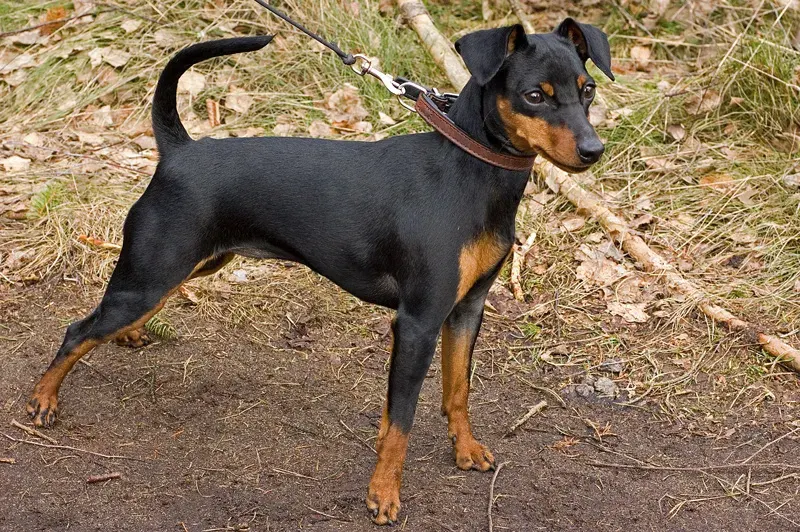
The FCI breed standard describes a reduced image of the German Pinscher without the drawbacks of a dwarfed appearance; its elegant, square build shows clearly under the short, smooth coat. The coat is short, dense, smooth, close and shiny.
Colours are solid deer red, reddish-brown to dark red-brown, or black and tan (lacquer black with red or brown markings, as dark and clearly defined as possible).
- Height at the withers: 25–30 cm.
- Weight: 4–6 kg.
Temperament
Energetic, curious and self-confident, the Min Pin has a proud, high-stepping gait and a watchdog temperament. It barks readily and can be wary of strangers.
Intelligent but sometimes stubborn, it needs consistent, playful training. It dislikes rough handling, so care is needed around young children.
With children and other pets
The standard describes a lively, spirited, self-assured and even-tempered dog, an agreeable family and companion dog. It rates 3 out of 5 with children and 3 out of 5 with other dogs in our ratings.
- It is a lively companion that enjoys activity.
- It is small: teach children to handle it gently.
Training tips
According to the standard, Miniature Pinschers were already kept in large numbers around the turn of the 20th century, and the 1925 stud book recorded some 1,300 entries; as with the German Pinscher, only the black-and-tan and solid red colours were kept. The Royal Kennel Club notes that it was once used as a ratter and that the first breed club was founded in Germany in 1895. It rates 3 out of 5 for trainability in our ratings.
- Use short, varied, reward-based sessions.
- It rates 4 out of 5 for energy: give it daily walks and games.
Health
This is a fairly robust breed. Kneecap luxation, some eye conditions and dental health should be monitored.
Its fine build makes it prone to fractures after a fall or a jump from a height.
Common health issues in detail
The Royal Kennel Club recommends eye testing as best practice for breeding dogs and notes that the breed has a breed club health scheme.
We found no large population study of health in the Miniature Pinscher.
This is general information. For any question about your dog's health, consult a veterinarian.
Feeding
Active but greedy, it needs small-breed food in measured portions. Avoid table scraps, which encourage weight gain.
Adjust the ration to its activity level.
Exercise
It needs daily walks and lively games. It loves running, exploring and joining in family activities.
Its rodent-hunting instinct makes it bolt, so keep it on a lead outside fenced areas.
The Min Pin handles heat reasonably well thanks to its short coat, but avoid outings in the hottest hours and scorching ground. In winter, especially in colder regions, a small coat can help. It lives very well in an apartment if it gets daily exercise. Its tendency to bark may bother neighbours, though, so early training helps a lot.
Grooming
Its short, smooth coat needs very little care: a grooming mitt once a week is enough.
Remember teeth and nails, and protect it from cold in winter.
Choosing a puppy
Choose a breeder who eye-tests the parents and takes part in the breed club health scheme.
- Ask for the parents' eye test results.
- Meet the mother: she should be lively and confident.
Our guide on how to recognise a responsible breeder explains what to ask.
Similar breeds
The German Pinscher is its larger relative. The Manchester Terrier, Affenpinscher and Italian Greyhound are other small, lively dogs.