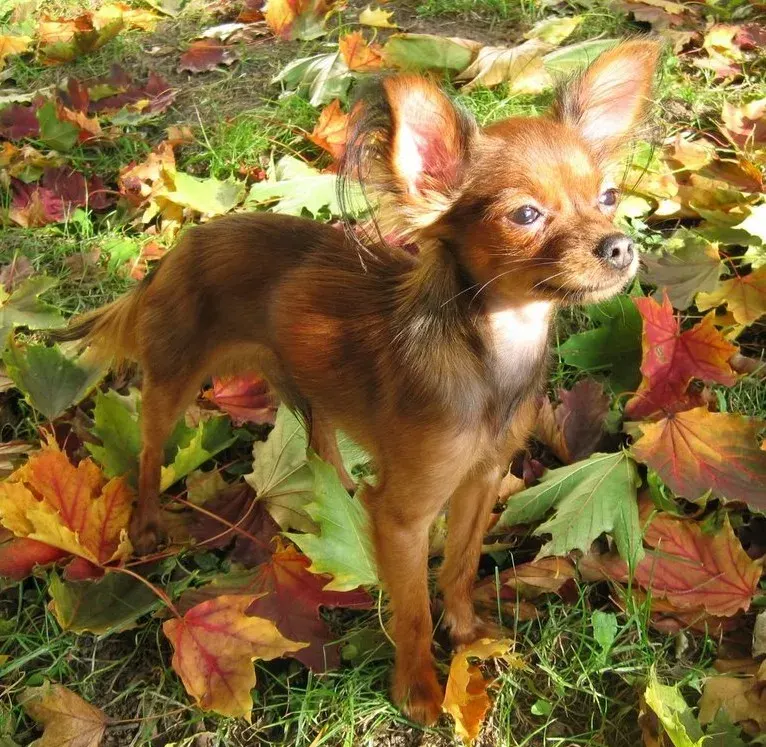
A tiny, elegant dog with large ears, the Russian Toy (Russkiy Toy) is lively, cheerful and very attached to its owners.
History and origins
The Russian Toy descends from English Toy Terriers, which were very popular with the Russian aristocracy in the early 20th century. The breed was rebuilt in Russia after the Second World War.
It comes in two varieties: smooth-coated and long-coated, with fringed ears.
Appearance and colours
The FCI breed standard describes a small, elegant, long-legged dog with fine bone and lean muscles, very harmonious and well proportioned. There are two coats: smooth-haired (short, close and shiny, without undercoat) and long-haired (3–5 cm, straight or slightly wavy, with feathering on the legs and tail and fringes that hide the edges of the ears).
Colours are black and tan, brown and tan, blue and tan, lilac and tan, red with black, blue, brown or lilac, red, fawn and cream.
- Height at the withers: 22–27 cm.
- Weight: up to 3 kg.
Temperament
Lively, cheerful and very affectionate, the Russkiy Toy is attached to its family and often reserved with strangers. It can bark readily.
Being fragile, it needs care around young children and gentle training.
With children and other pets
The standard describes an active, very cheerful dog, neither cowardly nor aggressive, always curious and strongly devoted to its owner. It rates 2 out of 5 with children and 3 out of 5 with other dogs in our ratings.
- It is tiny and fine-boned: it suits homes with older, gentle children.
- It enjoys games and company.
Training tips
According to the standard, the English Toy Terrier was popular in Russia in the early 20th century, but between 1920 and 1950 its breeding almost stopped; Russian breeders revived it from the mid-1950s, largely from dogs without pedigrees, and the breed developed its own way in Russia. The Royal Kennel Club calls it a long-legged, elegant little dog recently revived in Russia. It rates 3 out of 5 for trainability in our ratings.
- Use short, gentle, reward-based sessions.
- It rates 4 out of 5 for energy: give it daily games and walks.
Health
Its tiny size exposes it to fractures, kneecap luxation, dental problems (retained baby teeth) and, in puppies, low blood sugar.
Regular veterinary check-ups, especially dental, are recommended.
Common health issues in detail
The Royal Kennel Club recommends eye testing as best practice for breeding dogs and notes that the breed has a breed club health scheme.
We found no large population study of health in the Russian Toy.
This is general information. For any question about your dog's health, consult a veterinarian.
Feeding
Food for very small dogs, in small, frequent portions, suits it.
Avoid too many treats.
Exercise
Daily walks and indoor play are enough. It is active and playful.
Use a harness.
It can feel the cold in winter. It is perfectly suited to apartments; watch out for falls and balconies.
Grooming
The smooth variety needs only a rub with a grooming mitt; the long-coated variety needs weekly brushing.
Tooth brushing is essential.
Choosing a puppy
Choose a breeder who eye-tests the parents and takes part in the breed club health scheme.
- Ask for the parents' eye results.
- Meet the mother: she should be cheerful and confident.
Our guide on how to recognise a responsible breeder explains what to ask.
Similar breeds
The Chihuahua, Miniature Pinscher, Papillon and Italian Greyhound are other small, fine-boned companions.