Nicknamed the 'American gentleman' for its tuxedo coat, the Boston Terrier is cheerful, affectionate and easy to live with in the city.
History and origins
The Boston Terrier was developed in Boston, USA, in the late 19th century from bulldog and terrier crosses. It quickly became a very popular companion dog.
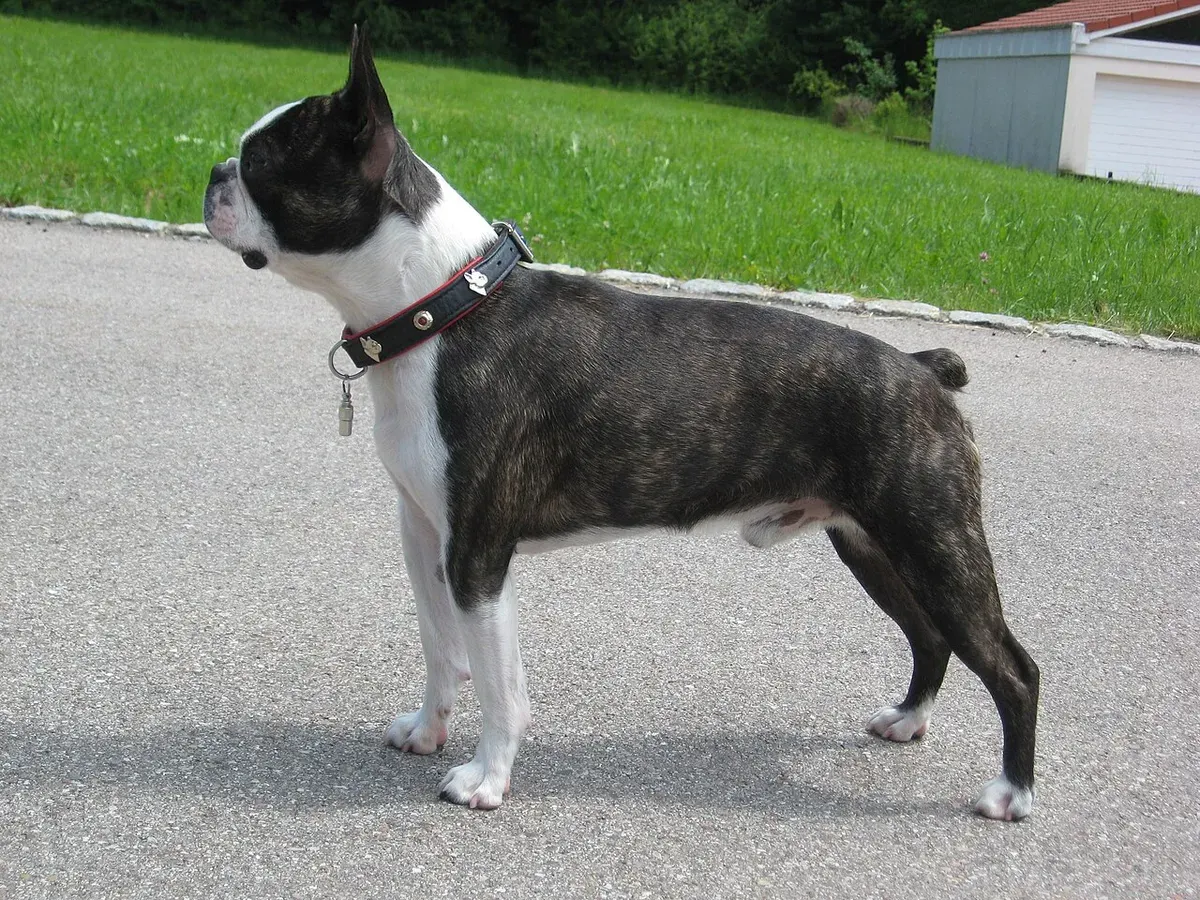
Its black, brindle or seal coat with white markings looks like a tuxedo.
Appearance and colours
The FCI breed standard describes a lively, highly intelligent, smooth-coated, short-headed, compactly built, short-tailed and well-balanced dog with a striking square appearance. The Royal Kennel Club calls it the smallest of the bull breeds, named after the city of Boston in the United States.
The coat is short, smooth, bright and fine. The colour is brindle, seal (black with a red cast in bright light) or black, with white markings: a white muzzle band, a white blaze between the eyes and a white forechest are required.
The standard divides weight into three classes:
- under 6.8 kg
- 6.8 kg to under 9 kg
- 9 kg to 11.35 kg
Temperament
Cheerful, affectionate and sociable, the Boston is excellent with children and usually gets on with other animals. It is lively, playful and sometimes a little stubborn.
It learns well with positive training.
With children and other pets
The standard describes a friendly, lively dog with an excellent disposition and a high degree of intelligence, an incomparable companion. It rates 5 out of 5 with children and 4 out of 5 with other dogs in our ratings.
- It is a cheerful, sociable family dog.
- It overheats easily: it rates 1 out of 5 for heat tolerance in our ratings.
Training tips
It rates 4 out of 5 for trainability in our ratings.
- Short, playful, reward-based sessions suit it well.
- Keep walks and games moderate in warm weather, and never let it overexert itself.
Health
Its short muzzle exposes it to breathing difficulties and heatstroke. Its large eyes are prone to injuries and ulcers, and deafness can occur.
Regular veterinary follow-up is recommended.
Common health issues in detail
Breathing (BOAS). Like other flat-faced breeds, the Boston Terrier can suffer from brachycephalic obstructive airway syndrome. In a UK study of 107 Boston Terriers, 37.5% had no signs of the syndrome (grade 0), compared with 10% of French Bulldogs and 15.2% of Bulldogs in an equivalent study. Within the breed, more extreme features (narrow nostrils, a shorter face, visible white of the eyes and a thicker neck compared with the chest) increased the risk, but measurements overlapped, so the authors recommend respiratory function grading to select unaffected dogs.
Health tests. The Royal Kennel Club recommends for breeding dogs:
- eye testing (minimum)
- a DNA test for hereditary cataract (HSF4) and respiratory function grading for BOAS (best practice)
It also notes that the breed can be affected by conformational concerns.
This is general information. For any question about your dog's health, consult a veterinarian.
Feeding
Food suited to its size, in measured portions, suits it.
Avoid excess weight, which worsens breathing difficulties.
Exercise
Daily walks and play are enough. It loves to play but must avoid exertion in hot weather.
Use a harness.
Never leave it in a car. It is very well suited to apartment life.
Grooming
Its short coat needs very little care: a weekly rub with a grooming mitt is enough.
Clean its eyes and facial folds.
Choosing a puppy
Choose a breeder who eye-tests the parents, carries out the HSF4 DNA test and has the parents' breathing graded.
- Ask for the parents' respiratory function grades and eye results.
- Look for open nostrils and quiet breathing, at rest and after a little play.
- Meet the mother: she should be lively and friendly.
Our guide on how to recognise a responsible breeder explains what to ask.
Similar breeds
The French Bulldog, Pug and Bulldog are other popular flat-faced companions. The Staffordshire Bull Terrier is another small bull-and-terrier breed with a longer muzzle.