An always-cheerful ball of white fluff, the Bichon Frise is a gentle, sociable, easy-going companion that sheds very little.
History and origins
The Bichon Frise belongs to the bichon family, small companion dogs known for centuries around the Mediterranean. Its ancestors are thought to have travelled with sailors and been prized on islands, particularly the Canaries, hence its old name 'Tenerife'.
It enjoyed great success at European courts during the Renaissance before becoming a popular companion dog worldwide.
Appearance and colours
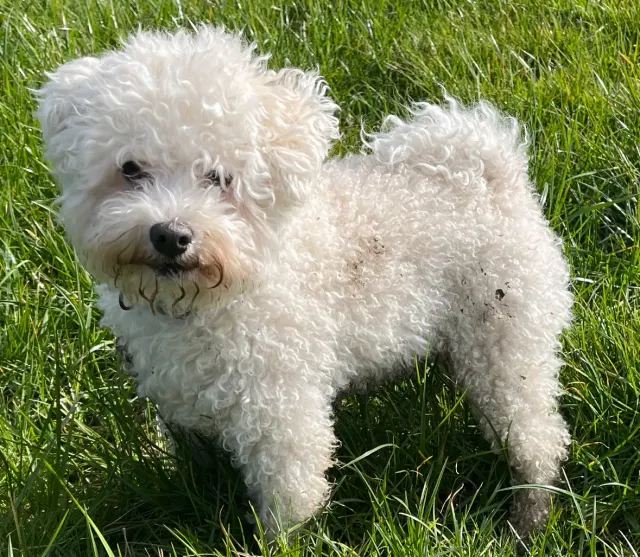
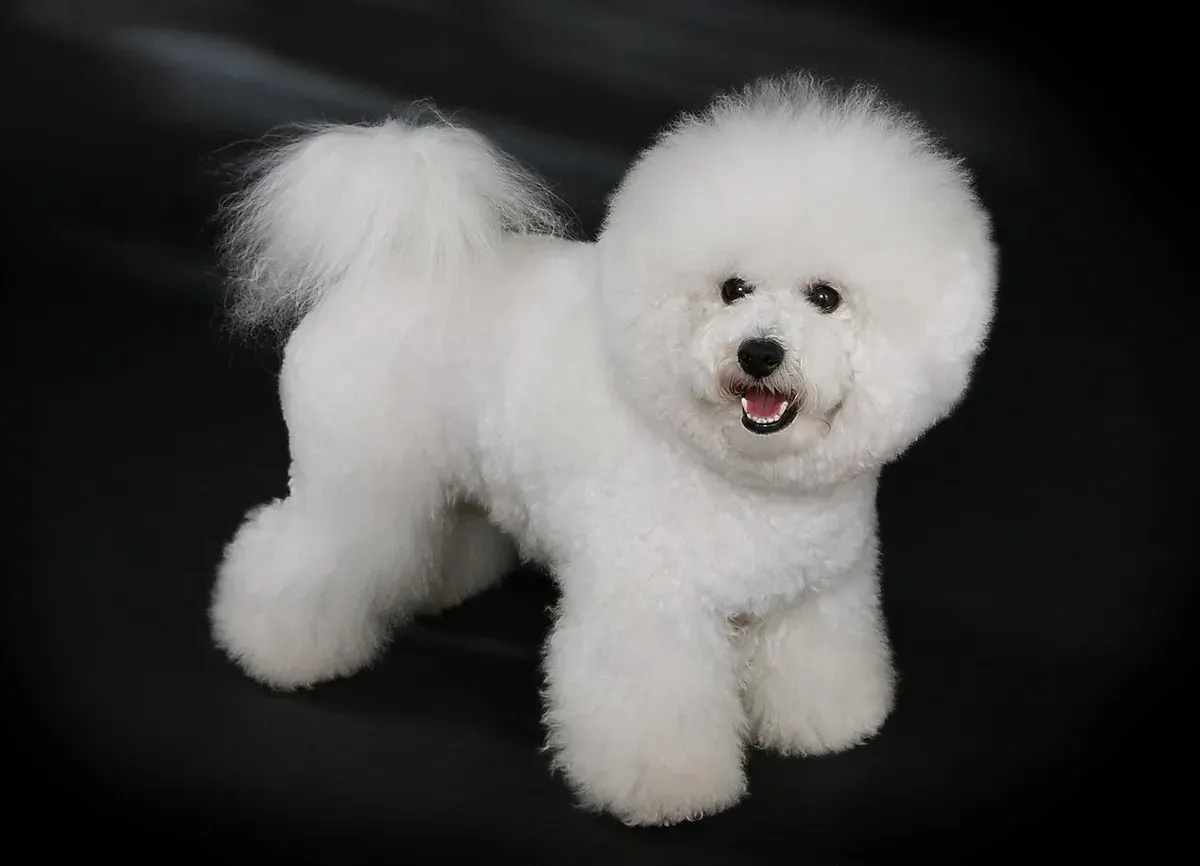
The FCI breed standard describes a cheerful little dog with a lively gait, very loose white corkscrew curls, a proudly carried head and a tail curved gracefully over the back. The body is longer than tall, and the dark eyes and black nose form an equilateral triangle on the white head.
The profuse coat has loose spiral curls over a soft, dense undercoat; it must be neither flat, corded, woolly nor matted. The colour is pure white, although before 12 months a slight beige (champagne) tinge may cover up to 10% of the dog.
- Height at the withers: 25–29 cm (males may be 1 cm taller, females 2 cm smaller).
- Weight: about 5 kg.
Temperament
Merry, affectionate and sociable, the Bichon Frise loves everyone: children, guests and other animals. It is playful, sometimes a clown, and very attached to its family.
It copes poorly with long periods alone. House-training may take a little more patience than with some breeds, so rely on routine and rewards.
With children and other pets
The standard describes a true companion that can be taken anywhere: neither nervous nor a frequent barker, very sociable with people and dogs, even strangers, adaptable and very attached to its owners. It rates 5 out of 5 with children and 5 out of 5 with other dogs in our ratings.
- It is a sociable family dog, but small: teach children to handle it gently.
- It adapts easily to new places and people.
Training tips
According to the standard, the Bichon Frisé was brought to France from Italy during the Renaissance; because it looked like a very small Barbet, it was called "barbichon", shortened to "bichon". Painters of the 17th and 18th centuries depicted it with kings and nobles, and it nearly disappeared after the two world wars. It rates 4 out of 5 for trainability in our ratings.
- It learns well with short, cheerful, reward-based sessions.
- Start grooming and handling early: its coat needs regular care.
Health
This is a long-lived breed. Things to watch for include skin allergies, kneecap luxation, dental problems and some types of bladder stones.
Regular veterinary follow-up and good dental hygiene help keep it in shape.
Common health issues in detail
The Royal Kennel Club recommends eye testing for breeding dogs as a minimum.
We found no large population study of health in the Bichon Frisé.
This is general information. For any question about your dog's health, consult a veterinarian.
Feeding
Good-quality small-breed food in measured portions suits it well. It loves food, so limit treats and table scraps.
Fresh water should be available at all times.
Exercise
Daily walks and play are enough to keep it happy. It also enjoys simple tricks and search games.
It adapts easily to its family's pace, whether active or more relaxed.
In summer a slightly shorter trim helps it cope with heat, without shaving down to the skin, which must stay protected from the sun. Walk it in the cool hours and keep it indoors during heat peaks. Its white coat gets dirty quickly, so budget for regular grooming.
Grooming
Its soft, curly coat barely sheds, but dead hair stays caught in the coat and forms mats. Brushing several times a week and a trim at the groomer every four to six weeks are necessary.
Clean around the eyes regularly to limit tear staining.
Choosing a puppy
Choose a breeder who eye-tests the parents and raises the puppies in the home.
- Ask for current eye certificates for both parents.
- Meet the mother: she should be sociable and calm, as the standard describes.
- Ask how the coat is kept and how often it needs professional grooming.
Our guide on how to recognise a responsible breeder explains what to ask.
Similar breeds
The Bolognese, Maltese, Havanese and Coton de Tuléar belong to the same family of small Bichon-type companion dogs.