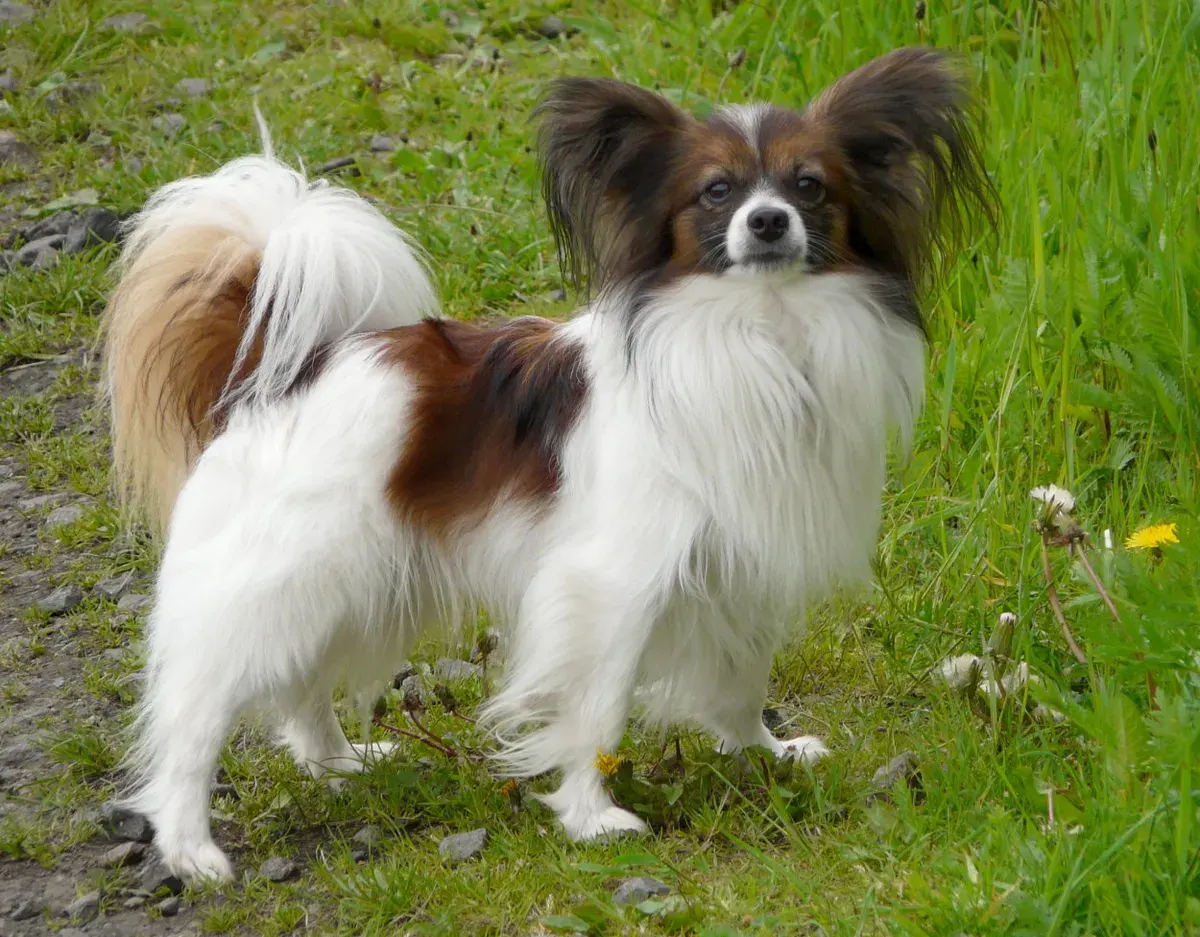
Recognisable by its large, fringed ears shaped like butterfly wings, this little dog is lively, clever and surprisingly athletic.
History and origins
The Continental Toy Spaniel is an old companion dog seen in many Renaissance paintings in France, Italy and Belgium.
It comes in two varieties: the Papillon, with upright ears, and the Phalène, with drop ears.
Appearance and colours
The FCI breed standard describes a small toy spaniel of normal, harmonious build, with long hair and a moderately long muzzle, graceful yet robust, with a proud carriage and an easy, elegant gait; the body is somewhat longer than tall. The coat has no undercoat and is abundant, glossy and wavy, short on the face and longer on the neck, ears and tail. The Royal Kennel Club notes two varieties: the Papillon, with erect ears like a butterfly's wings, and the drop-eared Phalène.
All colours are admitted on a white background; on the body and legs the white must dominate.
- Height at the withers: about 28 cm.
- Weight: under 2.5 kg, or 2.5–4.5 kg for males and 2.5–5 kg for females (minimum 1.5 kg).
Temperament
Lively, cheerful and very intelligent, the Papillon loves learning and joining in family activities. It is affectionate and often reserved with strangers.
It excels with positive training and at agility.
With children and other pets
The standard describes a lively personality. It rates 3 out of 5 with children and 4 out of 5 with other dogs in our ratings.
- It is tiny: teach children to handle it gently.
- It enjoys games and activity.
Training tips
The FCI lists France and Belgium as the breed's countries of origin and classifies it among the continental toy spaniels. The Royal Kennel Club calls it the intelligent and dainty butterfly dog. It rates 5 out of 5 for trainability in our ratings.
- It learns quickly: short, varied, reward-based sessions suit it.
- Give it daily walks and games.
Health
This breed is often long-lived. Kneecap luxation, some eye diseases, an open fontanelle and dental problems should be monitored.
Regular veterinary check-ups, especially dental, are recommended.
This is general information. For any question about your dog's health, consult a veterinarian.
Feeding
Food for very small dogs, in measured portions, suits it.
Avoid too many treats.
Exercise
It needs daily walks and active play. It enjoys tricks and agility.
Despite its size, it has good stamina.
It is perfectly suited to apartments; watch out for balconies and falls.
Grooming
Its silky, single coat needs brushing once or twice a week.
Remember tooth brushing.
Choosing a puppy
The FCI standard says only healthy dogs with typical breed conformation should be used for breeding.
- Ask what health checks the parents have had.
- Meet the mother: she should be lively and friendly.
Our guide on how to recognise a responsible breeder explains what to ask.
Similar breeds
The Chihuahua, Pomeranian, Japanese Chin and Cavalier King Charles Spaniel are other small companion dogs.