An elegant little dog of the Japanese nobility, the Japanese Chin is calm, refined and very affectionate with its family.
History and origins
The Japanese Chin was bred for centuries at the imperial court and among the nobility of Japan, probably from small dogs that came from China.
It reached Europe in the 19th century, where it charmed royal courts.
Appearance and colours
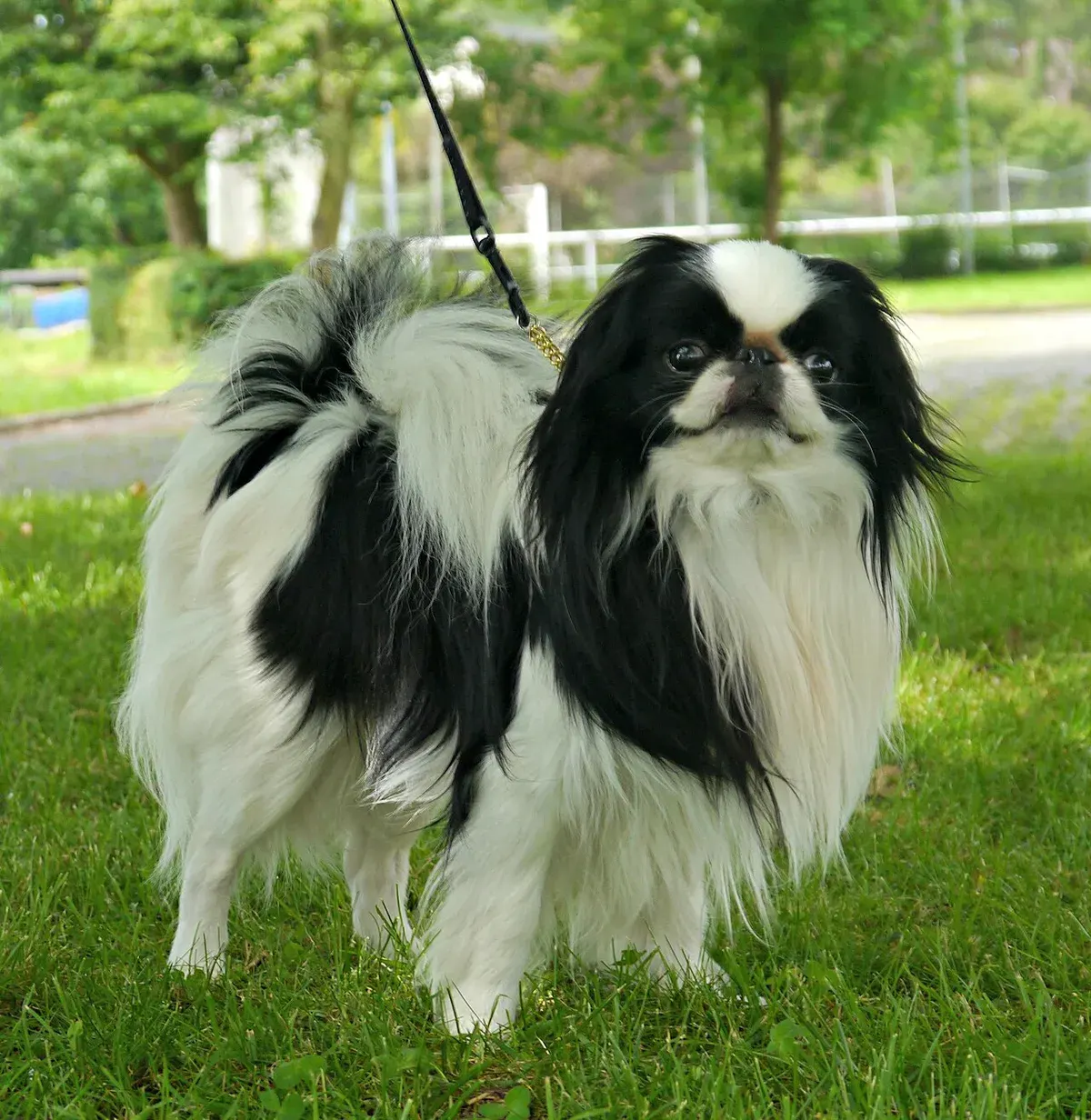
The FCI breed standard describes a small dog with a broad face, covered with a profuse coat, with an elegant, graceful figure; the body is about as long as it is tall. The coat is silky, straight and long, with profuse feathering on the ears, neck, thighs and tail.
The colour is white with black or red markings, ideally spread symmetrically around the eyes, over the ears and on the body, with a wide white blaze from muzzle to crown.
- Height at the withers: about 25 cm for males, females slightly smaller.
Temperament
Calm, refined and affectionate, the Chin is attached to its family and often reserved with strangers. It has almost cat-like habits: it grooms itself and likes to perch up high.
Sensitive, it responds to gentle training.
With children and other pets
The standard describes a clever, mild and lovely dog. It rates 3 out of 5 with children and 4 out of 5 with other dogs in our ratings.
- It is small: teach children to handle it gently.
- Avoid exertion in the heat: it rates 1 out of 5 for heat tolerance.
Training tips
According to the standard, the Chin's ancestors are thought to have been given by the rulers of Korea to the Japanese court in 732, and more came from China and Korea in the following century; under the Shogun Tsunayoshi Tokugawa (1680–1709) it was kept as an indoor toy dog in Edo Castle. The Royal Kennel Club describes it as intelligent, elegant and aristocratic. It rates 3 out of 5 for trainability in our ratings.
- Short, gentle, reward-based sessions suit it.
- Brush the coat regularly.
Health
Its short muzzle exposes it to breathing difficulties and heatstroke. Kneecap luxation and eye and heart problems should also be monitored.
Regular veterinary follow-up is recommended.
Common health issues in detail
The Royal Kennel Club recommends eye testing as best practice for breeding dogs. In August 2026 it also recognised breathing testing for brachycephalic obstructive airway syndrome (BOAS) under its Respiratory Function Grading scheme, which it will add to its health standard from January 2027.
We found no large population study of health in the Japanese Chin.
This is general information. For any question about your dog's health, consult a veterinarian.
Feeding
Food for very small dogs, in small portions, suits it.
Avoid excess weight.
Exercise
Short walks and indoor games are enough.
No exertion at all in hot weather.
It is perfectly suited to apartments.
Grooming
Its silky coat needs brushing twice a week. Clean its eyes and facial folds.
It sheds during the moult.
Choosing a puppy
Choose a breeder who eye-tests the parents and has their breathing graded.
- Ask for the parents' eye results and BOAS breathing grades.
- Watch the parents breathe at rest and after a short walk: noisy breathing is a warning sign.
- Meet the mother: she should be calm and gentle.
Our guide on how to recognise a responsible breeder explains what to ask.
Similar breeds
The Pekingese, King Charles Spaniel and Shih Tzu are other small, short-faced companions. The Papillon is another small, feathered companion.