A small, long-coated guardian of Tibetan monasteries, the Lhasa Apso is proud, watchful and very attached to its family.
History and origins
The Lhasa Apso comes from Tibet, where it guarded the inside of monasteries and homes, raising the alarm when strangers arrived. It is named after the capital, Lhasa.
It was often given as a gift and rarely sold.
Appearance and colours
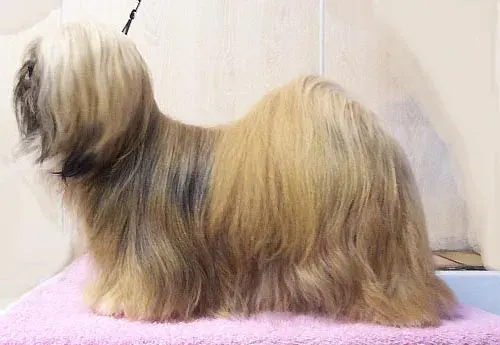
The FCI breed standard describes a well-balanced, sturdy, heavily coated dog, longer than tall. The top coat is long, heavy, straight and hard, neither woolly nor silky, with a moderate undercoat; the head furnishings fall over the eyes without affecting sight.
Golden, sandy, honey, dark grizzle, slate, smoke, particolour, black, white and brown are all equally acceptable; any colour is permitted except merle.
- Ideal height at the withers: 25 cm for males, females slightly smaller.
Temperament
Proud, watchful and independent, the Lhasa is affectionate with its family but wary of strangers. It barks to announce anyone's presence.
It dislikes being jostled and can be stubborn; patient training and early socialisation are needed.
With children and other pets
The standard describes a gay and assertive dog, alert and steady but somewhat aloof with strangers. It rates 3 out of 5 with children and 3 out of 5 with other dogs in our ratings.
- It is a good watchdog.
- Its long coat needs a lot of care (5 out of 5 for grooming needs in our ratings).
Training tips
According to the standard, the Lhasa Apso comes from Tibet, where its long, hard coat and dense undercoat insulate it and the hair over its eyes protects them from wind, dust and glare; the first Apsos arrived in Britain in the early 1920s. The Royal Kennel Club notes that it was kept for centuries by Tibetan monks as a companion and watchdog. It rates 2 out of 5 for trainability in our ratings.
- Use patient, reward-based training.
- Start grooming routines early.
Health
Eye problems, an inherited kidney disease, kneecap luxation and skin problems should be monitored.
Regular veterinary follow-up is recommended.
Common health issues in detail
The Royal Kennel Club recommends as a minimum for breeding dogs a DNA test for progressive retinal atrophy (PRA4), and eye testing as best practice.
We found no large population study of health in the Lhasa Apso.
This is general information. For any question about your dog's health, consult a veterinarian.
Feeding
Small-breed food in measured portions suits it.
Avoid excess weight.
Exercise
Daily walks and indoor play are enough.
It appreciates its routines.
It is well suited to apartments, but its alert barking should be managed early.
Grooming
Its long coat hardly sheds but tangles: brush daily if kept long, or choose a regular short clip. Keep the hair around the eyes clear.
Clean its eyes regularly.
Choosing a puppy
Choose a breeder who does the PRA4 DNA test and eye-tests the parents.
- Ask for the parents' PRA4 and eye results.
- Meet the mother: she should be confident and steady.
Our guide on how to recognise a responsible breeder explains what to ask.
Similar breeds
The Shih Tzu, Tibetan Terrier and Tibetan Spaniel are other Tibetan breeds. The Pekingese is another long-coated Asian companion.