A shaggy dog from the Tibetan mountains, the Tibetan Terrier is cheerful, affectionate and hardy. It sheds very little.
History and origins
The Tibetan Terrier lived in the valleys of the Himalayas, where it accompanied families, guarded homes and sometimes helped herd livestock. Despite its name, it is not a true terrier.
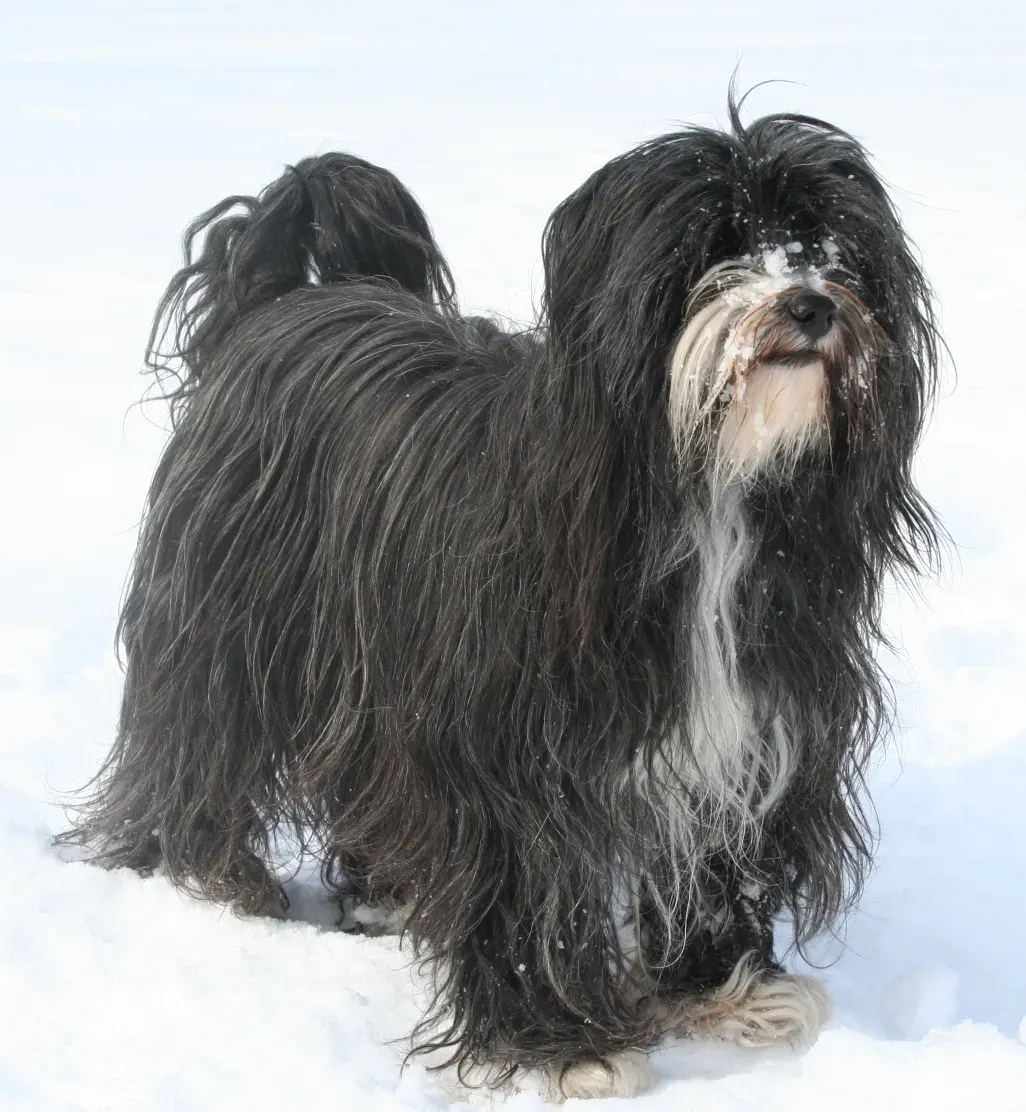
Its broad, flat feet helped it move through snow.
Appearance and colours
The FCI breed standard describes a sturdy, medium-sized, long-haired dog of generally square outline. It has a double coat: a fine, woolly undercoat and a profuse, fine, long top coat, straight or wavy but not curled.
Any colour is permissible, including white, golden, cream, grey or smoke, black, parti-colour and tricolour, except chocolate, liver or merle.
- Height at the withers: 36–41 cm for males, females slightly smaller.
Temperament
Cheerful, affectionate and very attached to its family, it is usually good with children. It can be reserved with strangers.
Intelligent but sometimes stubborn, it learns best with gentle, varied training.
With children and other pets
The standard describes a lively, good-natured, loyal companion with many engaging ways; outgoing, alert, intelligent and game, neither fierce nor pugnacious, and sparing of affection to strangers. It rates 4 out of 5 with children and 4 out of 5 with other dogs in our ratings.
- It is a cheerful family companion.
- Its long coat needs regular grooming (4 out of 5 in our ratings).
Training tips
According to the standard, despite its name the Tibetan Terrier is not a terrier but a herding dog that also guarded traders travelling to and from China; it is believed to be the original Holy Dog of Tibet. The Royal Kennel Club notes that it was brought to the UK in the 1930s by the surgeon Agnes Greig. It rates 3 out of 5 for trainability in our ratings.
- Use patient, reward-based training.
- Avoid exercise in the heat: it rates 2 out of 5 for heat tolerance.
Health
Some inherited eye diseases (lens luxation, retinal atrophy), hip dysplasia and hypothyroidism should be monitored. Tests are available.
Choose a breeder who tests their breeding dogs.
Common health issues in detail
Pituitary dwarfism has been found in the breed: a 2021 report described dwarf Tibetan Terrier puppies from three related litters that carried two copies of the same LHX3 mutation known in German Shepherds; all their parents were carriers, confirming recessive inheritance.
The Royal Kennel Club recommends as a minimum for breeding dogs DNA tests for neuronal ceroid lipofuscinosis (NCL12), primary lens luxation (PLL), progressive retinal atrophy (rcd4) and pituitary dwarfism (LHX3), and hip scoring, and as best practice a DNA test for PRA3 and eye testing.
This is general information. For any question about your dog's health, consult a veterinarian.
Feeding
Food matched to its size and activity suits it.
Avoid excess weight.
Exercise
It needs about an hour of daily activity, with walks and play.
It is agile and likes to climb.
It can live in an apartment if walked enough, and suits households that want little dog hair.
Grooming
Its long double coat hardly sheds but tangles: brush thoroughly several times a week, or choose a shorter clip.
Keep hair clear of the eyes and between the paw pads.
Choosing a puppy
Choose a breeder who does the DNA tests and hip scoring recommended by the Royal Kennel Club.
- Ask for the parents' DNA and hip results, including the dwarfism test.
- Meet the mother: she should be lively and friendly.
Our guide on how to recognise a responsible breeder explains what to ask.
Similar breeds
The Lhasa Apso and Tibetan Spaniel are other Tibetan breeds. The Polish Lowland Sheepdog and Bearded Collie are other shaggy herding dogs.