Gentle, cuddly and full of charm, the Shih Tzu is a calm little companion dog, perfect for apartments but sensitive to heat.
History and origins
The Shih Tzu comes from Tibet and China, where small long-haired dogs were given as gifts and bred at the imperial court. Its name means 'little lion' in Chinese.
Introduced to Europe in the 20th century, it is now one of the most widespread companion dogs in the world.
Appearance and colours
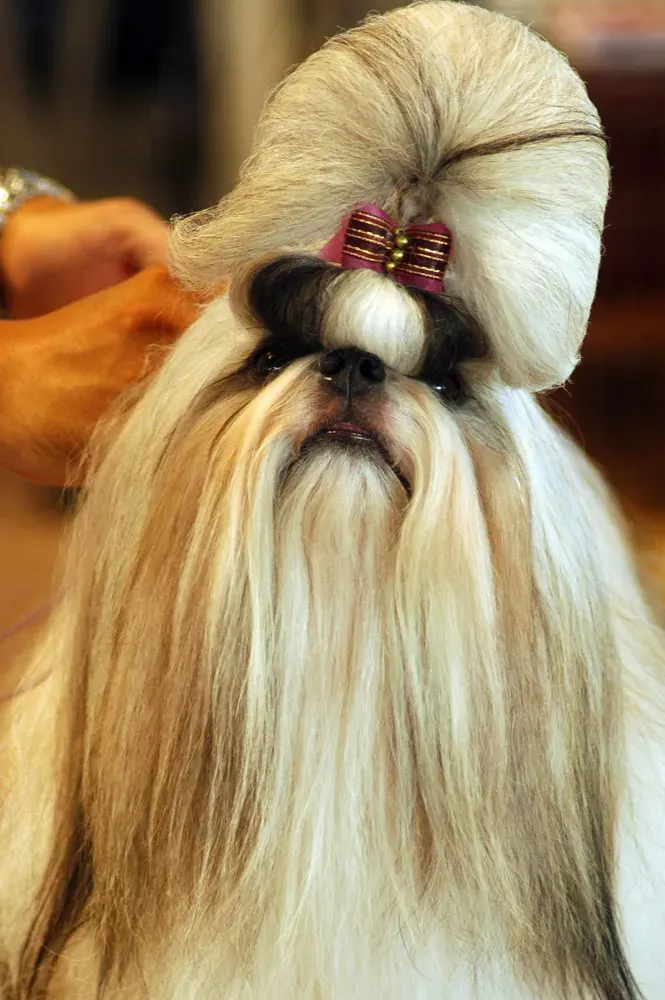
The FCI breed standard describes a sturdy dog, abundantly but not excessively coated, with a distinctly arrogant carriage and a "chrysanthemum-like" face, the result of hair growing upwards on the nose. The body is longer from withers to tail than it is tall.
The outer coat is long, dense and not curly, over a moderate undercoat; a slight wave is permitted. The standard says the hair must not affect the dog's ability to see or restrict its movement, and strongly recommends tying up the hair on the head. All colours are permissible except merle; in parti-coloured dogs, a white blaze on the forehead and a white tail tip are highly desirable.
- Height at the withers: not more than 27 cm.
- Weight: 4.5–8 kg, ideally 4.5–7.5 kg.
- In a UK study of more than 11,000 Shih Tzus, the mean adult weight was 7.9 kg.
Temperament
Affectionate, cheerful and sociable, the Shih Tzu loves human company and usually gets on well with children and other animals. It is calmer than many small breeds.
It can be a little stubborn: gentle, patient, reward-based training works best.
With children and other pets
The standard describes the Shih Tzu as intelligent, active and alert, friendly and independent. It rates 4 out of 5 with children and with other dogs in our ratings.
- Its prominent eyes are easily injured: teach children to keep fingers and toys away from the dog's face.
- It is small and sturdy, but still needs gentle handling; children should sit down to hold it.
- Its calm, friendly nature usually makes it easy to live with other pets, introduced gradually.
Training tips
It rates 3 out of 5 for trainability in our ratings: it learns with rewards but can be independent, as its standard notes.
- Keep sessions short, with tiny food rewards from its daily ration.
- Teach it to accept daily grooming, eye cleaning, tooth brushing and handling of its feet as a calm, rewarded routine.
Health
Its short muzzle exposes it to breathing difficulties and heat intolerance. Its large eyes are prone to irritation and ulcers, and dental and back problems can occur.
See a veterinarian if an eye becomes red or runny.
Common health issues in detail
In a UK study of 2,423 Shih Tzus seen by vets in 2016, the most common disorders were periodontal (gum) disease (9.5%), anal sac impaction (7.4%) and ear disorders (5.5%). By group, skin disorders (16.6%), dental disorders (13.3%) and eye disorders (11.9%) were the most frequent. The median age at death was 12.7 years, which the researchers describe as relatively long-lived.
Possible predispositions. The Shih Tzus in the study had more anal sac impaction, umbilical hernias and eye problems than earlier reports for dogs in general, which suggests the breed may be predisposed to them. Females were more often diagnosed with hernias, and males with skin and musculoskeletal disorders.
Teeth. The researchers highlight oral hygiene as a priority for the breed, and suggest that regular dental check-ups and tooth brushing from an early age could improve welfare.
Face and eyes. The Royal Kennel Club notes that flat-faced dogs may have narrowed airways, skin folds that harbour infection, overcrowded teeth and shallow eye sockets that leave the eyes prone to injury, ulcers and dryness.
Health tests. The Royal Kennel Club recommends an eye examination for breeding dogs.
This is general information. For any question about your dog's health, consult a veterinarian.
Feeding
Small-breed food in measured portions is enough. It tends to put on weight if given too many treats.
Kibble suited to its short jaw makes chewing easier.
Exercise
Gentle walks and play at home are enough for its well-being. It likes routine and having its family around.
Avoid any exertion in hot weather.
In summer, limit outings to the cool hours, keep it in a cool room and never leave it in a car. A short 'puppy cut' makes grooming easier and keeps it more comfortable in summer.
Grooming
Its long, silky coat grows continuously and tangles quickly: brush daily if kept long, or opt for a regular short clip at the groomer. Tie up or trim the hair above the eyes.
Clean around the eyes and the teeth regularly.
Choosing a puppy
Choose a breeder who has the parents' eyes examined, selects for open nostrils and a moderate face, and shows you how the puppies are being introduced to grooming.
- Watch the parents breathe at rest: snoring or noisy breathing is a health problem.
- Look at the parents' eyes: they should be clear, without redness or discharge.
- Ask about hernias, dental problems and the age of older relatives.
- Avoid merle Shih Tzus, which the standard does not accept.
- Consider an adult from a rescue.
Our guide on how to recognise a responsible breeder explains what to ask.
Similar breeds
The Lhasa Apso is the Tibetan breed with which the Shih Tzu was long confused. The Pekingese is another long-coated companion from China. The Tibetan Spaniel is another small companion from Tibet. The Maltese is a small, long-coated white companion.