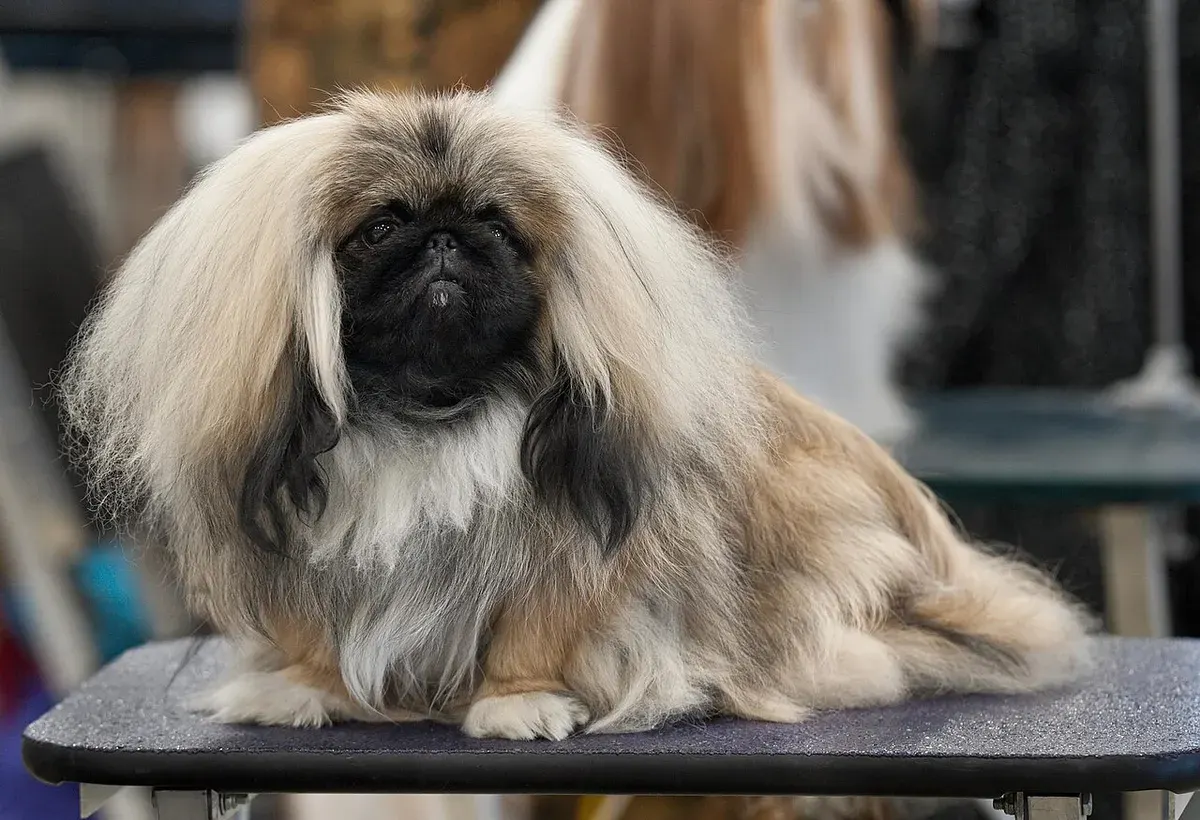
Once the dog of China's imperial palaces, the Pekingese is dignified, independent and devoted to its owners, with the look of a little lion.
History and origins
The Pekingese was reserved for the Chinese imperial court and lived in the Forbidden City. It reached Europe in the 19th century after the looting of the Summer Palace in 1860.
Its abundant mane earned it the nickname 'lion dog'.
Appearance and colours
The FCI breed standard describes a lion-like dog with an alert, intelligent expression: small, well-balanced, moderately thick-set, with great dignity. The standard states that any sign of breathing distress or inability to move soundly is unacceptable, and that the coat must not be excessive. The coat is moderately long and straight, with a mane forming a cape around the neck, a coarse top coat and a thick, softer undercoat.
All colours and markings are of equal merit; albino, liver and merle are not accepted.
- Ideal weight: up to 5 kg for males and 5.4 kg for females.
Temperament
Dignified, brave and independent, the Pekingese is very attached to its family but can be aloof with strangers. It dislikes being jostled, so care is needed with young children.
Stubborn, it needs patient, respectful training.
With children and other pets
The standard describes a fearless, loyal and aloof dog, neither timid nor aggressive. It rates 2 out of 5 with children and 3 out of 5 with other dogs in our ratings.
- It suits calm homes and older, gentle children.
- Avoid exertion in the heat: it rates 1 out of 5 for heat tolerance.
Training tips
The Royal Kennel Club traces the breed to the Tang dynasty in China, where short-legged, short-faced dogs of this type are recorded from the 8th century; it was a favourite of the imperial palace in Peking, hence its name, and commoners were not allowed to own one. It rates 2 out of 5 for trainability in our ratings.
- Use patient, gentle, reward-based training.
- Its coat needs a great deal of care (5 out of 5 for grooming needs in our ratings).
Health
Its very short muzzle exposes it to brachycephalic airway syndrome and heatstroke. Its prominent eyes are fragile and its long back is prone to disc herniation.
Regular veterinary follow-up is essential.
Common health issues in detail
A hospital study of 426 Pekingese found that disc extrusion (a slipped disc) was uncommon before 2 years of age and mostly affected the back and the neck; calcified discs visible on X-ray, black coat colour, higher body weight and being a spayed female were associated with a higher risk.
The Royal Kennel Club recommends eye testing as best practice for breeding dogs and notes that the breed can be affected by conformation-related problems. In August 2026 it also recognised breathing testing for brachycephalic obstructive airway syndrome (BOAS) under its Respiratory Function Grading scheme, which it will add to its health standard from January 2027.
This is general information. For any question about your dog's health, consult a veterinarian.
Feeding
Small-breed food in measured portions suits it.
Avoid excess weight, which worsens breathing difficulties.
Exercise
Short, calm walks are enough.
No exertion at all in hot weather.
It is perfectly suited to apartment life.
Grooming
Its long, thick coat needs daily brushing or a maintenance clip. Clean the facial folds and eyes every day.
It sheds heavily during the moult.
Choosing a puppy
Choose a breeder who eye-tests the parents, has their breathing graded and breeds for open nostrils and sound movement.
- Ask for the parents' eye results and BOAS breathing grades.
- Watch the parents breathe and move: noisy breathing or stiffness are warning signs.
- Keep the adult dog lean to protect its back.
Our guide on how to recognise a responsible breeder explains what to ask.
Similar breeds
The Shih Tzu, Japanese Chin, Lhasa Apso and Pug are other Asian companion breeds.