A small dog from Tibetan monasteries, the Tibetan Spaniel is lively, intelligent and affectionate, with an almost cat-like independence.
History and origins
The Tibetan Spaniel was bred in Tibetan monasteries, where it sat on the walls to watch the surroundings and raise the alarm. Despite its name, it is not a true hunting spaniel.
It was often exchanged as a gift between monasteries and neighbouring courts.
Appearance and colours
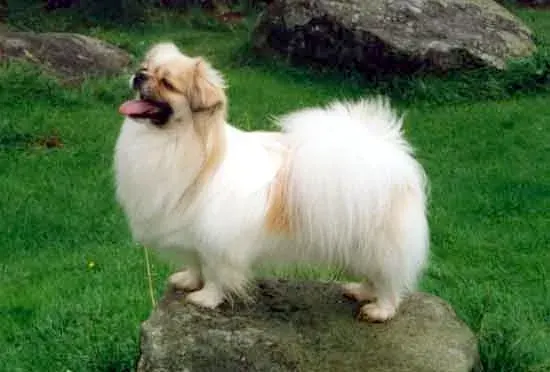
The FCI breed standard describes a small, active and alert dog, well balanced, slightly longer than tall, with a small head carried proudly. The top coat is silky, smooth on the face and front of the legs, of moderate length and lying flat on the body, over a fine, dense undercoat, with feathering on the ears, legs and tail.
All colours and mixtures of colours are permitted except merle.
- Height at the withers: about 25.4 cm.
- Ideal weight: 4.1–6.8 kg.
Temperament
Lively, affectionate and intelligent, the Tibbie loves its family but stays reserved with strangers. It likes to watch from a high vantage point.
Independent, it learns best with gentle, varied methods.
With children and other pets
The standard describes a gay and assertive dog, highly intelligent, aloof with strangers, alert, loyal but independent. It rates 4 out of 5 with children and 4 out of 5 with other dogs in our ratings.
- It is a loyal companion and a good watchdog.
- Avoid exercise in the heat: it rates 2 out of 5 for heat tolerance.
Training tips
The FCI classifies the Tibetan Spaniel as a companion dog. The Royal Kennel Club notes that it was another breed favoured by Tibetan monks as a companion and watchdog, often kept together with Lhasa Apsos in monasteries, and that it has been popular in the UK since the 1950s. It rates 3 out of 5 for trainability in our ratings.
- Use patient, reward-based training.
- Short daily walks and games suit it.
Health
This is a fairly healthy breed. Progressive retinal atrophy, kneecap luxation and some breathing issues linked to its short muzzle should be monitored.
Regular veterinary follow-up is recommended.
Common health issues in detail
The Royal Kennel Club recommends as best practice for breeding dogs a DNA test for progressive retinal atrophy (PRA3) and eye testing.
We found no large population study of health in the Tibetan Spaniel.
This is general information. For any question about your dog's health, consult a veterinarian.
Feeding
Small-breed food in measured portions suits it.
Avoid excess weight.
Exercise
Daily walks and play are enough.
It adapts well to the family's pace.
It lives very well in an apartment.
Grooming
Its silky coat needs brushing once or twice a week. Care for the mane and feathering.
It sheds more during the moult.
Choosing a puppy
Choose a breeder who does the PRA3 DNA test and eye-tests the parents.
- Ask for the parents' PRA3 and eye results.
- Meet the mother: she should be confident and friendly.
Our guide on how to recognise a responsible breeder explains what to ask.
Similar breeds
The Lhasa Apso and Tibetan Terrier are other Tibetan breeds. The Pekingese and Japanese Chin are other Asian companion dogs.