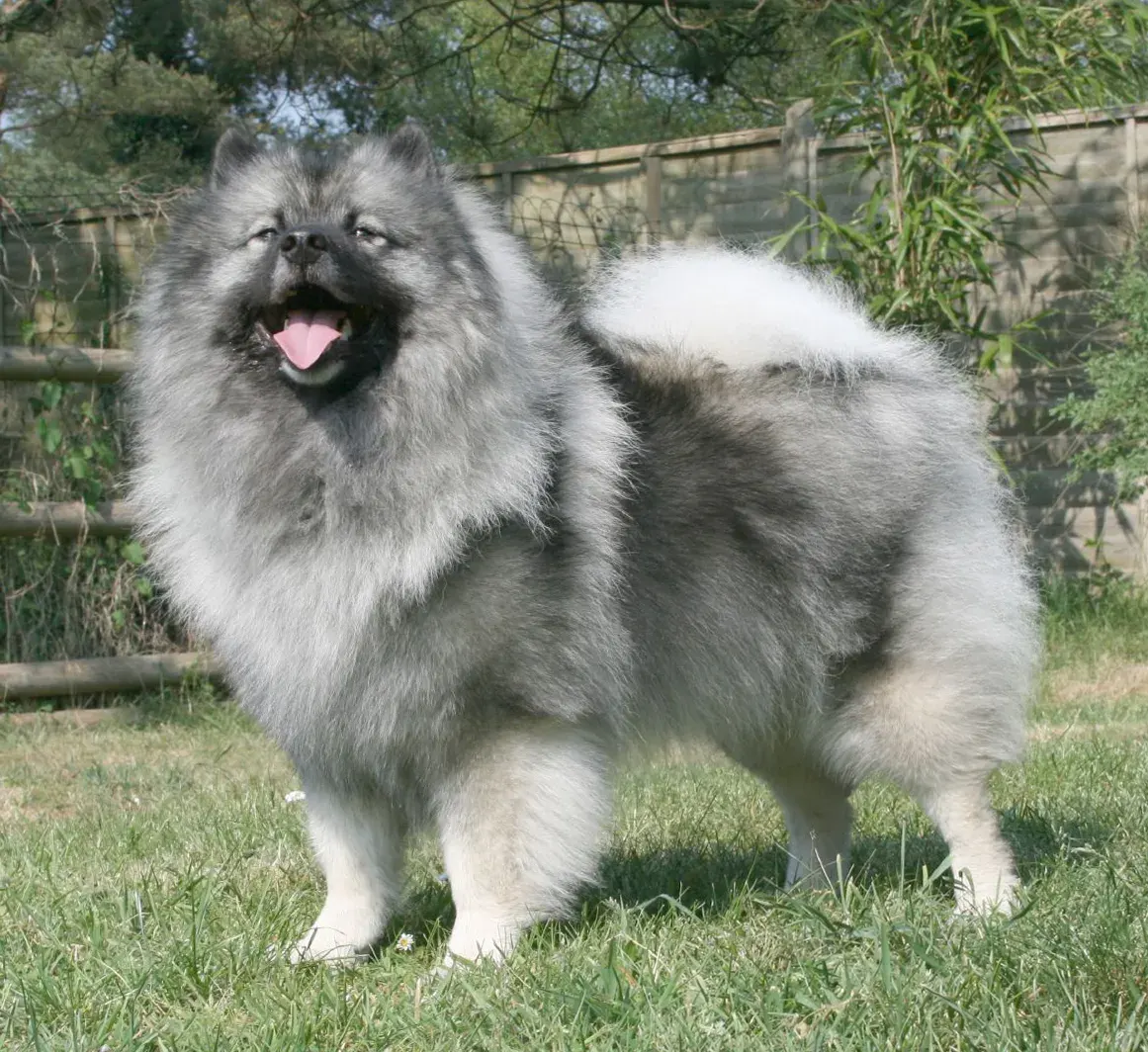
With its 'spectacles' outlined around the eyes, the Keeshond is an affectionate, cheerful grey spitz that is very family-oriented.
History and origins
The Keeshond, or Wolfspitz, was the watchdog of barges and farms in the Netherlands and Germany. It became a symbol of the Dutch Patriot party in the 18th century.
The FCI classifies it as a variety of the German Spitz.
Appearance and colours
The FCI breed standard, which covers the Keeshond as the German Wolfsspitz, describes a spitz with a beautiful stand-off coat over a plentiful undercoat, a strong mane-like ruff, a bushy tail carried over the back, a fox-like head and small, pointed, closely set ears. The long, straight top coat stands off over a short, thick, cotton-wool undercoat.
The colour is grey-shaded: silver-grey with black hair tips, a dark muzzle and ears, and well-defined "spectacles" (a fine black line from the outer corner of the eye towards the ear).
- Height at the withers: 49 cm (± 6 cm).
Temperament
Cheerful, affectionate and very sociable, the Keeshond adores its family and gets on well with children and other animals. It is a good watchdog without being aggressive.
It learns easily with positive training.
With children and other pets
The standard describes a dog that is always attentive, lively and extraordinarily attached to its owner, very teachable and easy to train, neither timid nor aggressive, distrustful of strangers and without hunting instinct; it names robustness and longevity among its outstanding attributes. It rates 5 out of 5 with children and 4 out of 5 with other dogs in our ratings.
- It is a devoted family dog and a natural watchdog.
- Its coat needs regular brushing (4 out of 5 for grooming needs in our ratings).
Training tips
According to the standard, the German Spitz family descends from the Stone Age "peat dog" and the later lake-dwelling Spitz; in non-German-speaking countries the Wolfsspitz is known as the Keeshond. The Royal Kennel Club calls it the traditional barge guard dog of the Netherlands, nicknamed the "Dutch Barge Dog" in the UK. It rates 4 out of 5 for trainability in our ratings.
- It learns easily with reward-based training.
- Avoid exercise in the heat: it rates 2 out of 5 for heat tolerance.
Health
Hip dysplasia, kneecap luxation, hypothyroidism and an inherited parathyroid disease should be monitored.
Tests are available, so ask the breeder.
Common health issues in detail
The breed is predisposed to primary hyperparathyroidism, in which an overactive parathyroid gland disturbs calcium levels. A 2025 genetic study describes it as inherited in a dominant way, usually appearing after 8 years of age, and linked it to a variant in the SIRT6 gene; it notes that a DNA test based on a closely associated variant has been used in the USA since 2008.
We found no large population study of overall health in the Keeshond.
This is general information. For any question about your dog's health, consult a veterinarian.
Feeding
Good-quality food in measured portions suits it; it gains weight easily.
Limit treats.
Exercise
Daily walks of about an hour and play are enough.
It loves taking part in family life.
It is a good family dog in an apartment if the home stays cool and it is walked every day.
Grooming
Its thick double coat needs brushing several times a week, daily during moults.
Do not shave it.
Choosing a puppy
Choose a breeder who DNA-tests the parents for primary hyperparathyroidism.
- Ask for the parents' hyperparathyroidism DNA results.
- Ask about the health of older relatives.
- Meet the mother: she should be lively and friendly.
Our guide on how to recognise a responsible breeder explains what to ask.
Similar breeds
The German Spitz and Pomeranian share its standard. The Eurasier descends partly from the Wolfsspitz, and the Samoyed is another spitz.