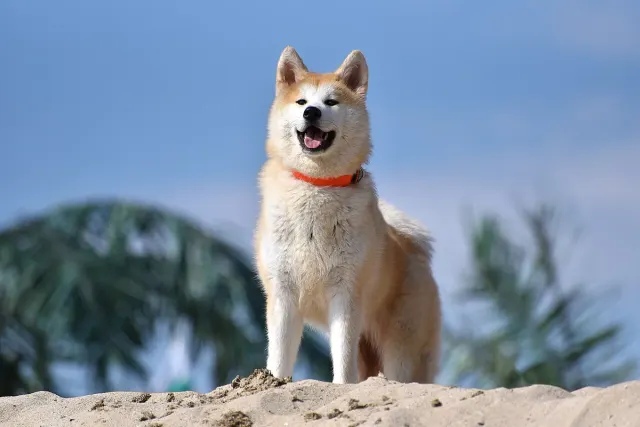
Finland's red-coated national dog, the Finnish Spitz is lively, cheerful and very vocal: it 'sings' to point out game.
History and origins
The Finnish Spitz is an ancient Finnish hunting dog used to locate capercaillie and other birds in trees, then bark continuously to guide the hunter.
It is considered Finland's national dog.
Appearance and colours
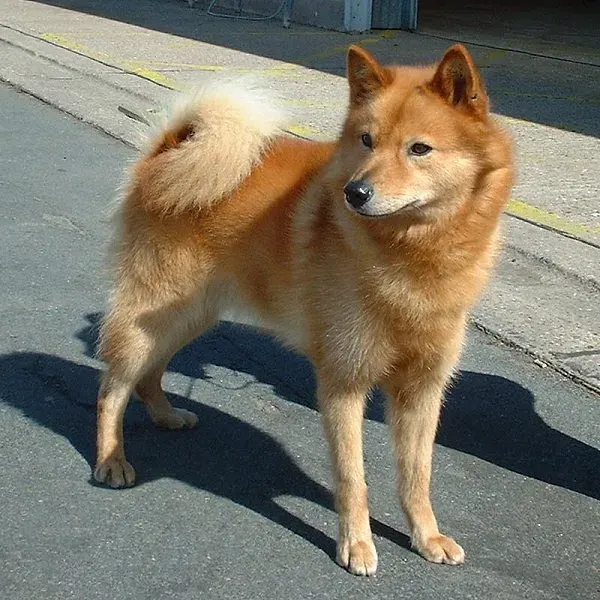
The FCI breed standard describes a lean, firm dog, a little smaller than medium-sized and almost square. The coat is moderately long and stand-off on the body, stiffer on the neck, shoulders and back, short on the head and legs, with a short, soft, light undercoat.
The colour on the back is bright red or golden red, lighter inside the ears, on the cheeks, throat, chest, belly and tail. A small white spot on the chest and small white markings on the feet are permitted.
- Height at the withers: 44–50 cm for males, 39–45 cm for females.
Temperament
Lively, cheerful and affectionate, the Finnish Spitz is good with children but independent. It is very vocal and barks a lot, which is part of its nature.
It needs patient, varied training.
With children and other pets
The standard describes a lively, vigorous, brave and determined dog, which may be a little reserved with strangers but never vicious. It rates 4 out of 5 with children and 3 out of 5 with other dogs in our ratings.
- It is a lively family dog.
- It marks game by barking: expect a vocal dog.
Training tips
According to the standard, dogs of this type have hunted in Finland for hundreds of years; the first standard dates from 1892, and in 1979 the breed was named the National Dog of Finland. It hunts forest game birds, small predators, waterfowl and elk, working independently but cooperatively and marking game by barking. It rates 2 out of 5 for trainability in our ratings.
- Use patient, reward-based training and keep sessions short.
- Teach a reliable recall early: it is an independent hunter.
Health
This is a robust breed. Hip dysplasia, epilepsy and some autoimmune diseases should be monitored.
Regular veterinary follow-up is recommended.
Common health issues in detail
Epilepsy has been studied in the breed. A Finnish study of 2,141 Finnish Spitz dogs estimated the prevalence of idiopathic epilepsy at 5.4%; males were more often affected and the median age of onset was 3 years. Most seizures began with a focal onset; the disease did not progress in most dogs and was easily controlled by treatment in 78.9% of them, and the authors found it partly inherited.
We found no other large population study of health in the Finnish Spitz.
This is general information. For any question about your dog's health, consult a veterinarian.
Feeding
Good-quality food matched to its activity suits it.
Watch its weight.
Exercise
It needs an hour or more of daily activity, ideally out in nature.
Its hunting instinct means a lead outside safe areas.
Its frequent barking makes it a poor fit for apartments; a house with a garden, away from neighbours, is preferable.
Grooming
Its double coat needs weekly brushing, more during moults.
It is clean and has little odour.
Choosing a puppy
Choose a breeder who can tell you about epilepsy in the puppy's family.
- Ask whether the parents or their relatives have had seizures.
- Meet the mother: she should be lively and confident.
- Ask how much the parents bark.
Our guide on how to recognise a responsible breeder explains what to ask.
Similar breeds
The Norwegian Elkhound is another Nordic hunting spitz. The Shiba Inu, Korean Jindo and German Spitz are other spitz-type dogs.