Skip to content
Caninpedia

Norwegian Elkhound

A sturdy grey Nordic spitz, the Norwegian Elkhound is brave, tireless and affectionate with its family.
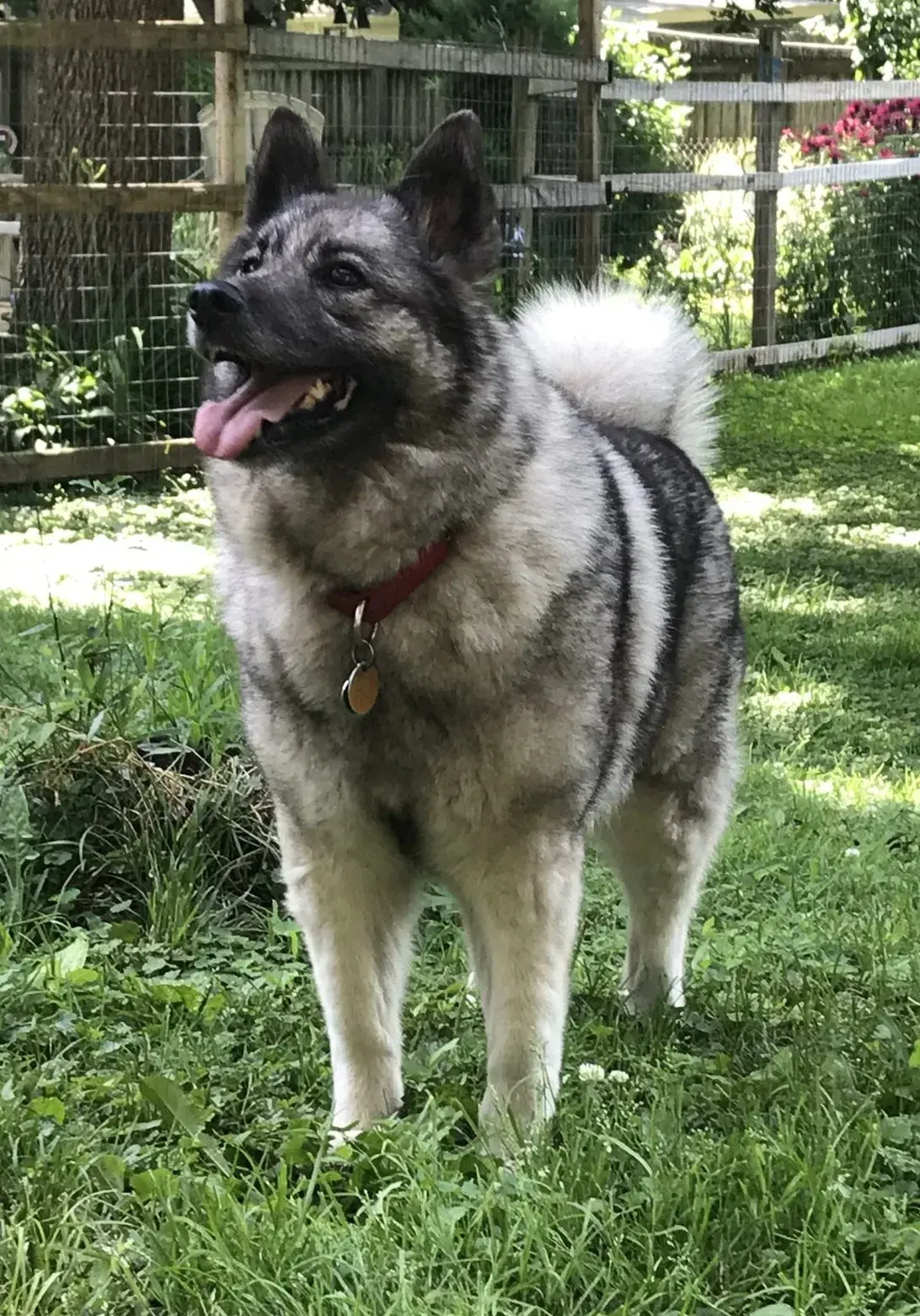
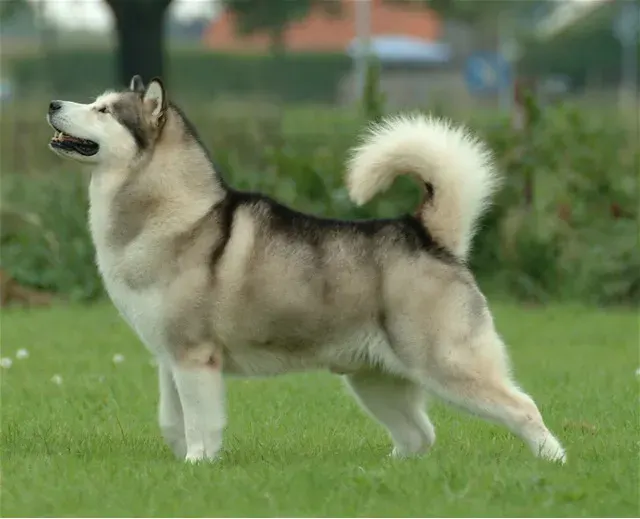
Photo of the Norwegian Elkhound dog breed
Photo: HawkNightingale175 — CC BY 4.0 (source)

History and origins

The Norwegian Elkhound is a very old breed from Norway, used to track moose and hold them at bay by barking until the hunter arrived.

Dogs of this type are associated with the Viking era.

Appearance and colours

The FCI breed standard describes a typical spitz: compact, short-bodied and square, with erect ears and a tail tightly curled over the back. The coat is thick and abundant, of medium length, with a coarse outer coat and soft undercoat.

The colour is grey in various shades, made by the black tips of the outer coat, lighter on the chest, belly, legs and in a "harness marking" from the withers to the elbow; the ears and front of the muzzle are dark.

  • Ideal height at the withers: 52 cm for males, 49 cm for females.

Temperament

Confident, cheerful and independent, it is affectionate with its family and good with children. It is watchful and barks readily.

Intelligent but stubborn, it needs consistent, varied training.

With children and other pets

The standard describes a fearless, energetic and brave dog. It rates 4 out of 5 with children and 3 out of 5 with other dogs in our ratings.

  • It is an energetic family dog.
  • It sheds a lot (4 out of 5 in our ratings).

Training tips

The FCI describes the breed as an elk-hunting dog. The Royal Kennel Club notes that Stone Age skeletons of dogs very similar to today's Elkhound have been found in Norway, suggesting an ancient and unchanged breed. It rates 3 out of 5 for trainability in our ratings.

  • Use patient, reward-based training.
  • Avoid exercise in the heat: it rates 2 out of 5 for heat tolerance.

Health

Hip dysplasia, progressive retinal atrophy, hypothyroidism and some skin cysts should be monitored.

Regular veterinary follow-up is recommended.

Common health issues in detail

The Royal Kennel Club recommends as a minimum for breeding dogs DNA tests for primary open-angle glaucoma (POAG-2) and progressive retinal atrophy (prcd-PRA), and as best practice a DNA test for chondrodysplasia (CDSL), eye testing and hip scoring.

We found no large population study of health in the Norwegian Elkhound.

This is general information. For any question about your dog's health, consult a veterinarian.

Feeding

It is food-loving and gains weight easily, so measure portions.

Food matched to its real activity is essential.

Exercise

It needs one to two hours of daily activity, ideally in nature and in cool weather.

Keep it on a lead outside safe areas.

Mountain regions suit it better. It needs a house with a garden and active owners.

Grooming

Its thick double coat needs brushing once or twice a week, far more during moults.

Do not shave it.

Choosing a puppy

Choose a breeder who does the DNA tests, eye testing and hip scoring recommended by the Royal Kennel Club.

  • Ask for the parents' DNA, eye and hip results.
  • Meet the mother: she should be confident and friendly.

Our guide on how to recognise a responsible breeder explains what to ask.

Similar breeds

The Finnish Spitz is another Nordic hunting spitz. The Keeshond, Korean Jindo and Siberian Husky are other spitz-type dogs.
Frequently asked questions

What colours does the Norwegian Elkhound come in?

The colour is grey in various shades, made by the black tips of the outer coat, lighter on the chest, belly, legs and in a "harness marking" from the withers to the elbow; the ears and front of the muzzle are dark. Read more in “Appearance and colours”.

What health problems are common in the Norwegian Elkhound?

The Royal Kennel Club recommends as a minimum for breeding dogs DNA tests for primary open-angle glaucoma (POAG-2) and progressive retinal atrophy (prcd-PRA), and as best practice a DNA test for chondrodysplasia (CDSL), eye testing and hip scoring. Read more in “Common health issues in detail”.

How do I choose a Norwegian Elkhound puppy?

Choose a breeder who does the DNA tests, eye testing and hip scoring recommended by the Royal Kennel Club. Read more in “Choosing a puppy”.

Is the Norwegian Elkhound good with children?

The Norwegian Elkhound is generally good with children. We rate it 4/5 for living with children; whatever the breed, always supervise children and dogs together. See also: The 10 best dog breeds for families with children.

Is the Norwegian Elkhound good with other dogs?

The Norwegian Elkhound usually tolerates other dogs, especially when it has been well socialised. It is rated 3/5 with other dogs; early socialisation makes a big difference.

Can a Norwegian Elkhound live in an apartment?

The Norwegian Elkhound is not well suited to apartment life: it needs space and a lot of activity. Its energy level is rated 4/5. Looking for an apartment dog? See The 10 best dog breeds for apartment living.

How big does a Norwegian Elkhound get?

The Norwegian Elkhound is a medium breed: adults usually weigh 20–25 kg and measure 47–54 cm at the withers. It belongs to the “Spitz and primitive types” group.

How long does a Norwegian Elkhound live?

The Norwegian Elkhound typically lives 12 to 15 years. That is about average for dogs. Looking for a longer-lived breed? See The 10 longest-living dog breeds.

Does the Norwegian Elkhound shed a lot?

Yes, the Norwegian Elkhound sheds quite a lot. Regular brushing, about once a week, keeps its coat in good condition. Looking for a lighter shedder? See The 10 dog breeds that shed the least.

Is the Norwegian Elkhound easy to train and good for first-time owners?

The Norwegian Elkhound is moderately easy to train with consistent, reward-based methods. Its high energy (rated 4/5) needs plenty of daily activity. The FCI describes the breed as an elk-hunting dog. Overall, it is possible for a first-time owner who is ready to learn. Looking for an easier breed to train? See The 10 easiest dog breeds to train.

Can a Norwegian Elkhound handle hot weather?

The Norwegian Elkhound is fairly sensitive to heat. In hot weather, keep walks to the cooler hours and make sure it always has shade and water. Need a dog for a hot climate? See The 10 dog breeds best suited to hot climates.

Norwegian Elkhound appears in these lists

Sources

Breed standards, kennel club pages and health references used for this profile.

Back to all breeds