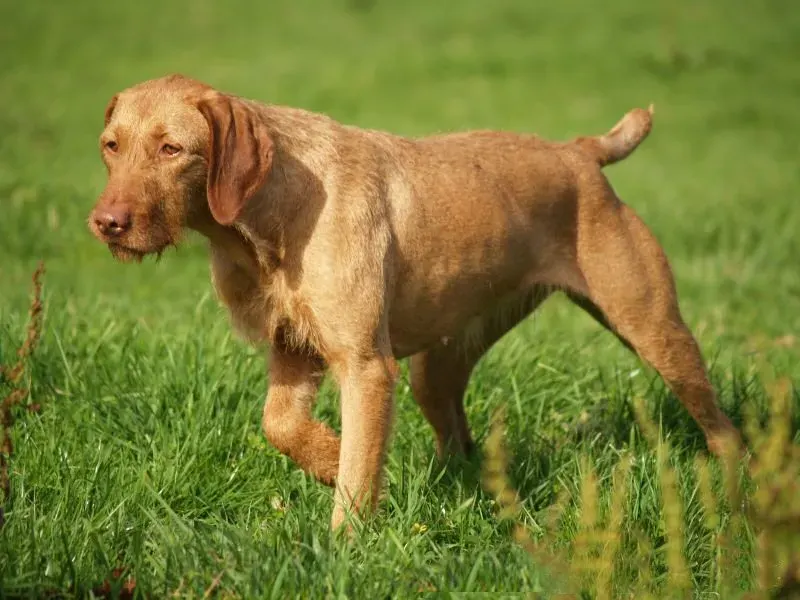
The wire-coated, bearded version of the Vizsla, this Hungarian pointer is sturdy, affectionate and made for hunting in all weathers.
History and origins
The Wirehaired Vizsla was created in Hungary in the 1930s by crossing the Vizsla with the German Wirehaired Pointer, to produce a dog more resistant to cold and brambles.
It is recognised as a separate breed by the Fédération Cynologique Internationale.
Appearance and colours
The FCI breed standard describes a lively, russet-gold hunting dog, dry and lean but more robust than the smooth Vizsla, embodying endurance and working ability. The coat is wiry, close-lying, strong and dense, 2–3 cm long, with a dense, water-repellent undercoat and pronounced eyebrows.
The colour is various shades of russet gold and dark sandy gold.
- Height at the withers: 58–64 cm for males, 54–60 cm for females.
Temperament
Gentle, affectionate and very attached to its family, it is usually good with children. A little calmer than the Vizsla, it is still very energetic.
It learns well with positive training and copes poorly with being alone.
With children and other pets
The standard describes an affectionate, intelligent, self-confident dog, easily trained, that cannot bear rough treatment, keeps contact with its handler and is passionate in the search. It rates 4 out of 5 with children and 4 out of 5 with other dogs in our ratings.
- It is an affectionate family dog that needs plenty of activity.
- It rates 5 out of 5 for energy.
Training tips
According to the standard, the breed was created in the 1930s by crossing the smooth-haired Hungarian Vizsla with the German Wirehaired Pointer, and its character is the same as the Vizsla's. The Royal Kennel Club dates the first cross to 1904. It rates 4 out of 5 for trainability in our ratings.
- Use gentle, reward-based training; harshness does not suit it.
- Retrieving, tracking and water work suit it.
Health
This is a fairly healthy breed. Hip dysplasia and some eye conditions should be monitored.
Regular veterinary follow-up is recommended.
Common health issues in detail
The Royal Kennel Club recommends as a minimum for breeding dogs a DNA test for hyperuricosuria (HUU), and hip and elbow scoring as best practice.
We found no large population study of health in the Wirehaired Vizsla.
This is general information. For any question about your dog's health, consult a veterinarian.
Feeding
Food suited to its high activity level works well.
Avoid excess weight.
Exercise
It needs at least two hours of daily activity: hunting, running and swimming.
It loves water.
It needs a house with a garden and active owners.
Grooming
Its wiry coat needs weekly brushing, with light stripping from time to time. Clean its beard.
Check for grass seeds after outings.
Choosing a puppy
Choose a breeder who does the HUU DNA test and scores hips and elbows.
- Ask for the parents' HUU, hip and elbow results.
- Meet the mother: she should be affectionate and confident.
Our guide on how to recognise a responsible breeder explains what to ask.
Similar breeds
The Hungarian Vizsla is its smooth-coated relative and the German Wirehaired Pointer one of its ancestors. The Wirehaired Pointing Griffon and Spinone Italiano are other rough-coated pointing dogs.