An Italian pointing dog with a wiry coat and an almost human gaze, the Spinone is calm, patient and exceptionally kind, ideal for families.
History and origins
The Spinone Italiano is an old pointing dog from Piedmont and northern Italy, valued for its toughness in thick brush thanks to its wiry coat.
It works at an extended, methodical trot.
Appearance and colours
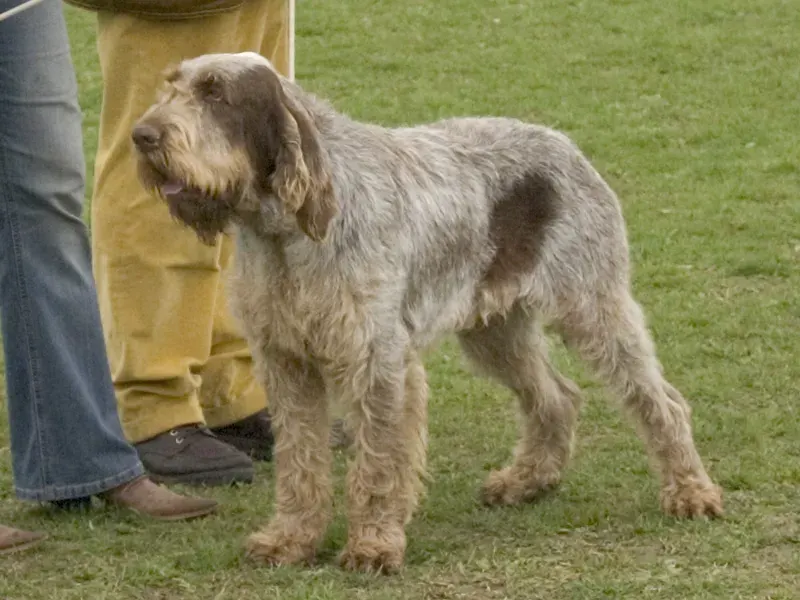
The FCI breed standard describes a solidly built, robust and vigorous dog with powerful bone, well-developed muscles and a rough coat. The coat is 4–6 cm long on the body, stiff, harsh, dense and rather flat, without undercoat, forming thick eyebrows, a moustache and a tufted beard.
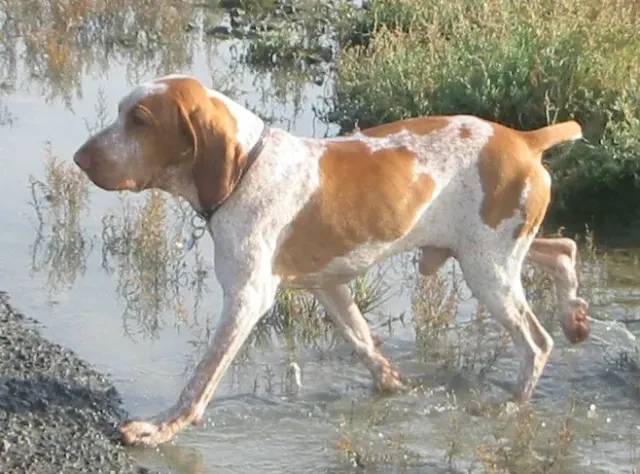
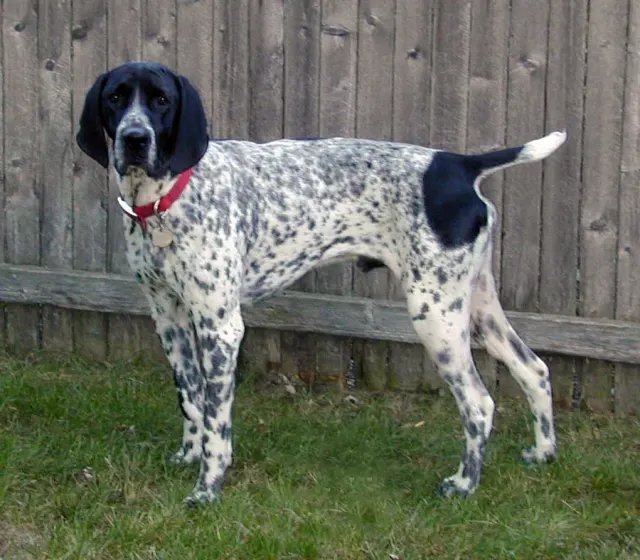
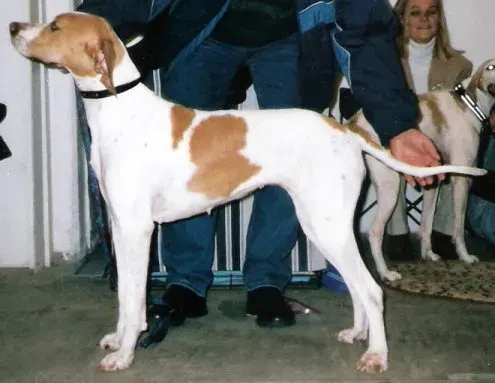
Colours are pure white, white with orange or brown (chestnut) markings or speckling, and orange or brown roan.
- Height at the withers: 60–70 cm for males, 58–65 cm for females.
- Weight: 32–37 kg for males, 28–30 kg for females.
Temperament
Calm, gentle and very patient, the Spinone is excellent with children and sociable with other dogs. It is affectionate and sometimes a little stubborn.
It responds well to gentle, patient training.
With children and other pets
The standard describes a naturally sociable, docile and patient dog, an experienced hunter on all terrain, resistant to fatigue and an excellent natural retriever. It rates 5 out of 5 with children and 4 out of 5 with other dogs in our ratings.
- It is a gentle, patient family dog.
- Avoid exercise in the heat: it rates 2 out of 5 for heat tolerance.
Training tips
According to the standard, old texts describe a rough-haired dog of Italian origin as the ancestor of today's Spinone; a 1683 French book mentions a "griffon" from Italy and Piedmont, and a 15th-century fresco by Andrea Mantegna in the ducal palace of Mantua shows such a dog. The Royal Kennel Club notes that its pounding trot gives it stamina rather than speed. It rates 3 out of 5 for trainability in our ratings.
- Use patient, reward-based training.
- Retrieving and swimming suit it.
Health
Hip dysplasia, bloat, ectropion and an inherited neurological disease (cerebellar ataxia), for which a test exists, should be monitored.
Choose a breeder who tests their breeding dogs.
Leishmaniasis prevention is important for hunting dogs.
Common health issues in detail
Idiopathic epilepsy is reported to be common and often severe in the Spinone. A 2025 genetic study of 52 affected and 51 unaffected dogs, with a separate validation group, found no single gene responsible and concluded that the disease is probably influenced by many genes.
The Royal Kennel Club recommends as a minimum for breeding dogs a DNA test for cerebellar ataxia (CA), which imported dogs must have, and hip and elbow scoring, and eye testing as best practice.
This is general information. For any question about your dog's health, consult a veterinarian.
Feeding
Split the ration into two meals and avoid exercise straight afterwards. It tends to gain weight.
Adjust the amount to its activity.
Exercise
It needs one to one and a half hours of daily activity at a fairly relaxed pace.
It loves water.
It needs a house with a garden.
Grooming
Its wiry coat needs weekly brushing, with light stripping from time to time. Clean its beard and ears.
It drools a little.
Choosing a puppy
Choose a breeder who does the CA DNA test, hip and elbow scoring and eye testing, and can tell you about epilepsy in the puppy's family.
- Ask for the parents' CA, hip, elbow and eye results.
- Ask whether the parents or relatives have had seizures.
- Meet the mother: she should be calm and sociable.
Our guide on how to recognise a responsible breeder explains what to ask.
Similar breeds
The Wirehaired Pointing Griffon, German Wirehaired Pointer and Wirehaired Vizsla are other rough-coated pointing dogs. The Bracco Italiano is the other Italian pointing breed.