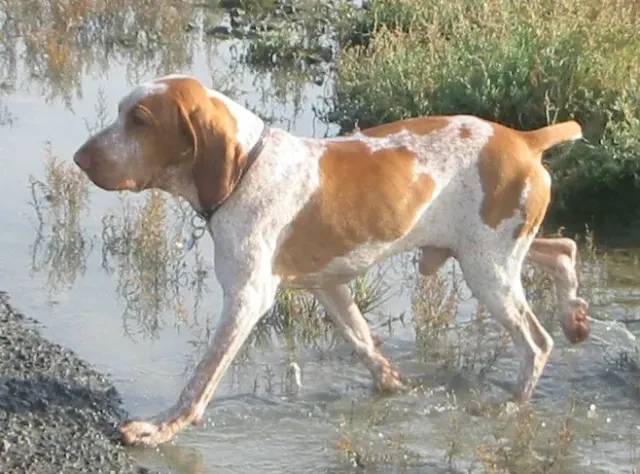
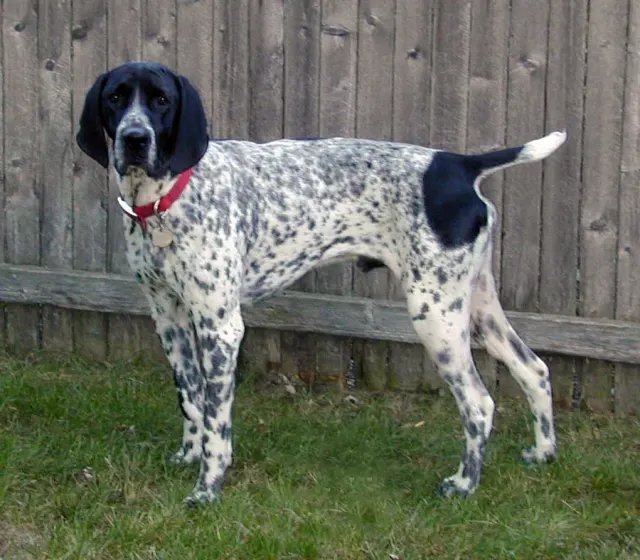
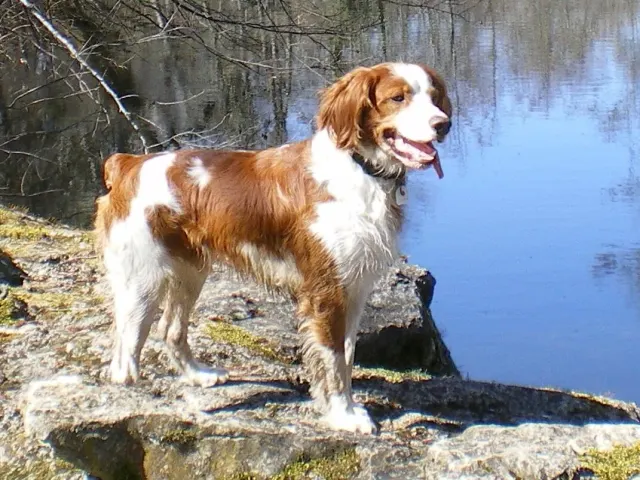
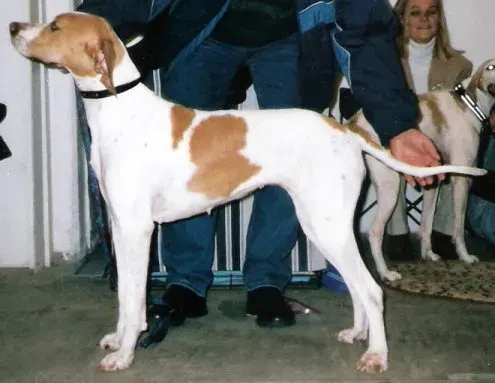
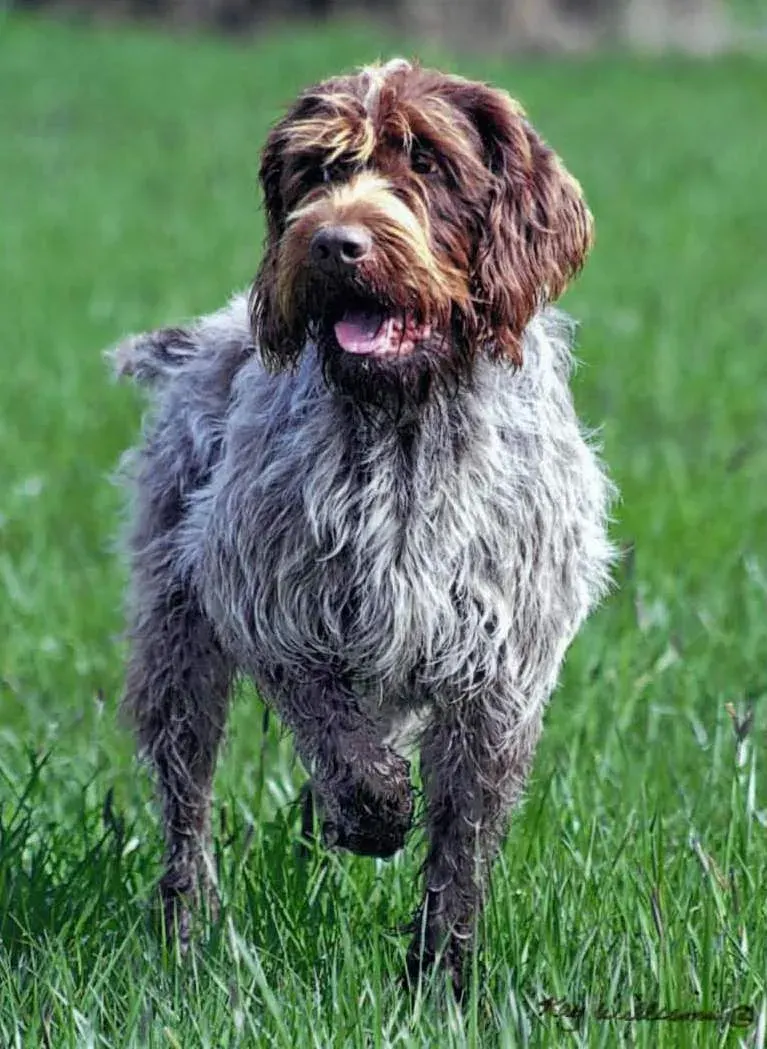
A bearded, wire-coated pointing dog, the Korthals Griffon is versatile, affectionate and very cooperative, in the field and at home.
History and origins
The Wirehaired Pointing Griffon was created in the late 19th century by Dutchman Eduard Korthals, who worked mainly in Germany and France. France is now its reference country with the FCI.
It hunts in open fields, woodland and marshes.
Appearance and colours
The FCI breed standard describes a vigorous, rustic, medium-sized dog, longer than tall, with a long, square muzzle and bushy eyebrows, moustache and beard that give it a firm, assured expression. The coat is harsh and coarse, like a wild boar's bristles, never curly or woolly, over a fine, dense undercoat.
The preferred colour is steel grey with brown (liver) patches, or solid brown; liver roan, white and brown, and white and orange are also allowed.
- Height at the withers: about 55–60 cm for males, 50–55 cm for females.
Temperament
Affectionate, cheerful and very close to its owner, the Korthals is usually excellent with children. It is watchful and cooperative.
It learns well with positive training and copes poorly with being alone.
With children and other pets
The standard describes a gentle, proud dog and an excellent hunter, very attached to its owner and its territory, which it guards vigilantly, and very gentle with children. It rates 5 out of 5 with children and 4 out of 5 with other dogs in our ratings.
- It is a gentle family dog that needs plenty of exercise.
- The harsh coat needs little grooming.
Training tips
According to the standard, the breed was renewed and improved in the second half of the 19th century by E. K. Korthals through selection and training. The Royal Kennel Club notes that Korthals, a Dutchman, wanted to perpetuate the talents of a hard-working wirehaired pointing bitch. The FCI describes it as a versatile pointing dog, also used to track wounded big game. It rates 4 out of 5 for trainability in our ratings.
- Retrieving, tracking and scent work suit it.
- Use calm, reward-based training.
Health
This is a fairly robust breed. Hip dysplasia, ear infections and some eye conditions should be monitored.
Regular veterinary follow-up is recommended.
Common health issues in detail
The Royal Kennel Club recommends hip and elbow scoring as best practice for breeding dogs.
We found no large population study of health in the Wirehaired Pointing Griffon.
This is general information. For any question about your dog's health, consult a veterinarian.
Feeding
Food matched to its activity suits it.
Avoid excess weight.
Exercise
It needs one and a half to two hours of daily activity: hunting, swimming and tracking.
It loves water.
It needs a house with a garden and an active family.
Grooming
Its harsh, rugged coat needs weekly brushing, with light stripping from time to time. It sheds very little.
Clean its beard.
Choosing a puppy
Choose a breeder who hip- and elbow-scores the parents.
- Ask for the parents' hip and elbow scores.
- Meet the mother: she should be gentle and confident.
Our guide on how to recognise a responsible breeder explains what to ask.
Similar breeds
The German Wirehaired Pointer, Spinone Italiano and Wirehaired Vizsla are other rough-coated pointing dogs. The Barbet is another bearded French gundog.