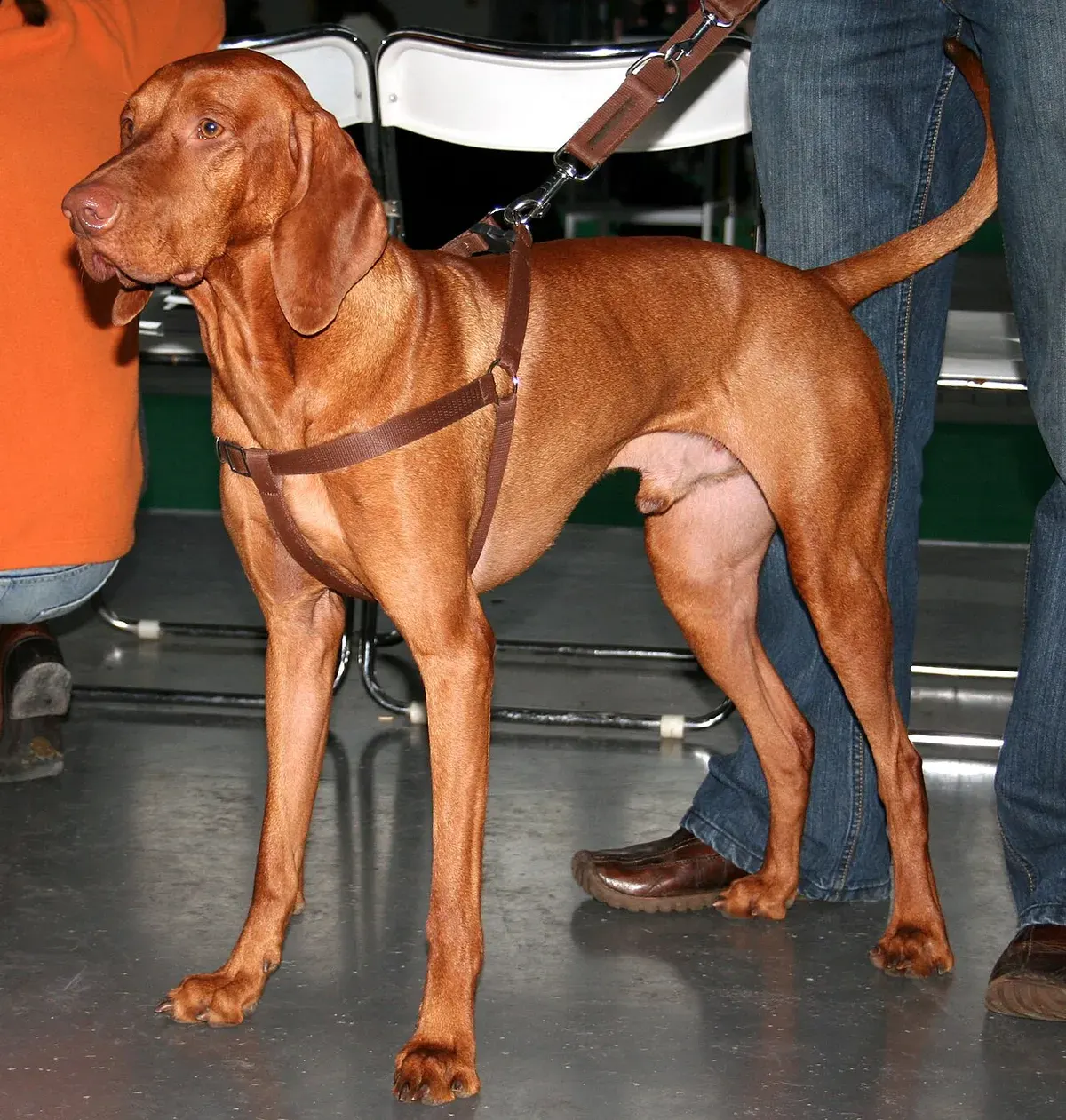
An elegant, toast-coloured pointing dog, the Vizsla is gentle, sensitive and extremely attached to its family: a true 'velcro dog'.
History and origins
The Vizsla is an old Hungarian hunting dog, prized by the Magyar nobility for pointing and retrieving game on the plains.
Nearly lost after the two World Wars, it was saved and has spread around the world.
Appearance and colours
The FCI breed standard describes a medium-sized, elegant gundog of noble appearance with a short russet-gold coat; its rather light, dry, lean build combines beauty and strength. The coat is short, dense, coarse and hard, without undercoat.
The colour is various shades of russet gold and dark sandy gold; a small white patch on the chest or throat is permitted.
- Height at the withers: 58–64 cm for males, 54–60 cm for females.
Temperament
Gentle, affectionate and sensitive, the Vizsla constantly seeks contact with its family. It is excellent with children and learns very quickly.
It copes poorly with loneliness and harshness; positive training works very well.
With children and other pets
The standard describes a lively, friendly, even-tempered dog, easy to train, that keeps close contact with its owner while working and cannot bear rough treatment; it must be neither aggressive nor shy. It rates 5 out of 5 with children and 4 out of 5 with other dogs in our ratings.
- It is an affectionate family dog that likes to stay close to its people.
- It rates 5 out of 5 for energy: it needs a great deal of exercise.
Training tips
According to the standard, the Vizsla's ancestors came to the Carpathian basin with the nomadic Hungarian tribes; descriptions and pictures appear in 14th-century documents, and pointing-dog trials were held in Hungary by the end of the 19th century. The Royal Kennel Club notes that it was used in falconry on the Hungarian plains. It rates 5 out of 5 for trainability in our ratings.
- It learns easily with gentle, reward-based training; harshness does not suit it.
- Retrieving, tracking and running games suit it.
Health
This is a fairly healthy breed. Epilepsy, hip dysplasia and some autoimmune diseases should be monitored.
Regular veterinary follow-up is recommended.
Leishmaniasis prevention is important.
Common health issues in detail
The Royal Kennel Club recommends as a minimum for breeding dogs hip and elbow scoring and eye testing including gonioscopy.
We found no large population study of health in the Hungarian Vizsla.
This is general information. For any question about your dog's health, consult a veterinarian.
Feeding
Good-quality food matched to its intense activity suits it.
Avoid exercise just after meals.
Exercise
It needs at least two hours of daily activity: running, hunting, canicross and retrieving games.
It is an ideal companion for athletes.
It needs a house with a garden and an active family who are at home most of the time.
Grooming
Its short coat needs weekly brushing. It has little odour.
It feels the cold in winter.
Choosing a puppy
Choose a breeder who scores hips and elbows and eye-tests the parents, including gonioscopy.
- Ask for the parents' hip, elbow and eye results.
- Meet the mother: she should be friendly and even-tempered.
Our guide on how to recognise a responsible breeder explains what to ask.
Similar breeds
The Wirehaired Vizsla is its rough-coated relative. The Weimaraner, German Shorthaired Pointer and Rhodesian Ridgeback are other athletic, short-coated hunting dogs.