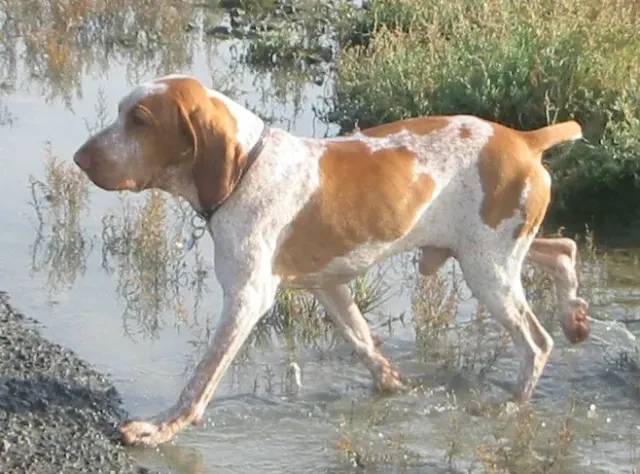
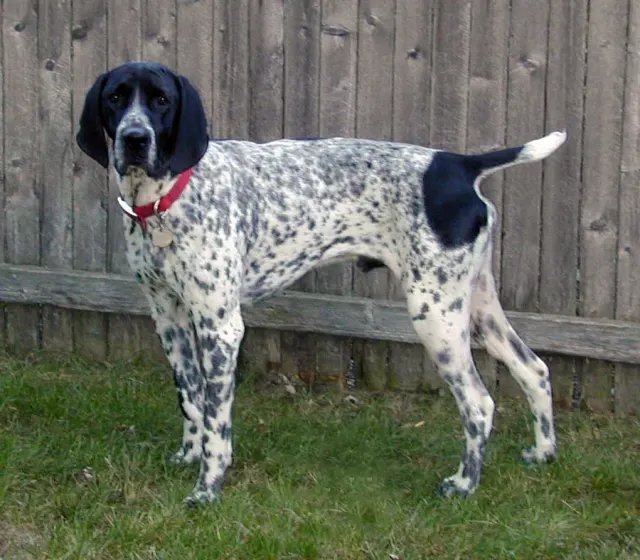
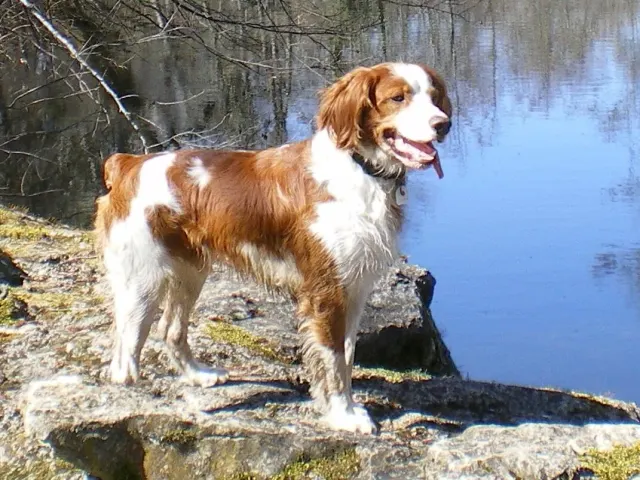
An elegant athlete with a spectacular point, the English Pointer is fast, tireless and gentle, made for open spaces and hunters.
History and origins
The English Pointer was developed in England from the 17th century, with contributions from Spanish pointing dogs and sighthounds. Its rigid, intense point has become iconic.
It is renowned for its speed and wide-ranging search in open country.
Appearance and colours
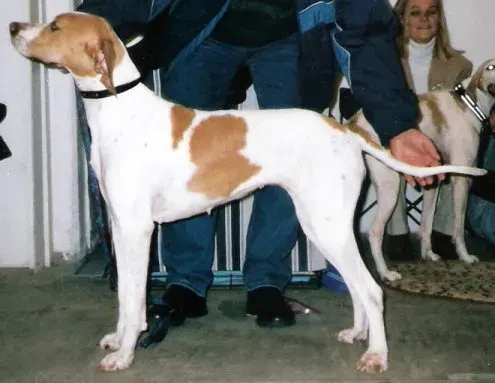
The FCI breed standard describes a symmetrical, well-built dog whose outline is a series of graceful curves, strong but lissom. The coat is fine, short and hard, perfectly smooth and straight with a distinct sheen.
The usual colours are lemon and white, orange and white, liver and white and black and white; solid colours and tricolours are also permitted.
- Height at the withers: 63–69 cm for males, 61–66 cm for females.
Temperament
Gentle, affectionate and usually good with children, the Pointer is calm at home when well exercised. It is independent at work.
It learns with patient, positive training.
With children and other pets
The standard describes an aristocratic, alert dog with an air of strength, endurance and speed, and a kind, even disposition. It rates 4 out of 5 with children and 4 out of 5 with other dogs in our ratings.
- It is a gentle family dog, but needs a great deal of exercise.
- Its short coat needs little grooming.
Training tips
The FCI classifies the Pointer as a British pointing dog with a working trial. The Royal Kennel Club describes it as an athletic, stylish dog with great scenting powers. It rates 3 out of 5 for trainability in our ratings.
- Use reward-based training and teach a reliable recall early.
- It rates 5 out of 5 for energy: it needs daily running in safe areas.
Health
This is a robust breed. Hip dysplasia, some eye conditions and a rare inherited neuropathy should be monitored.
Regular veterinary follow-up is recommended.
Leishmaniasis prevention is essential.
Common health issues in detail
The Royal Kennel Club recommends hip scoring as best practice for breeding dogs.
We found no large population study of health in the English Pointer.
This is general information. For any question about your dog's health, consult a veterinarian.
Feeding
It needs food suited to intense activity and stays naturally lean.
Avoid exercise just after meals.
Exercise
It needs at least two hours of daily activity, ideally free running in wide open spaces.
It is not made for city life.
The Pointer copes well with moderate heat thanks to its short coat and lean build, but hunting and training should be done in the cool hours with plenty of water. It suits hunters and sporty families living outside cities.
Grooming
Its short coat needs weekly brushing.
Its thin skin is prone to sunburn and scratches.
Choosing a puppy
Choose a breeder who hip-scores the parents.
- Ask for the parents' hip scores.
- Meet the mother: she should be kind and steady.
- Ask whether the parents come from working or show lines.
Our guide on how to recognise a responsible breeder explains what to ask.
Similar breeds
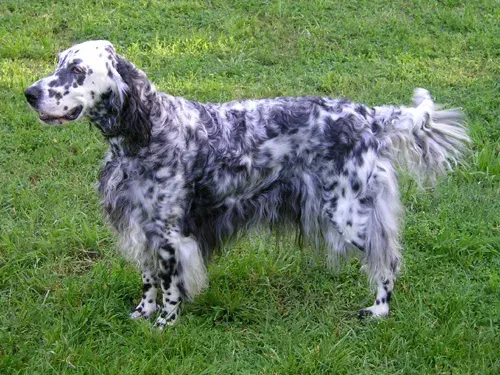
The German Shorthaired Pointer, Hungarian Vizsla and Weimaraner are other short-coated pointing dogs. The English Setter is another British pointing breed.