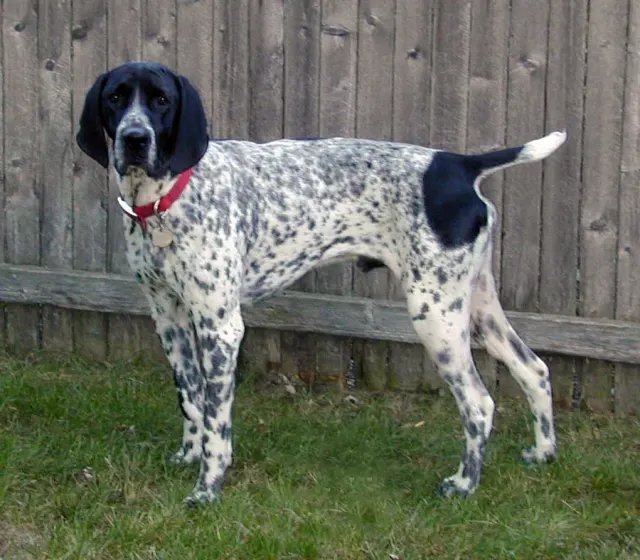
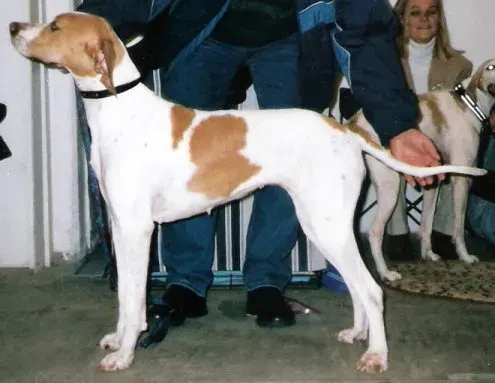
An ancient Italian pointing dog with a noble look and long ears, the Bracco Italiano is gentle, biddable and very attached to its family.
History and origins
The Bracco Italiano is one of Europe's oldest pointing breeds, prized by great Italian families from the Renaissance for bird hunting.
Nearly lost in the 19th century, it was revived by dedicated breeders.
Appearance and colours
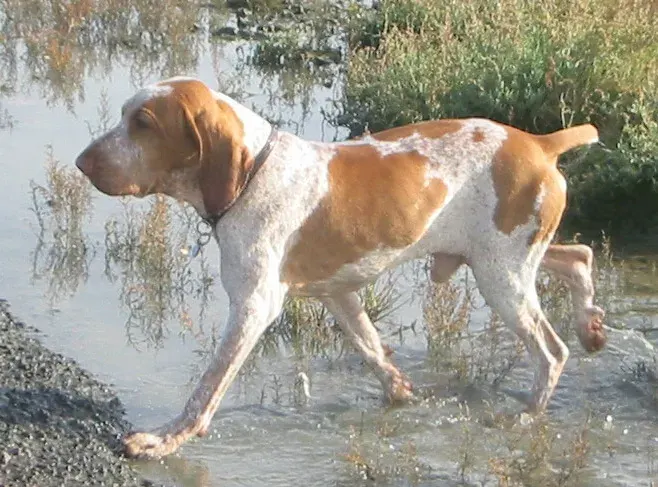
The FCI breed standard describes a strongly and harmoniously built pointer of powerful appearance, with lean limbs, well-developed muscles and a markedly sculpted head; the body is as long as or slightly longer than the dog is tall. The Royal Kennel Club calls it a stylish Italian hunt, point and retrieve breed.
The coat is short, dense and glossy. Colours are white; white with orange or amber patches; white with brown patches; orange roan; or liver roan, for which a warm brown "recalling the colour of a monk's frock" is preferred.
- Height at the withers: 55–67 cm (preferably 58–67 cm for males and 55–62 cm for females).
- Weight: 25–40 kg depending on size.
Temperament
Gentle, calm and affectionate, the Bracco is often excellent with children. It is sensitive and responds very poorly to harshness.
It learns well with gentle, positive training.
With children and other pets
The standard describes a tough, reliable dog, adapted to all types of hunting, with an excellent ability to understand. It rates 5 out of 5 with children and 4 out of 5 with other dogs in our ratings.
- It is usually gentle and sociable at home.
- It needs plenty of exercise to be calm indoors.
Training tips
According to the standard, this pointer of ancient Italian origin appears in 14th-century frescoes; it was selected for a fast, wide-ranging trot and is a natural retriever. The standard calls it docile and easy to train. It rates 3 out of 5 for trainability in our ratings.
- Retrieving, scent work and long walks suit it.
- Use reward-based training and build a reliable recall.
Health
Hip and elbow dysplasia, ear infections, eyelid problems and bloat should be monitored.
Regular veterinary follow-up is recommended.
Common health issues in detail
The Royal Kennel Club recommends hip scoring and elbow grading as best practice for breeding dogs.
We found no large population study of health in the Bracco Italiano.
This is general information. For any question about your dog's health, consult a veterinarian.
Feeding
Split the ration into two meals and avoid exercise straight afterwards.
Avoid excess weight.
Exercise
It needs one to two hours of daily activity, with walking and runs in a safe area.
It hunts at a rhythmic trot rather than a gallop.
It needs a house with a garden.
Grooming
Its short coat needs weekly brushing. Clean its long ears and lip folds regularly.
It drools a little.
Choosing a puppy
Choose a breeder who hip-scores and elbow-grades the parents.
- Ask for the parents' hip and elbow results.
- Ask whether the parents are working or show dogs, and what exercise they need.
Our guide on how to recognise a responsible breeder explains what to ask.
Similar breeds
The Spinone Italiano is the other Italian pointing breed, with a rough coat. The German Shorthaired Pointer, Braque Français and English Pointer are other short-coated pointers.