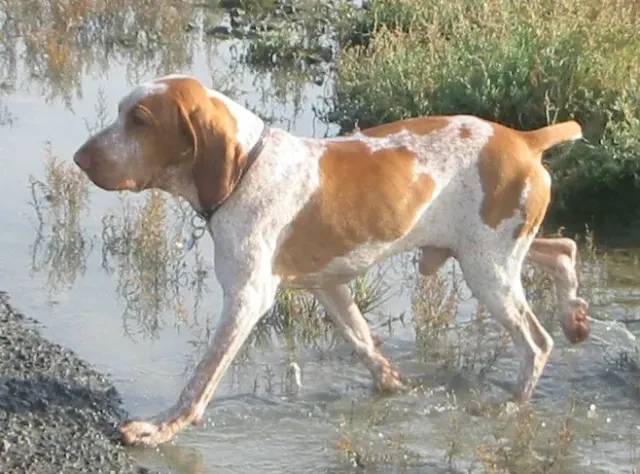
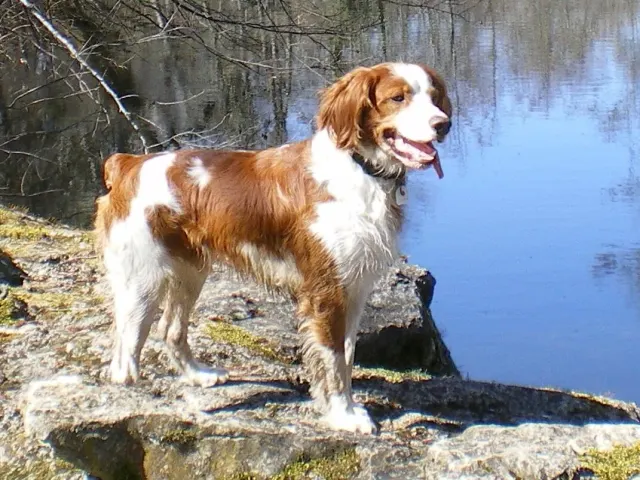
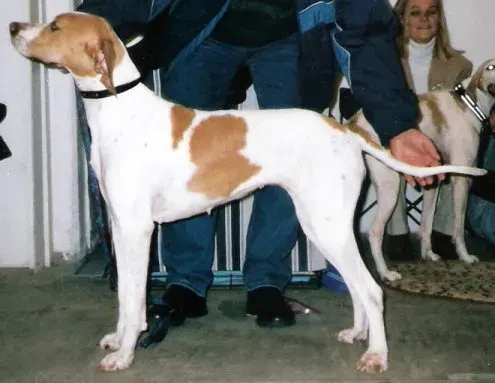
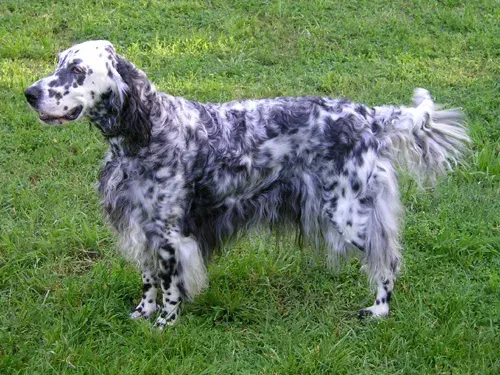
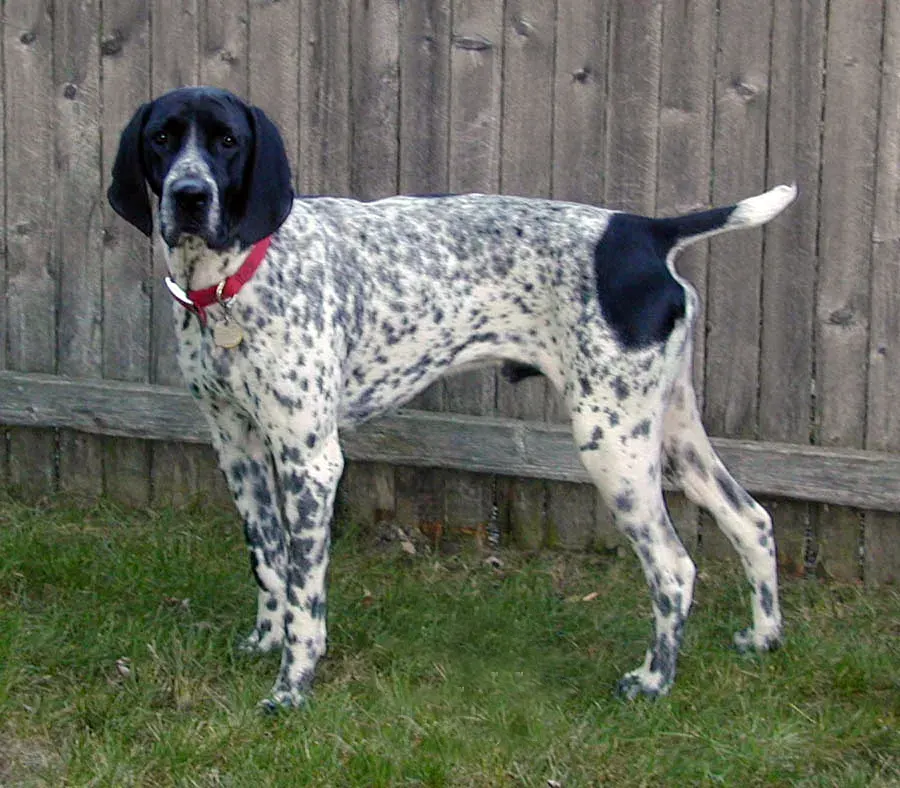
A French pointing dog with a white coat ticked in black, the Braque d'Auvergne is gentle, sensitive and very attached to its owner.
History and origins
The Braque d'Auvergne comes from the Cantal in France's Massif Central, where it has long hunted over rugged volcanic terrain. Its coat is white with black patches and ticking, with a black head.
It is an enduring, methodical pointing dog.
Appearance and colours
The FCI breed standard describes a robust, strongly boned but not heavy pointer of medium proportions, light in its movement and elegant, built to cover long distances with a supple action and work all day on difficult terrain. The Royal Kennel Club calls it a strong, substantial gundog from France.
The coat is short, not too fine, never hard, and shiny. The colour is black with white markings, in two recognised types, flecked or greying; the head should be black, ideally with a white blaze on the muzzle.
- Height at the withers: 57–63 cm for males (ideal 60 cm), 53–59 cm for females (ideal 56 cm), with a tolerance of 2 cm above and 1 cm below.
Temperament
Gentle, affectionate and sensitive, it is very attached to its owner and usually good with children. It dislikes rough handling.
It learns well with gentle, consistent training.
With children and other pets
The standard describes a gentle, very affectionate, intelligent and obedient dog that adapts well to family life. It rates 4 out of 5 with children and 4 out of 5 with other dogs in our ratings.
- It enjoys family life when it gets enough exercise.
- It is a hunting dog: be careful with small pets.
Training tips
According to the standard, the Auvergne pointer is a very ancient breed, present in the Cantal region for more than two centuries, possibly shaped with the help of the Knights of Malta; created by and for hunters, its training mainly consists of developing its natural qualities, including a powerful sense of smell. It rates 4 out of 5 for trainability in our ratings.
- Give it long daily outings and scent or retrieving games.
- Use reward-based training.
Health
This is a fairly robust breed. Hip dysplasia and ear infections should be monitored.
Regular veterinary follow-up is recommended.
Common health issues in detail
The Royal Kennel Club recommends hip scoring as best practice for breeding dogs.
We found no large population study of health in the breed.
This is general information. For any question about your dog's health, consult a veterinarian.
Feeding
Food matched to its activity suits it.
Avoid excess weight outside the hunting season.
Exercise
It needs one to two hours of daily activity, ideally in nature.
It is first and foremost a hunting dog.
It needs a house with a garden and active owners.
Grooming
Its short coat needs weekly brushing. Clean its ears.
Check for grass seeds and ticks after outings.
Choosing a puppy
The Braque d'Auvergne is rare outside France. Choose a breeder who hip-scores the parents.
- Ask for the parents' hip results.
- Ask whether the parents hunt, and what exercise they need.
Our guide on how to recognise a responsible breeder explains what to ask.
Similar breeds
The Braque Français is another French pointer. The Bracco Italiano, German Shorthaired Pointer and English Pointer are other short-coated pointing dogs.