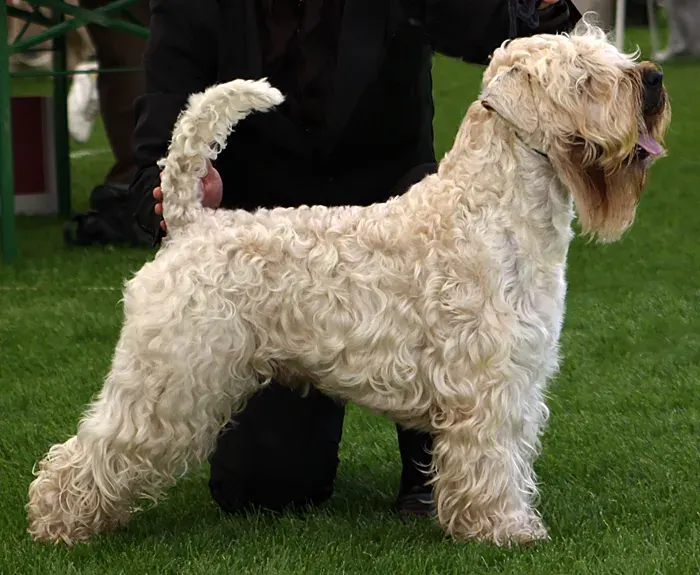
An Irish terrier with a silky, wheat-coloured coat, the Wheaten is cheerful, sociable and very affectionate, and excellent with children.
History and origins
The Soft-coated Wheaten Terrier is an old Irish farm dog used for guarding, hunting vermin and herding cattle.
Its coat, the colour of ripe wheat, gave it its name.
Appearance and colours
The FCI breed standard describes a hardy, active, short-coupled and well-built dog giving an idea of strength, neither too leggy nor too low. It has a single coat, soft and silky, wavy or loosely curled, up to 12.7 cm long if untrimmed.
The colour is a clear wheaten, from light wheaten to a golden reddish hue.
- Height at the withers: 46–48 cm for males, females somewhat less.
- Weight: 18–20.5 kg for males, females somewhat less.
Temperament
Cheerful, exuberant and very sociable, the Wheaten adores its family and often greets visitors enthusiastically. It is usually excellent with children.
Less scrappy than other terriers, it is still a little stubborn and needs consistent training.
With children and other pets
The standard describes a spirited, good-tempered dog, very affectionate and loyal to its owners, very intelligent, a trusty, faithful friend, defensive without aggression. It rates 5 out of 5 with children and 3 out of 5 with other dogs in our ratings.
- It is an affectionate family dog.
- Its coat needs regular grooming (4 out of 5 in our ratings).
Training tips
According to the standard, the Wheaten is probably the oldest of Ireland's four terrier breeds, with references to soft-coated dogs going back at least 200 years; small farmers used it to kill vermin and help on the farm, and to hunt badgers and otters. It was officially recognised in Ireland in 1937. It rates 3 out of 5 for trainability in our ratings.
- Use consistent, reward-based training.
- It rates 4 out of 5 for energy: give it daily exercise.
Health
The breed is predisposed to diseases that cause protein loss through the kidneys or gut; regular screening (urine and blood tests) is advised. Hip dysplasia and some eye diseases are also reported.
Discuss this with your veterinarian.
Common health issues in detail
The breed is predisposed to protein-losing enteropathy (PLE), a gut disease in which protein leaks from the intestine. A small 2025 study found that even healthy Wheatens showed changes in several gut biomarkers, which may help detect the disease earlier.
The Royal Kennel Club recommends as best practice for breeding dogs eye testing and hip scoring, and notes that the breed has a breed club health scheme.
This is general information. For any question about your dog's health, consult a veterinarian.
Feeding
Good-quality food matched to its activity suits it.
Monitor its weight and digestion.
Exercise
It needs about an hour of daily activity, with games and walks.
It loves joining in all family activities.
It is a good family dog in an apartment if it gets enough exercise, and it sheds very little.
Grooming
Its silky, wavy coat hardly sheds but tangles easily: brush daily or every other day and trim every six to eight weeks.
Clean its beard after meals.
Choosing a puppy
Choose a breeder who eye-tests and hip-scores the parents, takes part in the breed club health scheme and can tell you about gut problems in the puppy's family.
- Ask for the parents' eye and hip results.
- Ask whether relatives have had protein-losing gut disease.
- Meet the mother: she should be friendly and confident.
Our guide on how to recognise a responsible breeder explains what to ask.
Similar breeds
The Irish Terrier and Kerry Blue Terrier are the other Irish terriers. The Bedlington Terrier and Tibetan Terrier are other soft-coated breeds.