Nicknamed the 'King of Terriers', the Airedale is the largest of them all: intelligent, versatile, playful and protective.
History and origins
The Airedale Terrier was developed in the 19th century in the Aire valley in Yorkshire to hunt otters and rats along rivers. It later served as a messenger and medical dog in the First World War.
It was also one of the first police dogs in Europe.
Appearance and colours
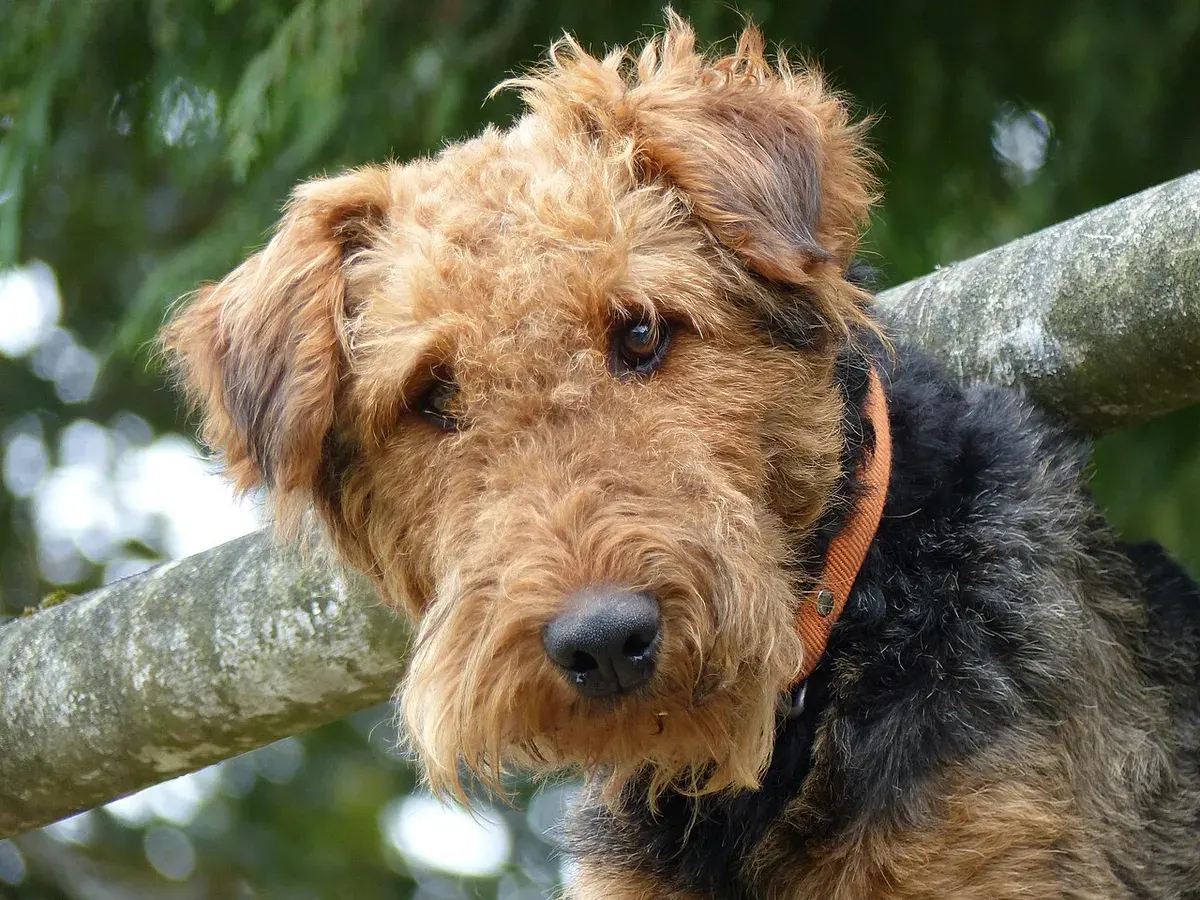
The FCI breed standard describes the largest of the terriers, a muscular, active, fairly compact dog, neither leggy nor long in the body, which is why it is known as the "King of Terriers". Its expression is keen, and its character shows in its eyes, ear carriage and erect tail.
The coat is hard, dense and wiry, lying straight and close, with a shorter, softer undercoat; curly or soft coats are highly undesirable. The body saddle, the top of the neck and the top of the tail are black or grizzle, and all other parts are tan. A few white hairs between the forelegs are acceptable.
- Height at the withers: about 58–61 cm for males, 56–59 cm for females.
Temperament
Intelligent, confident and humorous, the Airedale is playful with children and protective of its family. It can be independent and stubborn.
It needs varied, positive training, as it bores easily.
With children and other pets
The standard describes the Airedale as outgoing, confident, friendly, courageous and intelligent, alert at all times, not aggressive but fearless. It rates 4 out of 5 with children and 3 out of 5 with other dogs in our ratings.
- It is big, strong and playful: supervise play with small children.
- Like most terriers, it may chase small animals, so introduce pets carefully.
Training tips
The standard notes the Airedale's remarkable scenting powers: it has been used for tracking, helped the Red Cross in wartime and served with the police and armed forces. The breed takes its name from the Airedale show in Yorkshire, where many "waterside terriers" from the river valleys were shown. It rates 3 out of 5 for trainability in our ratings.
- Give it daily exercise and a job: tracking, scent games and dog sports suit it.
- Use varied, reward-based sessions; repetition bores it.
Health
This is a fairly robust breed. Hip dysplasia, hypothyroidism and some skin conditions should be monitored.
Regular veterinary follow-up is recommended.
Common health issues in detail
The Royal Kennel Club recommends hip scoring and elbow grading (BVA/KC schemes) as best practice for breeding dogs.
We found no large population study of health in the Airedale.
This is general information. For any question about your dog's health, consult a veterinarian.
Feeding
Good-quality food matched to its activity suits it.
Avoid excess weight.
Exercise
It needs one to two hours of daily activity: running, games, tracking and swimming.
It makes an excellent hiking companion.
The Airedale copes fairly well with moderate heat, especially with a coat kept short. In summer, walk it during the cool hours, with water. It needs a house with a garden and an active family; in an apartment it needs lots of outings.
Grooming
Its wiry coat needs weekly brushing and stripping or clipping every two to three months. It sheds little.
Clean its beard after meals.
Choosing a puppy
Choose a breeder who hip-scores and elbow-grades the parents.
- Ask to see both parents' hip and elbow results.
- Meet the mother: she should be confident and friendly, as the standard requires.
- Ask how the coat is kept: hand-stripping keeps its texture.
Our guide on how to recognise a responsible breeder explains what to ask.
Similar breeds
The Welsh Terrier looks like a smaller Airedale, with the same black and tan colouring. The Irish Terrier and Kerry Blue Terrier are other long-legged terriers. The Giant Schnauzer is a large, wire-coated working dog of similar build.