Close to the Yorkie but slightly larger, the Silky Terrier is a small, silky-coated terrier that is lively, playful and affectionate.
History and origins
The Australian Silky Terrier was developed in late 19th-century Australia from crosses between the Australian Terrier and the Yorkshire Terrier.
It combines the sturdiness of the former with the silky coat of the latter.
Appearance and colours
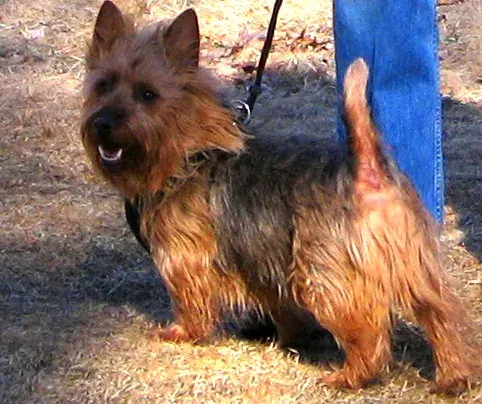
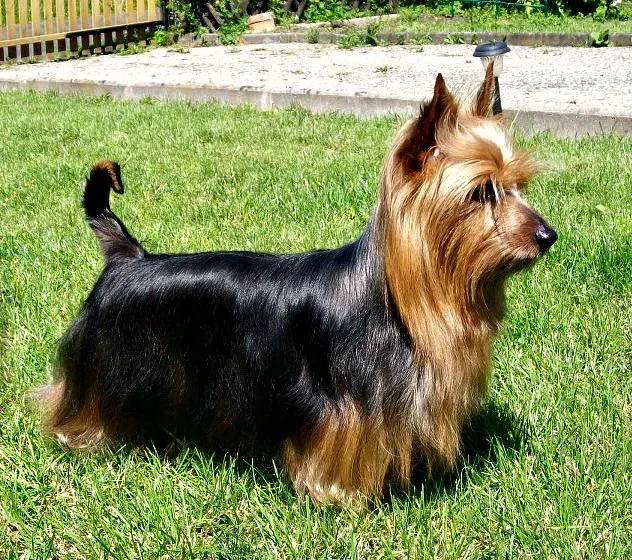
The FCI breed standard describes a compact, moderately low-set dog of medium length, refined but with enough substance to hunt and kill domestic rodents. The straight, silky hair is parted along the back and gives a well-groomed appearance.
The coat must be flat, fine, glossy and silky, but not so long that it hampers movement: daylight should be visible under the dog, and the feet are free of long hair. All shades of blue and tan are accepted, with tan on the muzzle, cheeks, base of the ears and legs, and blue from the skull to the tip of the tail; a silver-blue or fawn topknot is desirable. Silver and white are not accepted.
- Height at the withers: 23–26 cm for males, slightly less for females, with weight in proportion.
Temperament
Lively, curious and affectionate, the Silky is a true terrier in a small body: it barks readily and hunts rodents. It is very attached to its family.
Consistent, patient training suits it.
With children and other pets
The standard asks for terrier character, keen alertness and activity, and calls the Silky "a courageous and dignified toy terrier, second to none as a companion". The Royal Kennel Club describes it as friendly and active. It rates 3 out of 5 with children and 3 out of 5 with other dogs in our ratings.
- It is small and can be injured by rough play: supervise young children.
- Like other terriers, it may chase small pets.
Training tips
The standard explains that the breed's two main ancestors were the Australian Terrier and the Yorkshire Terrier; a standard was first drawn up in Australia in the early 1900s. It rates 3 out of 5 for trainability in our ratings.
- Use short, varied, reward-based sessions.
- Daily walks and games help channel its terrier energy.
Health
Kneecap luxation, tracheal collapse, dental problems and a hip condition seen in small dogs (Legg-Calvé-Perthes disease) should be monitored.
Dental care is important.
This is general information. For any question about your dog's health, consult a veterinarian.
Feeding
Food for very small dogs, in measured portions, suits it.
Limit treats.
Exercise
Daily walks and play are enough to tire it out.
A harness protects its windpipe.
In summer, a shorter trim and walks during the cool hours improve its comfort. Watch out for balconies and bigger dogs.
Grooming
Its long, silky coat hardly sheds but tangles: brush daily or every other day.
Many owners keep it in a shorter trim.
Choosing a puppy
The FCI standard states that only healthy dogs with breed-typical conformation should be used for breeding.
- Meet the mother and check that she is alert and friendly.
- Ask the breeder to show you how the silky coat is groomed.
Our guide on how to recognise a responsible breeder explains what to ask.
Similar breeds
The Yorkshire Terrier and Australian Terrier are its two main ancestors. The Cairn Terrier is another small working terrier. The Maltese is a toy companion with a long, silky coat.