With its lamb-like look, the Bedlington Terrier hides a fast hunter. Gentle and affectionate at home, it sheds very little.
History and origins
The Bedlington Terrier comes from north-east England, near the mining town of Bedlington, where it hunted rats, rabbits and badgers. Crosses with sighthounds gave it its arched outline and speed.
It was long the companion of miners and poachers.
Appearance and colours
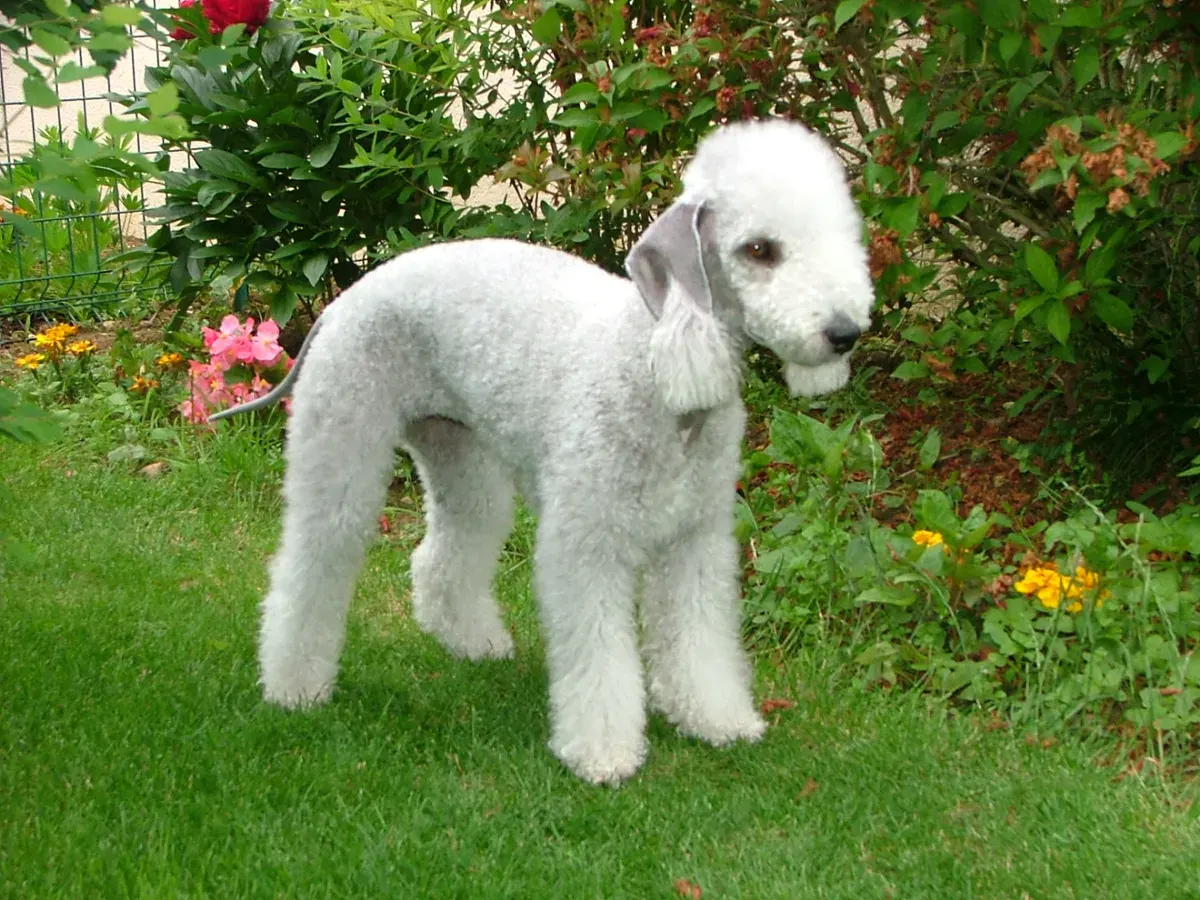
The FCI breed standard describes a graceful, lithe, muscular dog with a pear- or wedge-shaped head, no stop, and a mild, gentle expression in repose, crowned by a profuse, silky, nearly white topknot. The body is slightly longer than tall. The Royal Kennel Club calls it a Northumberland native with a distinctive lamb-like appearance.
The coat is very distinctive: thick and "linty", standing well out from the skin but not wiry, with a tendency to twist, especially on the head. Colours are blue, liver or sandy, with or without tan; blues must have black noses and livers and sandies brown noses.
- Height at the withers: about 41 cm, slightly less for females and slightly more for males.
- Weight: 8–10 kg.
Temperament
Gentle, affectionate and calm indoors, the Bedlington becomes quick and lively outside. It is usually good with children, but its hunting instinct remains strong.
It learns well with gentle training.
With children and other pets
The standard describes a spirited, game and confident dog, an intelligent companion with strong sporting instincts: good-tempered, affectionate and dignified, mild in repose but full of courage when roused. It rates 4 out of 5 with children and 3 out of 5 with other dogs in our ratings.
- It is gentle at home but remains a terrier: it may chase small animals.
- The standard notes it will not seek a fight but can defend itself.
Training tips
According to the standard, the Bedlington, once called the Rothbury Terrier, comes from the former mining areas of northern England and may have the longest traceable pedigree of any terrier; it was used to catch rabbits for the family pot, and a breed association was founded in 1877. It rates 3 out of 5 for trainability in our ratings.
- Use short, reward-based sessions and a solid recall.
- Give it the chance to run in a secure area.
Health
The breed is predisposed to an inherited liver disease caused by copper build-up; a genetic test exists. Some eye conditions are also reported.
Choose a breeder who tests their breeding dogs.
Common health issues in detail
Copper toxicosis. Bedlington Terriers are known for an inherited liver disease in which copper builds up in the liver. It was first linked to a deletion in the COMMD1 gene, but a 2023 study found that this deletion is no longer the main cause in the breed: a mutation in another gene, ATP7B, was significantly associated with the disease, so a clear COMMD1 result does not rule it out. Ask your vet about liver checks if your dog shows signs such as poor appetite, weight loss or jaundice.
Health tests. The Royal Kennel Club recommends for breeding dogs:
- a DNA test for copper toxicosis (COMMD1) (minimum)
- eye testing (best practice)
It also notes that the breed can be affected by conformational concerns.
This is general information. For any question about your dog's health, consult a veterinarian.
Feeding
Good-quality food, with appropriate copper content if needed, suits it; ask your veterinarian for advice.
Watch its weight.
Exercise
It needs about an hour of daily activity and loves to run in an enclosed area.
Keep it on a lead outside safe areas.
Calm indoors, it lives well in an apartment if it can run safely on a regular basis.
Grooming
Its linty coat hardly sheds but tangles: brush weekly and give it a breed-specific trim every six to eight weeks.
Clean its ears regularly.
Choosing a puppy
Choose a breeder who DNA-tests for copper toxicosis, eye-tests the parents and is open about liver disease in their lines.
- Ask for the parents' COMMD1 results and whether they have also tested for ATP7B.
- Ask whether any relatives have had liver disease.
- Meet the mother: she should be confident and good-tempered.
Our guide on how to recognise a responsible breeder explains what to ask.
Similar breeds
The Whippet is a lithe, fast dog of similar size. The Kerry Blue Terrier and Soft Coated Wheaten Terrier are other terriers with soft, non-wiry coats. The Border Terrier is another working terrier from the north of Britain.