The smallest retriever, the red 'Toller' is lively, clever and full of energy, with a unique hunting technique.
History and origins
The Nova Scotia Duck Tolling Retriever was developed in Nova Scotia, Canada, to lure ducks: it frolics at the water's edge, arousing the birds' curiosity, then retrieves the shot game.
It looks a little like a small fox, which helps attract the ducks.
Appearance and colours
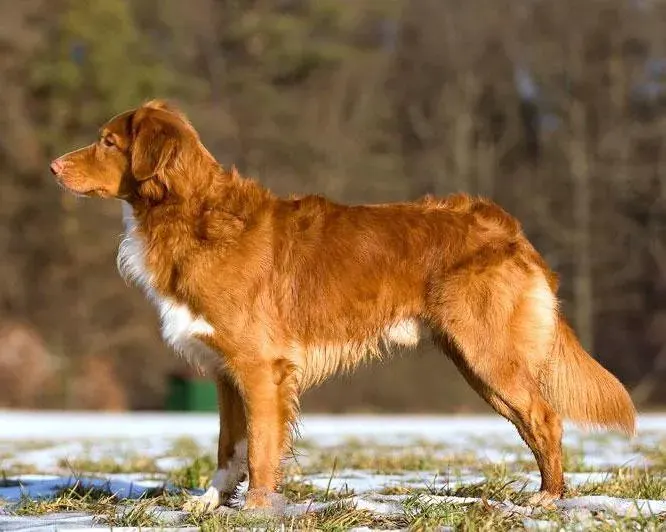
The FCI breed standard describes a medium-sized, powerful, compact, well-balanced and well-muscled dog with great agility and determination; many Tollers look slightly sad until they start work. It was bred to retrieve from icy water and has a water-repellent double coat of medium length with a dense undercoat.
The colour is various shades of red or orange, with lighter feathering and usually at least one white marking, such as on the tail tip, feet or chest.
- Ideal height at the withers: 48–51 cm for males, 45–48 cm for females (2.5 cm over or under allowed).
Temperament
Lively, intelligent and very energetic, the Toller is affectionate with its family and can be reserved with strangers. It may give a distinctive high-pitched scream when excited.
It learns quickly but gets bored with repetition.
With children and other pets
The standard describes a highly intelligent dog, easy to train, with great endurance, a strong swimmer and natural retriever, with a strong retrieving desire and playfulness. It rates 4 out of 5 with children and 4 out of 5 with other dogs in our ratings.
- It is a playful, active family dog.
- It rates 5 out of 5 for energy: it needs plenty of exercise and games.
Training tips
According to the standard, the breed was developed in Nova Scotia in the early 19th century to toll (lure) and retrieve waterfowl: it runs and plays along the shore in view of the ducks, drawing them within range. The Royal Kennel Club calls it a powerful, web-footed swimmer from Canada. It rates 4 out of 5 for trainability in our ratings.
- Retrieving and swimming suit it perfectly.
- Use varied, reward-based training.
Health
Some autoimmune diseases, progressive retinal atrophy, hip dysplasia and an inherited cleft palate should be monitored. Tests are available.
Choose a breeder who tests their breeding dogs.
Common health issues in detail
A Swedish owner survey covering 935 living Tollers found a lifetime prevalence of 3.0% for immune-mediated rheumatic disease, which resembles lupus, and 3.5% for steroid-responsive meningitis-arteritis (SRMA), an inflammation around the brain and spinal cord; 14% of living dogs had had a tumour of some kind, and owners reported cancer as the main cause of death in almost 40% of 177 dogs that had died.
The Royal Kennel Club recommends as a minimum for breeding dogs DNA tests for degenerative myelopathy (DM) and progressive retinal atrophy (prcd-PRA), and as best practice DNA tests for collie eye anomaly (CEA/CH), degenerative encephalopathy (DE) and juvenile Addison's disease (JADD), plus eye testing and hip and elbow scoring.
This is general information. For any question about your dog's health, consult a veterinarian.
Feeding
Food suited to its intense activity works well.
Avoid excess weight.
Exercise
It needs two hours of daily activity: retrieving, swimming, agility and search games.
It loves water.
It needs a house with a garden and a sporty family.
Grooming
Its medium-length double coat needs weekly brushing, more during the moult. Care for the feathering.
Dry its ears after swimming.
Choosing a puppy
Choose a breeder who does the DNA tests, eye testing and hip and elbow scoring recommended by the Royal Kennel Club.
- Ask for the parents' DNA, eye, hip and elbow results.
- Ask whether relatives have had autoimmune disease, SRMA or cancer.
- Meet the mother: she should be friendly and lively.
Our guide on how to recognise a responsible breeder explains what to ask.
Similar breeds
The Nederlandse Kooikerhondje is another duck-luring dog. The Golden Retriever, Flat-coated Retriever and Brittany are other gundogs.