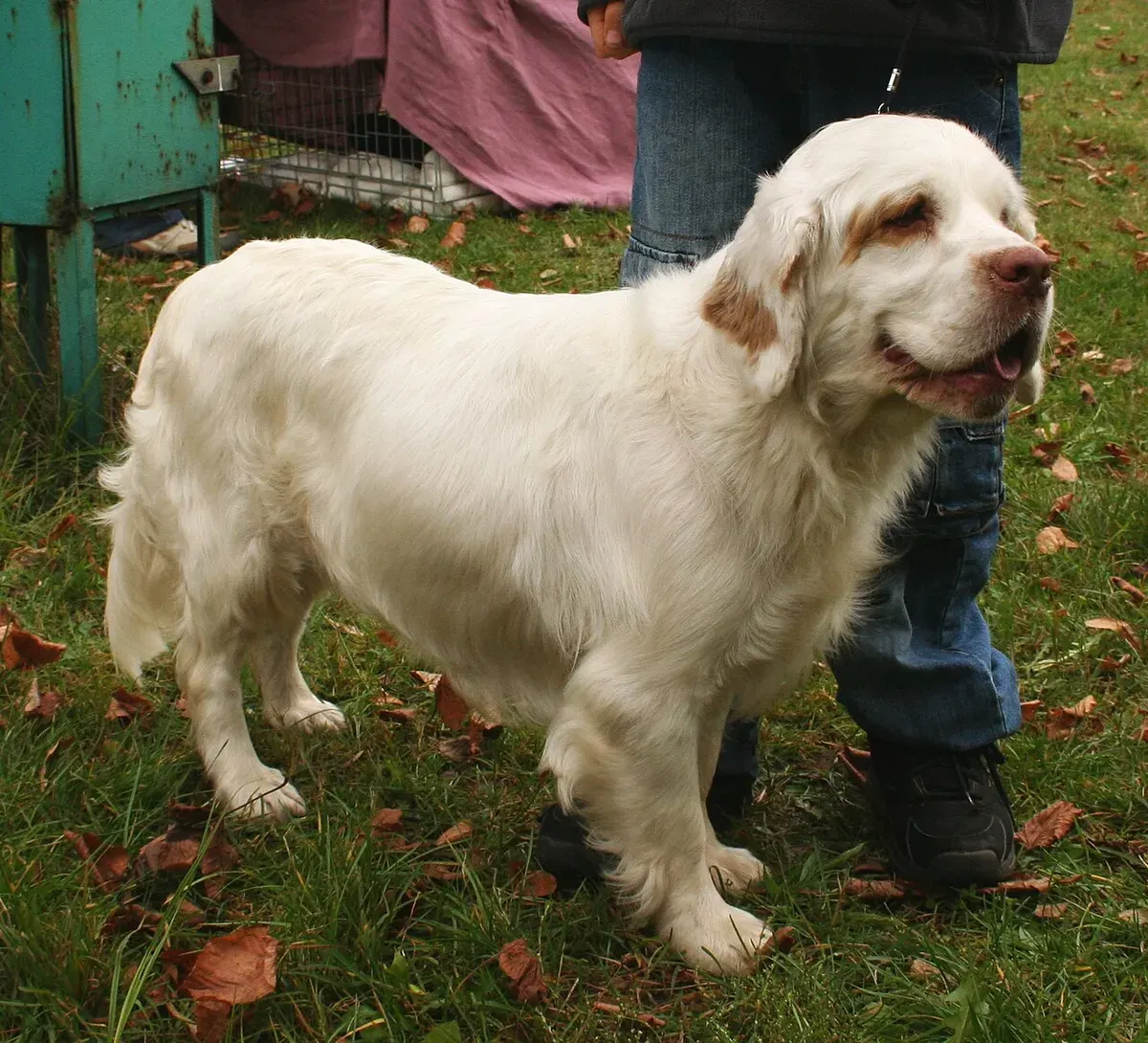
The heaviest of the spaniels, the Clumber is a calm, gentle and dignified dog that prefers leisurely walks to frantic running.
History and origins
The Clumber Spaniel is named after Clumber Park in Nottinghamshire, where it was developed in the 18th century by the Duke of Newcastle. It hunted slowly but methodically through undergrowth.
It remains an uncommon breed.
Appearance and colours
The FCI breed standard describes a balanced, well-boned, active dog with a thoughtful expression, denoting strength, firm, fit and capable of a day's work in the field, with a large, square head. The standard warns that the breed has become ever heavier since the 1950s and that its size must not weaken its hindquarters.
The coat is abundant, close, silky and straight, with feathering on the legs and chest. The body is plain white, with or without lemon or orange markings; slight head markings and freckles on the muzzle are allowed.
- Ideal weight: 29.5–34 kg for males, 25–29.5 kg for females.
Temperament
Calm, gentle and affectionate, the Clumber is a steady companion, usually good with children and other dogs. It can be a little stubborn.
It learns well with patient, reward-based training.
With children and other pets
The standard describes a stoical, great-hearted, highly intelligent dog, steady, reliable, kind and dignified, more aloof than other spaniels; any tendency to aggression is unacceptable. It rates 4 out of 5 with children and 4 out of 5 with other dogs in our ratings.
- It is a calm, gentle family dog.
- It is heavy: keep it lean, as the standard warns against ever-increasing weight.
Training tips
According to the standard, Clumber Spaniels are said to have come from France more than two hundred years ago and were bred by the Duke of Newcastle at Clumber Park in Nottinghamshire. It is a silent worker with an excellent nose, working at a more leisurely pace than other spaniels. It rates 3 out of 5 for trainability in our ratings.
- Retrieving and scent work suit it well.
- Use patient, reward-based training.
Health
Its heavy body and long back expose it to hip dysplasia and disc herniation. Eyelid problems and ear infections are common.
Regular veterinary follow-up and a controlled weight are essential.
Common health issues in detail
The Royal Kennel Club recommends for breeding dogs, as a minimum, hip scoring, elbow grading, eye testing and, since December 2025, a DNA test for exercise-induced collapse (EIC). It notes that EIC is highly prevalent in the breed and that breeders should reduce it gradually, still using some tested carriers, to protect genetic diversity.
We found no large population study of health in the Clumber Spaniel.
This is general information. For any question about your dog's health, consult a veterinarian.
Feeding
It loves food and gains weight easily, so measure portions.
Two meals a day are recommended.
Exercise
Calm daily walks of about an hour are enough.
Avoid jumping and intense effort.
It needs a house with a garden, ideally in a temperate region.
Grooming
Its dense white coat sheds a lot: brush two to three times a week. Clean its ears and eyes. It drools a little.
It gets dirty easily.
Choosing a puppy
Choose a breeder who carries out all the recommended tests, including the EIC DNA test.
- Ask for the parents' hip, elbow, eye and EIC results.
- Look for a sound, active dog that is not overweight.
- Meet the mother: she should be steady and kind.
Our guide on how to recognise a responsible breeder explains what to ask.
Similar breeds
The English Springer Spaniel and English Cocker Spaniel are lighter, faster British spaniels. The Basset Hound is another heavy, low-to-the-ground hunting dog.