An ancient French water dog with a woolly coat and bushy beard, the Barbet is cheerful, sociable and sheds very little.
History and origins
The Barbet is a very old French water dog used to retrieve waterfowl in marshes. It is thought to have contributed to several breeds, including the Poodle.
Nearly lost in the 20th century, it was revived by a few dedicated breeders.
Appearance and colours
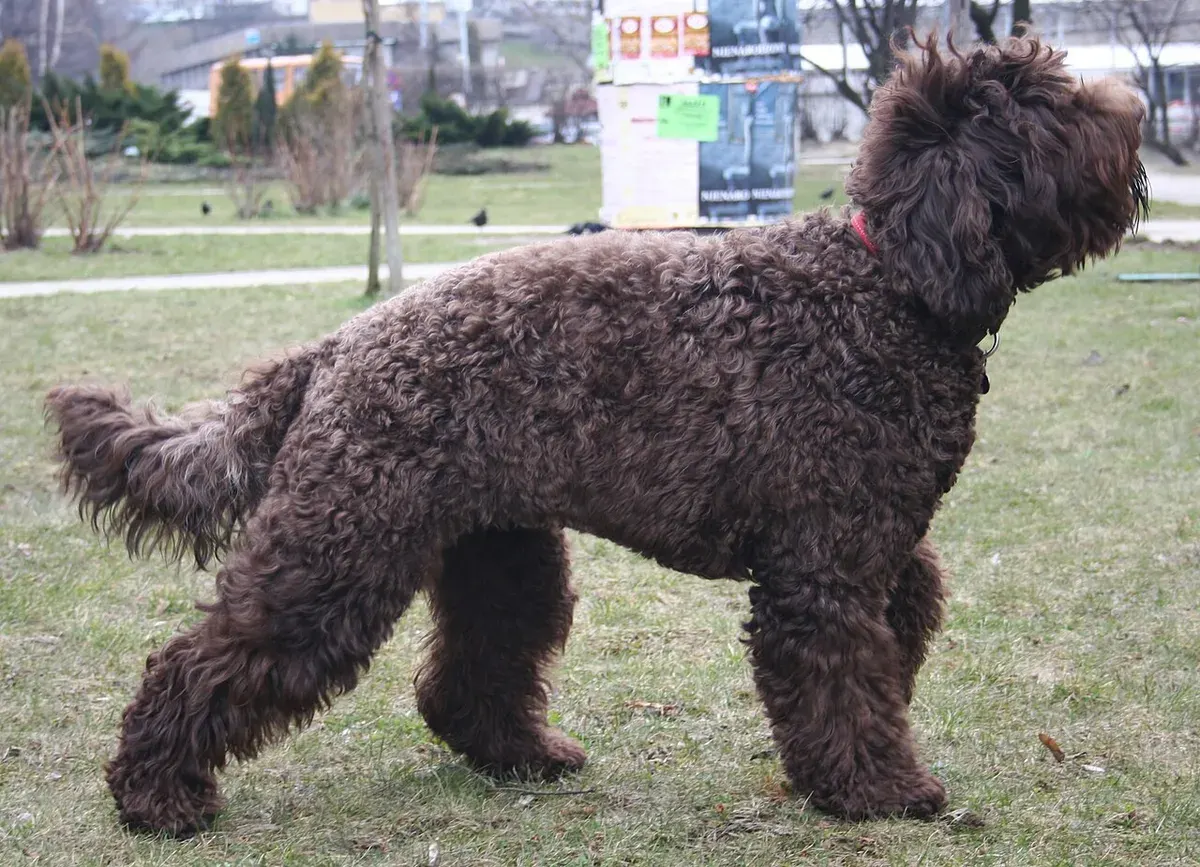
The FCI breed standard describes a medium-sized dog of medium proportions, slightly longer than tall, characterised by a thick, woolly coat that protects it from cold and damp. The coat forms a beard ("barbe" in French) on the chin, which gave the breed its name, and the hair on the skull falls over the bridge of the nose.
The coat is long, woolly and curly and can form cords; it covers the whole body in its natural state, an essential feature of the breed, although it may be groomed to suit work and maintenance. Accepted colours are solid black, grey, brown, fawn, pale fawn and white, or pied in varying degrees.
- Height at the withers: 58–65 cm for males, 53–61 cm for females, with a tolerance of 1 cm.
Temperament
Cheerful, affectionate and sociable, the Barbet is excellent with children and other dogs. It is calm at home and full of zest outdoors.
Intelligent, it learns well with positive training.
With children and other pets
The standard describes an even disposition: very attached to its owner and very sociable. It rates 5 out of 5 with children and 4 out of 5 with other dogs in our ratings.
- It enjoys family life and being included.
- Be ready for wet, muddy coats: it loves water in any weather.
Training tips
The standard describes a very ancient French water dog, mentioned as early as the 16th century, used to hunt waterfowl: more than a retriever, it searches for, finds and flushes game hidden in water plants, then retrieves it, and goes into water in all weather. It rates 4 out of 5 for trainability in our ratings.
- Swimming, retrieving and scent games suit it well.
- Use reward-based training; it is keen to work with its owner.
Health
This is a fairly healthy breed. Hip dysplasia, ear infections and epilepsy should be monitored.
Regular veterinary follow-up is recommended.
Common health issues in detail
As best practice for breeding dogs, the Royal Kennel Club recommends a DNA test for progressive retinal atrophy (prcd-PRA), eye testing, hip scoring and elbow grading.
We found no large population study of health in the Barbet.
This is general information. For any question about your dog's health, consult a veterinarian.
Feeding
Food matched to its activity suits it.
Avoid excess weight.
Exercise
It needs an hour and a half of daily activity, ideally with swimming and retrieving games.
It loves water, even cold water.
It needs a house with a garden and appeals to families who want little dog hair at home.
Grooming
Its woolly coat hardly sheds but mats easily: brush regularly and clip several times a year.
Clean its beard and dry its ears after swimming.
Choosing a puppy
Choose a breeder who carries out the recommended DNA, eye, hip and elbow tests.
- Ask for the parents' test results.
- Meet the mother: she should be sociable and even-tempered.
- Ask how the coat is maintained and how often it needs clipping.
Our guide on how to recognise a responsible breeder explains what to ask.
Similar breeds
The Poodle has a similar curly, low-shedding coat. The Portuguese Water Dog, Spanish Water Dog and Lagotto Romagnolo are other curly-coated European water dogs.