Smaller than the English Cocker and with a profuse coat, the American Cocker Spaniel is gentle, merry and very attached to its family.
History and origins
The American Cocker descends from the English Cocker but was bred in the United States in the 20th century towards a smaller dog with a rounder head and a fuller coat.
It has become mainly a companion and show dog.
Appearance and colours
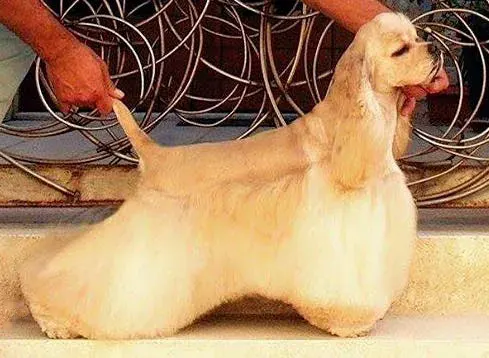
The FCI breed standard describes the smallest of the American sporting dogs: a sturdy, compact dog with a cleanly chiselled, refined head, standing well up at the shoulder, with a topline sloping slightly towards the hindquarters. It must be capable of considerable speed and great endurance, and, above all, "free and merry".
The coat is short and fine on the head and of medium length on the body, silky and flat or slightly wavy, with well-feathered ears, chest, belly and legs; excessive, curly or cotton-like coats are penalised. Colours fall into three varieties: black (including black and tan), any solid colour other than black (from light cream to dark red and brown), and parti-colour.
- Ideal height at the withers: about 38 cm for males and 35.5 cm for females.
Temperament
Gentle, cheerful and affectionate, the American Cocker loves family life and usually gets on well with children and other animals.
Sensitive, it responds well to gentle, positive training.
With children and other pets
The standard asks for an equable temperament with no suggestion of timidity. It rates 4 out of 5 with children and 4 out of 5 with other dogs in our ratings.
- It is a sociable, family-sized dog that likes to be involved in home life.
- Teach children to handle its ears and coat gently.
Training tips
The Royal Kennel Club explains that the breed shares its roots with the English Cocker Spaniel, through the famous black dog Obo, but from the 1920s American breeders selected more domed heads, shorter muzzles and more coat, until the two became separate breeds. It rates 4 out of 5 for trainability in our ratings.
- It responds well to gentle, reward-based training.
- Retrieving games, scent work and short training sessions keep its mind busy.
Health
The breed is prone to ear infections, several eye diseases (cataracts, glaucoma, retinal atrophy), skin problems and some autoimmune diseases.
Regular veterinary follow-up is important.
Common health issues in detail
The Royal Kennel Club asks breeders, at a minimum, to have their dogs eye-tested, including gonioscopy for pectinate ligament abnormality (PLA), a defect of the eye's drainage angle linked to glaucoma. As best practice, it adds a DNA test for progressive retinal atrophy (prcd-PRA) and hip scoring.
It also notes that the breed can be affected by conformational concerns.
We found no large population study of health in the American Cocker Spaniel.
This is general information. For any question about your dog's health, consult a veterinarian.
Feeding
Good-quality food in measured portions suits it; it gains weight easily.
A narrow bowl protects its ears.
Exercise
Daily walks of about an hour and play are enough.
It enjoys search games.
It lives well in an apartment; budget for regular grooming.
Grooming
Its long, profuse coat needs frequent brushing and professional grooming every six to eight weeks. Clean and dry its ears often.
It is one of the most demanding breeds to groom.
Choosing a puppy
Choose a breeder who eye-tests the parents, including gonioscopy, and carries out the PRA DNA test and hip scoring.
- Ask to see current eye certificates for both parents.
- Look for moderate coats and clear, healthy eyes and ears.
- Meet the mother: she should be friendly and confident.
Our guide on how to recognise a responsible breeder explains what to ask.
Similar breeds
The English Cocker Spaniel shares the same ancestors but has a longer muzzle and less coat. The English Springer Spaniel and Welsh Springer Spaniel are larger flushing spaniels. The Cavalier King Charles Spaniel is a companion spaniel of similar size.