Gentle, patient and always good-natured, the Golden Retriever is one of the best family dogs, but it copes poorly with strong heat.
History and origins
The Golden Retriever was developed in Scotland in the 19th century by Lord Tweedmouth, who wanted a gundog able to retrieve game on land and from water.
Its exceptionally gentle nature has made it a guide dog, an assistance dog and one of the most popular family dogs in the world.
Appearance and colours
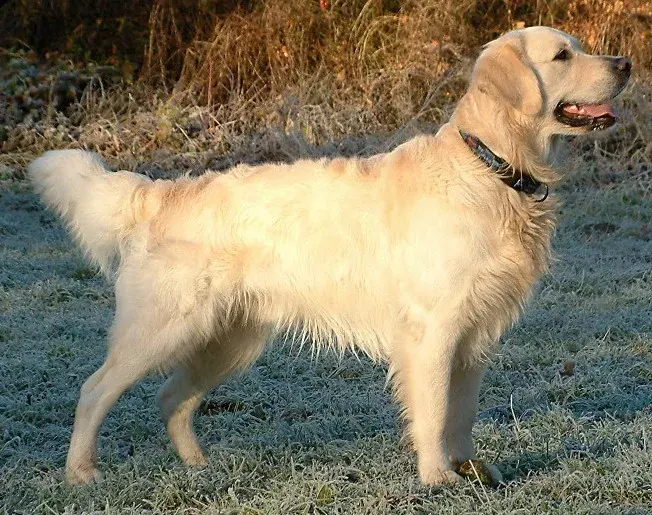
The FCI breed standard describes a symmetrical, balanced, active and powerful dog that moves with a level action and has a kindly expression. The ears are of moderate size, set roughly level with the eyes.
The coat is flat or wavy with good feathering, over a dense, water-resisting undercoat. Accepted colours are any shade of gold or cream, but neither red nor mahogany; a few white hairs on the chest are the only white allowed.
- Height at the withers: 56–61 cm for males, 51–56 cm for females.
Temperament
Affectionate, sociable and eager to please, the Golden gets on with almost everyone: children, strangers and other animals. It is no guard dog.
It learns very easily but stays playful and boisterous for a long time. It needs company and copes poorly with being alone.
With children and other pets
Its standard calls the Golden Retriever kindly, friendly and confident, and it scores 5 out of 5 both with children and with other dogs in our ratings. That gentleness is real, but a young Golden is also a large, enthusiastic dog.
- Teach calm greetings early: a bouncing adult can knock over a small child without meaning to.
- Retrievers like to carry things. Give it its own toys and teach children to swap a toy for a treat rather than pull it out of the dog's mouth.
- Introduce cats and small pets gradually, under supervision, and give every animal a place to retreat.
Whatever the breed, never leave a young child alone with a dog. Our guide to dogs and children explains the house rules.
Training tips
The standard describes the breed as biddable and intelligent, with natural working ability, and it scores 5 out of 5 for trainability in our ratings. Its gundog background makes retrieving and nose work the most rewarding games for it.
- Use reward-based training, with food, play and praise, in short, frequent sessions.
- Build a solid recall and a reliable "give" with retrieving games.
- Practise loose-lead walking while the puppy is small and light.
- Give it a job: scent games, obedience, retrieving work or gundog training keep its mind busy.
Health
The breed is prone to hip and elbow dysplasia, some eye and heart diseases, and a higher-than-average cancer risk. Skin allergies and ear infections are common.
Choose a breeder who health-screens their dogs and see a veterinarian regularly.
Common health issues in detail
The Golden Retriever is affected by several inherited conditions that breeders can screen for, including hip and elbow dysplasia and eye diseases, and cancer is a leading cause of death in the breed. In a US veterinary school study of 652 Golden Retrievers examined after death, 65% had died of cancer, at a median age of 9.8 years.
Cancer. In that study the most common cancers were haemangiosarcoma, a cancer of blood vessels (about 23% of the cancer deaths), and lymphoid cancers such as lymphoma (about 18%). Age had a larger effect on cancer deaths than neutering status. Regular veterinary check-ups help catch lumps, weight loss or pale gums early.
Eyes. Pectinate ligament dysplasia, an abnormality of the eye's drainage angle linked to glaucoma, was moderate or severe in 26% of 230 UK Golden Retrievers examined, and it became more common with age. It is detected by gonioscopy, an eye examination of the drainage angle.
Health tests. The Royal Kennel Club recommends these tests for breeding dogs:
- hip and elbow scoring by X-ray, an eye examination with gonioscopy, and a DNA test for progressive retinal atrophy (GR_PRA2) (minimum)
- DNA tests for ichthyosis (ICT-A), a scaling skin disease, and for progressive retinal atrophy (GR_PRA1) (best practice)
This is general information. For any question about your dog's health, consult a veterinarian.
Feeding
Very food-motivated, it gains weight easily. Measure portions and limit treats to protect its joints.
Puppies should be fed large-breed food for steady growth.
Exercise
It needs at least an hour of activity a day: walks, fetch, water games and search games. It loves to swim.
In hot weather, choose supervised swimming over running.
In summer, walk it at dawn and in the evening, keep it cool indoors and do not shave it. It can live in an apartment if it gets plenty of exercise, but a house with a garden is preferable. It is an excellent choice for families with children.
Grooming
Its double coat sheds heavily all year. Brushing two to three times a week, and daily during the moult, is needed.
Dry its ears well after swimming to prevent infections.
Choosing a puppy
Choose a breeder who carries out the tests listed above on both parents, shows you the certificates, raises the puppies in the home and lets you meet the mother with her litter.
- Ask for the parents' hip and elbow scores, eye examination results, including gonioscopy, and DNA results, and check them against the registration documents.
- Meet the mother. A kindly, confident dog is what the standard asks for, and what you want to see in the parents.
- Ask about the health and age at death of the grandparents and other relatives: a breeder who knows the family history takes cancer and longevity seriously.
- Consider an adult Golden from a rescue: its temperament and energy are already known.
Our guide on how to recognise a responsible breeder lists the questions to ask.
Similar breeds
The Labrador Retriever shares the Golden's friendly, trainable nature and size, with a short coat that needs less brushing. The Flat-coated Retriever is a retriever of the same size with a flat, glossy coat in black or liver. The Nova Scotia Duck Tolling Retriever is smaller and even more energetic.