Cheerful, optimistic and forever playful, the Flat-coated Retriever is an affectionate family dog that stays young at heart all its life.

History and origins
The Flat-coated Retriever was developed in 19th-century England as a retriever for gamekeepers, before being partly overshadowed by the Labrador and the Golden.
Its glossy black or liver coat and racy outline set it apart.
Appearance and colours
The FCI breed standard describes a bright, active, medium-sized dog with an intelligent expression, showing power without heaviness and raciness without weediness, with a long, well-moulded head.
The colour is black or liver only.
- Preferred height: 59–61.5 cm for males, 56.5–59 cm for females.
- Preferred weight in working condition: 27–36 kg for males, 25–32 kg for females.
Temperament
Cheerful, affectionate and very sociable, the Flatcoat loves everyone. It keeps a puppy-like character for years and adores play.
It learns well with positive training and lots of games.
With children and other pets
The standard describes a dog generously endowed with natural gundog ability, optimism and friendliness, shown by enthusiastic tail action; confident and kindly. It rates 5 out of 5 with children and 5 out of 5 with other dogs in our ratings.
- It is a cheerful, sociable family dog.
- It needs plenty of exercise and things to do.
Training tips
The FCI classifies the Flat-coated Retriever as a retriever with a working trial. The Royal Kennel Club describes it as a bright, active retriever with natural gundog ability. It rates 4 out of 5 for trainability in our ratings.
- Retrieving, swimming and scent games suit it well.
- Avoid exercise in the heat: it rates 2 out of 5 for heat tolerance.
Health
The breed has a high cancer rate, which partly explains its shorter life expectancy. Hip dysplasia and glaucoma are also monitored.
Regular veterinary follow-up is important.
Common health issues in detail
The Royal Kennel Club recommends eye testing including gonioscopy as a minimum for breeding dogs, and hip and elbow scoring as best practice.
We found no large population study of health in the Flat-coated Retriever that we could use here.
This is general information. For any question about your dog's health, consult a veterinarian.
Feeding
Food matched to its activity suits it.
Avoid excess weight.
Exercise
It needs one and a half to two hours of daily activity: retrieving, swimming and running.
It loves water.
Early-morning beach swims are ideal. It needs a house with a garden and an active family.
Grooming
Its flat, glossy coat needs brushing once or twice a week. Care for the feathering.
Dry its ears after swimming.
Choosing a puppy
Choose a breeder who eye-tests the parents, including gonioscopy, and scores hips and elbows.
- Ask for the parents' eye, hip and elbow results.
- Meet the mother: she should be friendly and confident.
- Ask about the health and lifespan of the puppy's relatives.
Our guide on how to recognise a responsible breeder explains what to ask.
Similar breeds
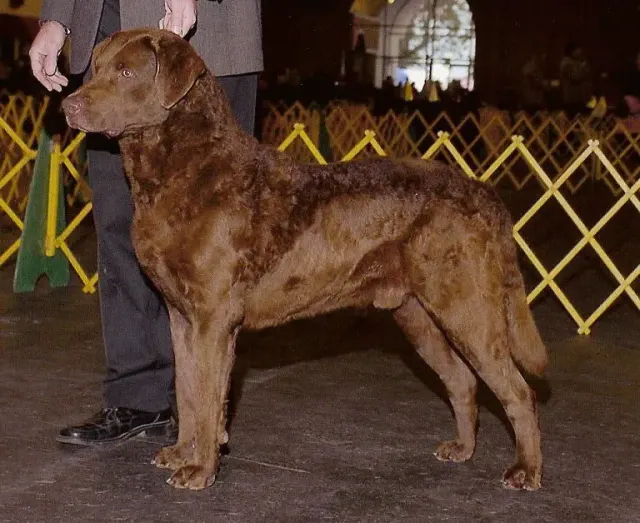
The Golden Retriever, Labrador Retriever, Chesapeake Bay Retriever and Nova Scotia Duck Tolling Retriever are other retrievers.