A tough American retriever with an oily, wavy coat, the Chesapeake is brave, loyal and tireless in cold water.
History and origins
The Chesapeake Bay Retriever was developed in the 19th-century United States around Chesapeake Bay (Maryland) to retrieve ducks in cold, rough water.
It descends in part from two Newfoundland-type dogs rescued from a shipwreck.
Appearance and colours
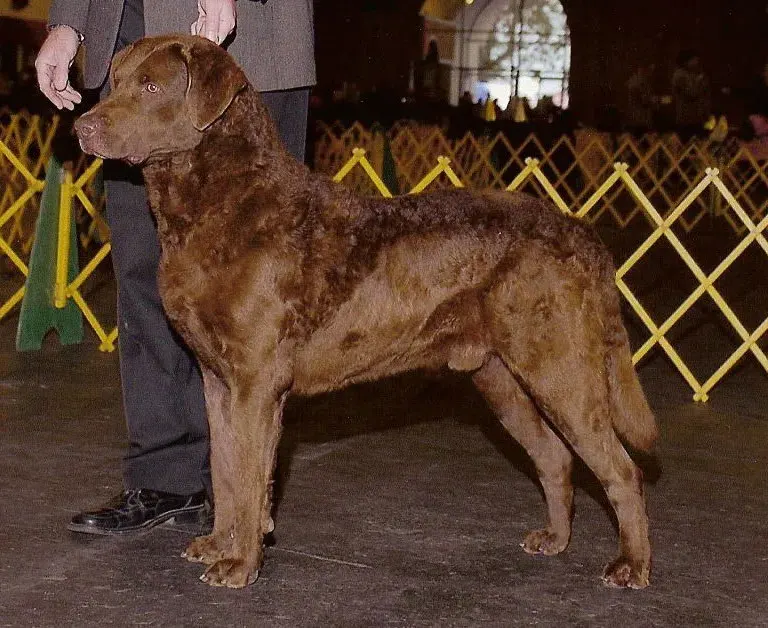
The FCI breed standard explains that the Chesapeake Bay Retriever was developed along the Chesapeake Bay to hunt waterfowl in the harshest weather and water, often breaking ice during many strenuous retrieves and facing wind, tide and long cold swims. It is slightly longer than tall, with a deep body. The Royal Kennel Club calls it a strong retriever bred to work in icy Atlantic waters.
The coat is thick and short, no more than 4 cm long, with a dense, fine, woolly undercoat; it is very short and straight on the face and legs, with a tendency to wave only on the shoulders, neck, back and loins. Its colour should match its working surroundings: any shade of brown, sedge or "deadgrass" is acceptable, solid colours being preferred, with only small white spots allowed.
- Height at the withers: 58–66 cm for males, 53–61 cm for females.
- Weight: 29.5–36.5 kg for males, 25–32 kg for females.
Temperament
Loyal, brave and very attached to its family, the Chessie is more reserved and protective than other retrievers. It can be stubborn and dominant.
It needs consistent training and early socialisation.
With children and other pets
The standard values its bright and happy disposition, intelligence, quiet good sense and affectionate, protective nature; extreme shyness or aggression are faults. It rates 4 out of 5 with children and 3 out of 5 with other dogs in our ratings.
- It is devoted to its family and may be watchful with strangers.
- It loves water: be ready for wet, muddy walks.
Training tips
The FCI classifies it as a retriever equally proficient on land and in water, with a working trial. It rates 4 out of 5 for trainability in our ratings.
- Retrieving, swimming and scent work give it the job it was bred for.
- Use consistent, reward-based training from the start.
Health
Hip dysplasia, some inherited eye diseases and degenerative myelopathy should be monitored.
Genetic tests exist, so ask the breeder for them.
Common health issues in detail
The Royal Kennel Club recommends for breeding dogs, as a minimum, hip scoring, elbow grading and a DNA test for degenerative myelopathy (DM), a progressive disease of the spinal cord. It notes that DM is highly prevalent in the breed and that breeders should reduce it gradually, still using some tested carriers, to avoid a rapid loss of genetic diversity. A DNA test for progressive retinal atrophy (prcd-PRA) is recommended as best practice.
We found no large population study of health in the Chesapeake Bay Retriever.
This is general information. For any question about your dog's health, consult a veterinarian.
Feeding
Food matched to its activity suits it.
Avoid excess weight.
Exercise
It needs one and a half to two hours of daily activity, ideally with swimming and retrieving.
It loves water.
Swimming at the beach or in lakes is ideal exercise. It needs a house with a garden and experienced owners.
Grooming
Its short, oily, wavy coat repels water: weekly brushing is enough, and baths should be rare to preserve its natural protection.
It has a slightly noticeable odour.
Choosing a puppy
Choose a breeder who hip-scores and elbow-grades the parents and carries out the DM and PRA DNA tests.
- Ask for the parents' test results, and how the breeder plans matings to reduce DM.
- Meet the mother: she should be happy, alert and friendly.
Our guide on how to recognise a responsible breeder explains what to ask.
Similar breeds
The Labrador Retriever, Flat-Coated Retriever and Golden Retriever are other retrievers. The Irish Water Spaniel is another water-loving gundog with a dense coat.