The fastest dog in the world is also a big couch potato at home: the Greyhound is gentle, calm and very affectionate.
History and origins
The Greyhound is a very old British sighthound, bred to course hare by sight and later for greyhound racing.
Many retired racing Greyhounds are now adopted as companion dogs.
Appearance and colours
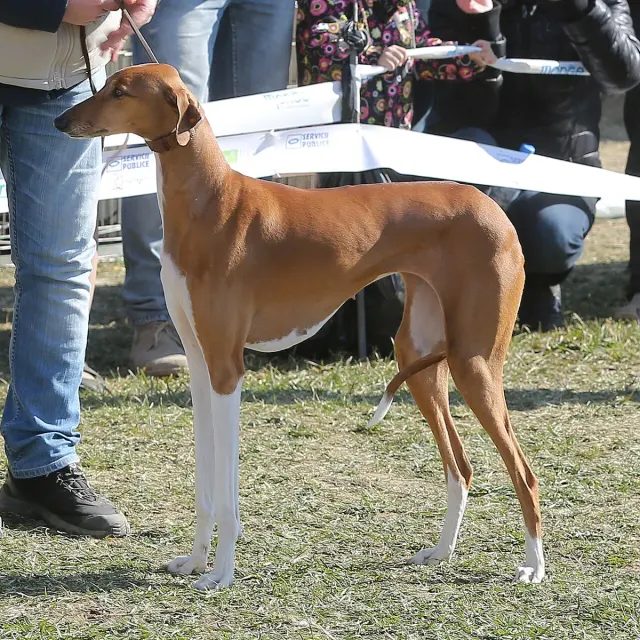
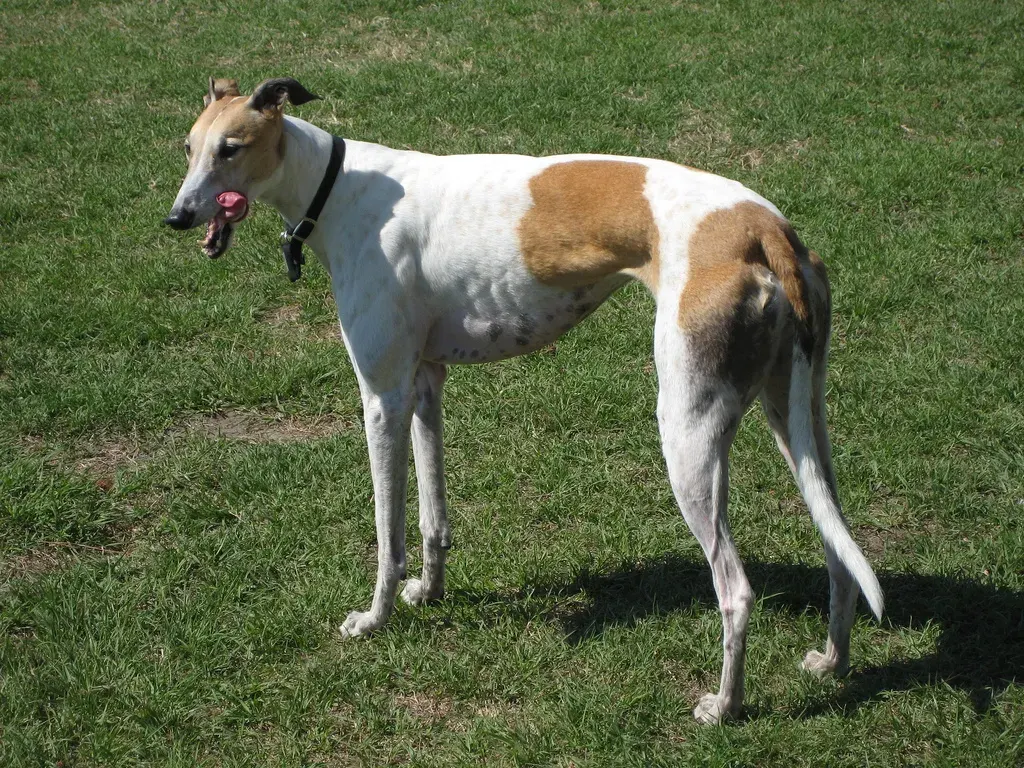
The FCI breed standard describes a strongly built, upstanding dog of generous proportions and muscular power, with a long head and neck, a deep chest, a slightly arched loin and powerful hindquarters. The coat is fine and close.
Colours are black, white, red, blue, fallow and brindle, or any of these broken with white.
- Ideal height at the withers: 71–76 cm for males, 68–71 cm for females.
Temperament
Calm, gentle and quiet, the Greyhound spends much of the day asleep. It is affectionate and usually good with children.
Its chase instinct can be strong around small animals; it responds well to gentle training.
With children and other pets
The standard describes a dog of remarkable stamina, intelligent, gentle, affectionate and even-tempered. It rates 4 out of 5 with children and 4 out of 5 with other dogs in our ratings.
- It is usually calm and quiet at home.
- Its chasing instinct is strong: be careful with cats and small animals.
Training tips
According to the standard, the Greyhound may have originated in the Middle East; greyhound-type dogs appear on Ancient Egyptian tombs, and the breed was developed to a standard in Britain. Racing Greyhounds were developed from the coursing hound. It rates 3 out of 5 for trainability in our ratings.
- Let it run only in safe, fenced areas: it chases by sight.
- Use gentle, reward-based training.
Health
This is a fairly robust breed. Like all sighthounds it is sensitive to some anaesthetics and carries little body fat, so tell your veterinarian. Bone cancer and dental problems are also reported.
Regular veterinary follow-up is recommended.
Common health issues in detail
A UK study of more than 5,400 pet Greyhounds under veterinary care found that the most common problems were dental (periodontal) disease (39.0%), overgrown nails (11.1%), wounds (6.2%) and osteoarthritis (4.6%). The median lifespan was 11.4 years, and females lived slightly longer than males.
The Royal Kennel Club recommends as best practice for breeding dogs a DNA test for Greyhound neuropathy (GN).
This is general information. For any question about your dog's health, consult a veterinarian.
Feeding
Good-quality food in two meals suits it; it should stay lean.
Avoid running straight after meals.
Exercise
It needs daily walks and, ideally, a few sprints a week in a fully enclosed area.
It tires quickly and enjoys resting.
In winter it needs a coat and a soft bed. Calm indoors, it can live in an apartment if walked daily and allowed to run safely from time to time.
Grooming
Its very short coat needs only a weekly rub with a grooming mitt.
Its thin skin is prone to scrapes and feels the cold.
Choosing a puppy
The UK study above notes that Greyhounds are increasingly kept as pets, often after their racing careers are over. If you buy a puppy, choose a breeder who does the GN DNA test.
- Ask for the parents' GN DNA results.
- Ask about the dog's teeth and any injuries if adopting a former racer.
- Meet the dog: it should be calm and gentle.
Our guide on how to recognise a responsible breeder explains what to ask.
Similar breeds
The Whippet and Italian Greyhound are smaller relatives. The Spanish Greyhound (Galgo) and Sloughi are other smooth sighthounds.