An extremely fine-boned sighthound from the Sahel, the Azawakh is a proud guard and hunting dog, devoted to its family and wary of strangers.
History and origins
The Azawakh comes from the Azawagh valley between Mali and Niger, where the nomadic peoples of the Sahel, notably the Tuareg, have used it for centuries to guard camps and hunt gazelle and hare.
It was recognised in Europe in the second half of the 20th century.
Appearance and colours
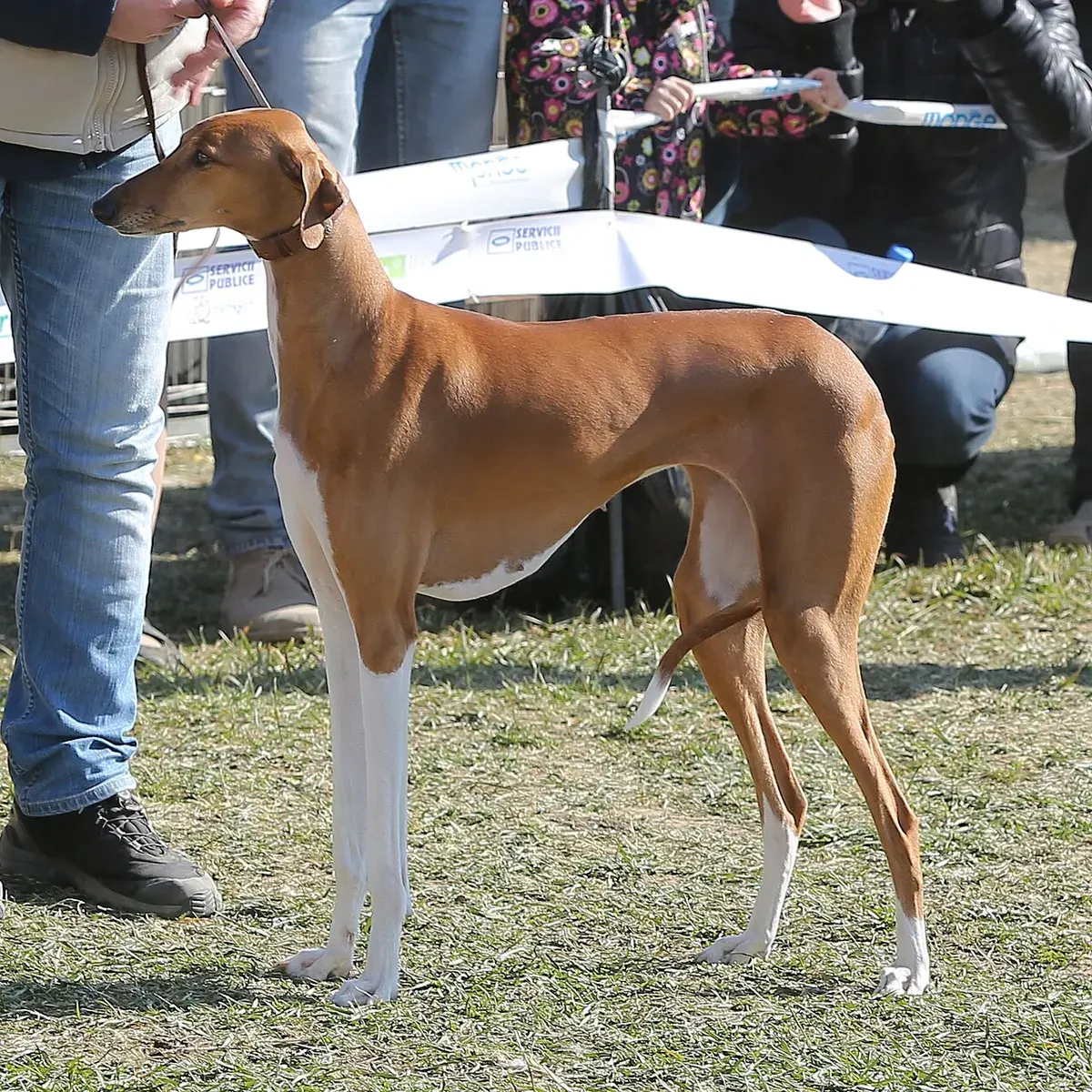
The FCI breed standard describes a particularly slim and elegant sighthound that gives an impression of great slenderness, with bones and muscles showing through thin, dry skin. Unusually, the body fits into a rectangle standing on its short side: the dog is taller than it is long.
The hair is short and fine, almost absent on the belly. The colour is fawn, from light sand to dark fawn (mahogany), with or without black brindling and a black mask, and with white limited to the extremities. The Royal Kennel Club also lists sable and red brindle among standard colours.
- Height at the withers: 64–74 cm for males, 60–70 cm for females.
- Weight: 20–25 kg for males, 15–20 kg for females.
Temperament
Proud, sensitive and deeply attached to its family, the Azawakh is wary, even aloof, with strangers. It happily lives in a group with the other dogs of the household.
It needs early socialisation and gentle, respectful training.
With children and other pets
The standard describes the Azawakh as quick, attentive and distant, often very reserved with strangers, but gentle and affectionate with its family and with people it chooses to accept. The Royal Kennel Club calls it gentle, loyal and sensitive. It rates 2 out of 5 with children and 2 out of 5 with other dogs in our ratings.
- It suits a calm home and needs time to accept visitors.
- Introduce it gradually to other dogs, and be careful with small pets.
Training tips
According to the standard, the Azawakh comes from the valley of the Azawakh, on the northern borders of Mali and Niger, where the Tuareg (who call it Oska), Dahoussahaq and Peul peoples used it to hunt gazelle, hare and ostrich and to drive off predators; it also shared the family life of nomadic camps. European breeders began working with it from 1968. It rates 2 out of 5 for trainability in our ratings.
- Use gentle, patient, reward-based training: harsh handling damages its trust.
- Let it run only in securely fenced areas.
Health
This is a hardy breed. Some autoimmune conditions, epilepsy and heart problems should be monitored. It is sensitive to anaesthetics.
Regular veterinary follow-up is recommended.
Close to the Sloughi in its traditional use, it needs a large, securely fenced property and protection against leishmaniasis; apartment life does not suit it.
This is general information. For any question about your dog's health, consult a veterinarian.
Feeding
Good-quality food matched to its activity suits it. Its very bony outline is normal.
Avoid exertion straight after meals.
Exercise
It needs long walks and regular free runs in a large enclosed area.
It has great stamina.
It is more sensitive to winter cold and damp.
Grooming
Its very short, fine coat needs only a rub with a grooming mitt.
It sheds little and has very little odour.
Choosing a puppy
The FCI standard disqualifies aggressive or overly shy dogs, extreme thinness and non-standard colours.
- Meet the parents and check that they are reserved but not fearful.
- Ask how the puppies have been socialised with people and everyday life.
Our guide on how to recognise a responsible breeder explains what to ask, and our guide to the sighthounds of North Africa and the Sahel explains the breed's background.