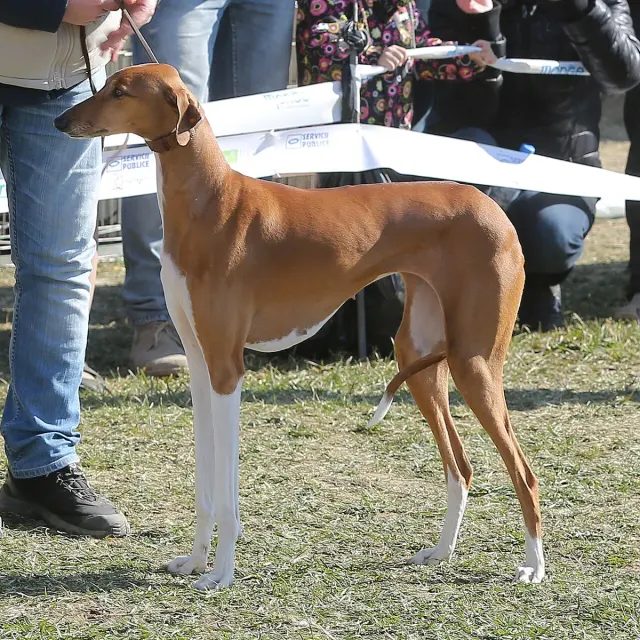
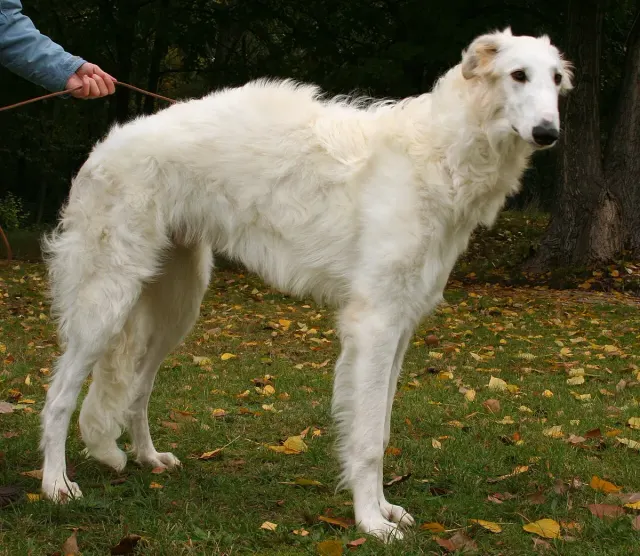
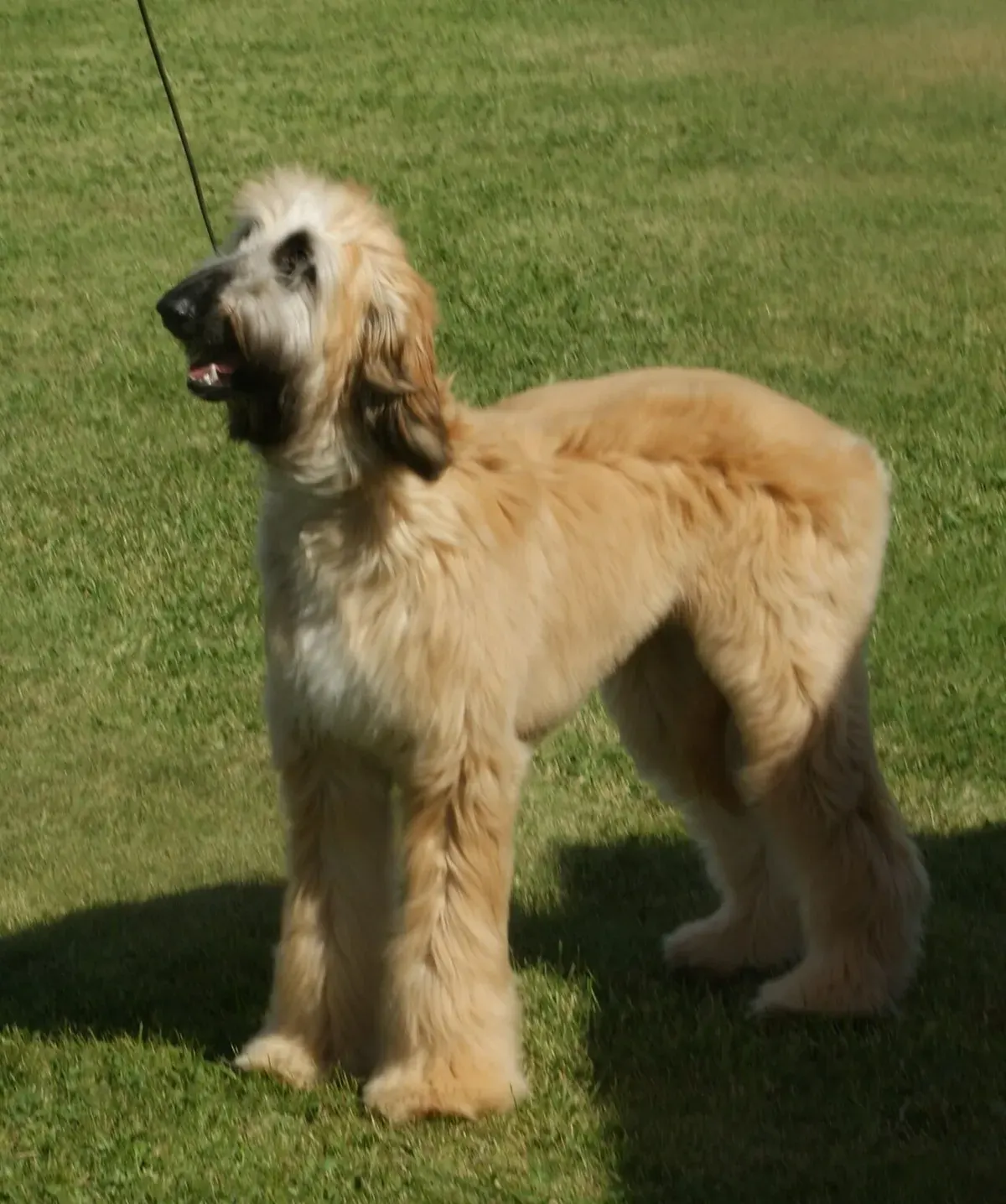
With its long silky coat and aristocratic bearing, the Afghan Hound is a fast, independent and dignified hunter.
History and origins
The Afghan Hound comes from the mountainous regions of Afghanistan, where it hunted hare, gazelle and other game by sight over rough terrain. Its long coat protected it from the cold.
It reached Europe in the early 20th century.
Appearance and colours
The FCI breed standard describes a sighthound that gives an impression of strength and dignity, combining speed and power, with the head held proudly and an "Eastern" expression: the Afghan "looks at and through one". The Royal Kennel Club notes that the breed's size range reflects the different types used on desert plains and in the mountains.
The coat is long and very fine on the ribs, legs and flanks, with a silky topknot, while mature dogs have short, close hair along the back (the "saddle") and on the foreface. The coat must develop naturally: the standard penalises any sign of clipping. All colours are accepted except merle, but white markings on the head are highly undesirable. The Royal Kennel Club lists more than twenty standard colours, from cream and gold to black, brindle and domino.
- Ideal height at the withers: 68–74 cm for males, 63–69 cm for females.
Temperament
Dignified, independent and sometimes aloof, the Afghan Hound is affectionate with its people in its own way. It is often reserved with strangers.
Training it takes a great deal of patience; its recall stays unreliable around game.
With children and other pets
The standard describes the Afghan as dignified and aloof, with "a certain keen fierceness". The Royal Kennel Club describes hounds in general as dignified, aloof but trustworthy companions. It rates 3 out of 5 with children and 3 out of 5 with other dogs in our ratings.
- It is usually reserved with strangers and appreciates a calm home.
- Its long coat needs daily handling, so teach children to respect its space during grooming.
Training tips
The standard notes that the Afghan is a hunter and will chase if given the opportunity; the Royal Kennel Club adds that it was equipped to hunt deer, gazelle, hare and fox at great speed. It rates 1 out of 5 for trainability in our ratings, the lowest score.
- Use patient, reward-based training and accept that it may choose not to obey.
- Let it run only in securely fenced areas: recall around moving animals is rarely reliable.
Health
This is a fairly robust breed. Hip dysplasia, some eye diseases (cataract) and hypothyroidism should be monitored. Like other sighthounds, it is sensitive to anaesthetics.
Regular veterinary follow-up is recommended.
Common health issues in detail
The Royal Kennel Club recommends hip scoring for hip dysplasia (BVA/KC scheme) as best practice for breeding dogs.
We found no large population study of health in the breed.
This is general information. For any question about your dog's health, consult a veterinarian.
Feeding
Good-quality food matched to its activity keeps it lean and supports coat quality.
Avoid exertion straight after meals.
Exercise
It needs long walks and free runs in a fully enclosed area.
It enjoys lure coursing.
Dust and grass awns cling to its coat, so check it after every outing. It prefers a house with an enclosed garden to an apartment.
Grooming
Its long coat needs thorough brushing several times a week and regular baths; otherwise it forms tight mats.
It is a major time commitment.
Choosing a puppy
Look for a breeder who hip-scores the parents and is honest about the work the coat requires.
- Ask to see the hip scores of both parents.
- Meet the adult dogs and check they are calm and confident; the standard disqualifies aggressive or overly shy dogs.
- Ask the breeder to show you how the coat is groomed, and how long it takes each week.
Our guide on how to recognise a responsible breeder explains what to ask.