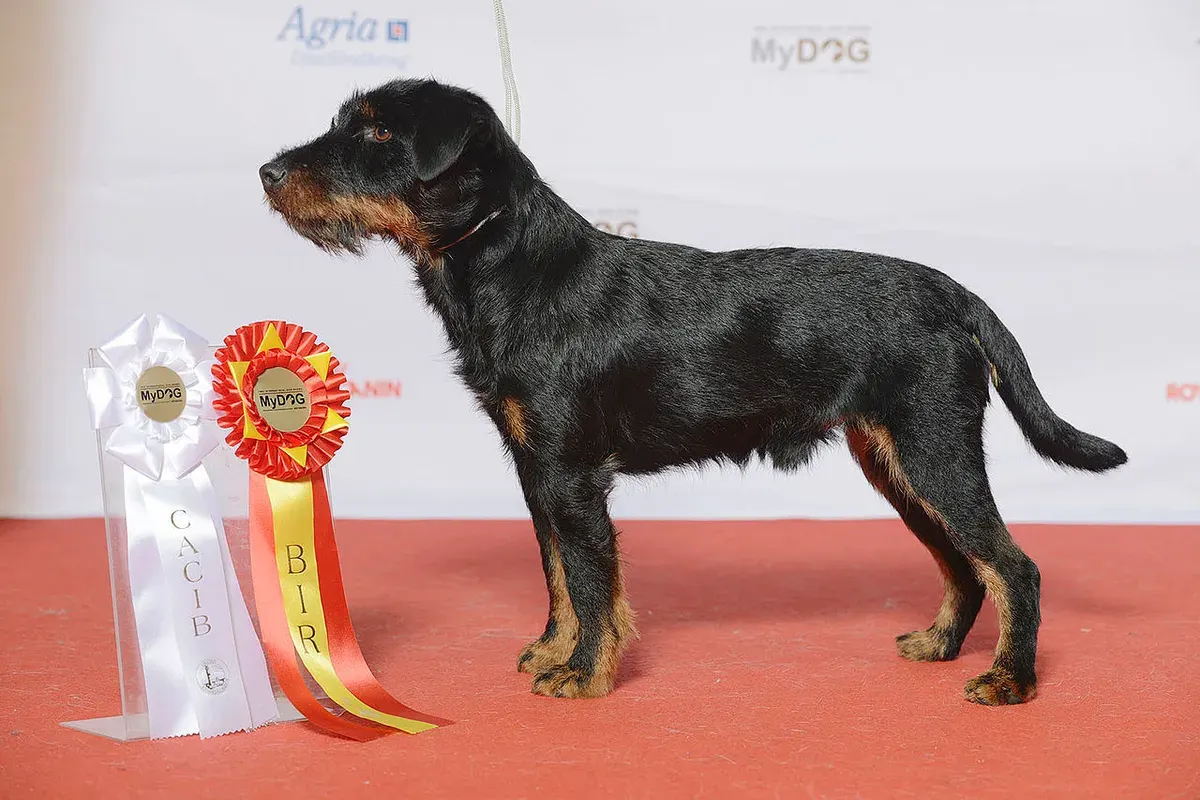
A small black-and-tan hunter with formidable energy, the Jagdterrier is first and foremost a working dog for experienced hunters.
History and origins
The German Hunting Terrier (Jagdterrier) was created in Germany in the 1920s by hunters who wanted a versatile terrier bred purely for ability: going to ground, blood tracking and retrieving on land and from water.
Today it is still mainly a hunting dog.
Appearance and colours
The FCI breed standard describes a smallish, compact, well-proportioned working hunting dog, usually black and tan. The coat is plain and dense: either hard and rough or coarse and smooth.
The colour is black, dark brown or greyish-black, with clearly defined yellow-red markings on the eyebrows, muzzle, chest, legs and base of the tail; small white markings on the chest and toes are tolerated.
- Height at the withers: 33–40 cm.
Temperament
Brave, tenacious and tireless, the Jagdterrier is very attached to its owner but can be wary of strangers and aggressive towards other animals.
It needs an experienced owner, firm training and a real job.
With children and other pets
The standard describes a courageous, hard, enduring and lively dog that takes pleasure in work, reliable, sociable and trainable, neither shy nor aggressive. It rates 2 out of 5 with children and 2 out of 5 with other dogs in our ratings.
- It is primarily a hunting dog and suits active, experienced owners.
- Its hunting instinct is very strong: be careful with small animals.
Training tips
According to the standard, the breed was created in Germany after the First World War by hunters who wanted a dog bred only for hunting performance, starting from four black and tan terriers and crossing in the Old English Wirehaired Terrier and the Welsh Terrier; the breed club was founded in 1926. It hunts underground and flushes game. It rates 3 out of 5 for trainability in our ratings.
- Use consistent, reward-based training.
- It rates 5 out of 5 for energy: it needs work and long daily exercise.
Health
This is a very robust breed. Lens luxation has been reported in the breed.
Hunting injuries are the main risk; regular veterinary follow-up is recommended.
This is general information. For any question about your dog's health, consult a veterinarian.
Feeding
A rich diet suited to intense activity suits it.
Adjust the ration between hunting and rest periods.
Exercise
It needs a lot of activity, ideally hunting or intense scent work, for several hours a week.
It is unsuited to a sedentary life.
It copes fairly well with heat, but its intensity at work means hunting or training should happen in the cool hours, with water. It does not suit apartment life or a family with no hunting experience.
Grooming
Its rough or smooth coat needs weekly brushing.
Check regularly for injuries, ticks and grass seeds after outings.
Choosing a puppy
The FCI standard says only healthy dogs with typical breed conformation should be used for breeding.
- Ask what health checks the parents have had.
- Meet the mother: she should be confident, neither shy nor aggressive.
Our guide on how to recognise a responsible breeder explains what to ask.
Similar breeds
The Welsh Terrier is one of the breeds behind it. The Jack Russell Terrier, Parson Russell Terrier and Wire Fox Terrier are other working terriers.