Longer-legged than the Jack Russell, the Parson Russell is a sporty, cheerful, tireless terrier made for active owners.
History and origins
The Parson Russell Terrier shares its origins with the Jack Russell: both descend from the terriers of the Reverend John Russell. The Parson was bred to keep up with horses on fox hunts, hence its longer legs.
It is recognised as a separate breed by the Fédération Cynologique Internationale.
Appearance and colours
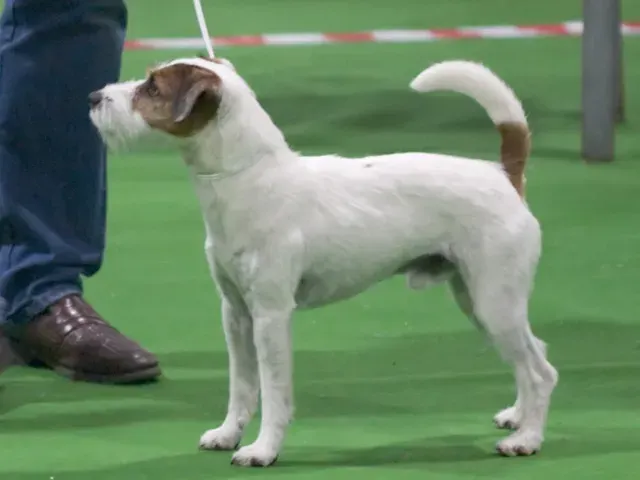
The FCI breed standard describes a workmanlike, active and agile terrier without exaggeration, built for stamina and endurance, balanced and flexible; honourable scars are permissible. The coat, whether rough, broken or smooth, is naturally harsh, close and dense with a good undercoat and weather-resistant.
The colour is white or predominantly white with tan, lemon or black markings, or any combination of these, preferably on the head and the root of the tail.
- Ideal height at the withers: 36 cm for males, 33 cm for females.
Temperament
Enthusiastic, intelligent and very sociable with people, the Parson is a spirited companion. Its hunting instinct is strong and it can be stubborn.
It needs consistent, playful training and a real daily outlet for its energy.
With children and other pets
The standard describes a terrier originally bred to work fox: confident, energetic, happy, bold and friendly. It rates 3 out of 5 with children and 2 out of 5 with other dogs in our ratings.
- It is a lively companion for active families.
- Its hunting instinct is strong: be careful with small animals.
Training tips
According to the standard, after long controversy over the "Jack Russell" type, the Kennel Club recognised the strain of Fox Terriers bred by the Victorian hunting parson John Russell as the Parson Russell Terrier. The Royal Kennel Club describes it as small and racy, with great stamina. It rates 3 out of 5 for trainability in our ratings.
- Use short, varied, reward-based sessions.
- It rates 5 out of 5 for energy: it needs plenty of exercise and games.
Health
This is a robust breed. Some inherited eye diseases, deafness and a neurological condition for which tests exist should be monitored.
Regular veterinary follow-up is recommended.
Common health issues in detail
The Royal Kennel Club recommends as a minimum for breeding dogs DNA tests for late-onset ataxia (LOA) and primary lens luxation (PLL), and as best practice a DNA test for spinocerebellar ataxia (SCA) and eye testing.
We found no large population study of health in the Parson Russell Terrier.
This is general information. For any question about your dog's health, consult a veterinarian.
Feeding
Food for very active small dogs, in suitable portions, suits it.
Keep an eye on its weight.
Exercise
It needs at least an hour and a half of daily activity: running, games, agility and canicross.
Keep it on a lead outside fenced areas.
It copes fairly well with heat, but should do intense activity early in the morning or in the evening in summer, with water available. It can live in an apartment if its exercise needs are truly met; otherwise it will become noisy and destructive.
Grooming
Its smooth or rough coat needs weekly brushing; the rough coat can be hand-stripped twice a year.
Remember nails and teeth.
Choosing a puppy
Choose a breeder who does the LOA, PLL and SCA DNA tests and eye-tests the parents.
- Ask for the parents' DNA and eye results.
- Meet the mother: she should be friendly and confident.
Our guide on how to recognise a responsible breeder explains what to ask.
Similar breeds
The Jack Russell Terrier is its shorter relative. The Wire Fox Terrier, Smooth Fox Terrier and Border Terrier are other working terriers.