Small but tireless, the Jack Russell is a lively, clever and daring terrier that needs plenty of activity.
History and origins
The Jack Russell Terrier is named after the Reverend John Russell, a keen fox-hunting enthusiast in 19th-century southern England. The modern breed was finalised in Australia before being recognised by the Fédération Cynologique Internationale.
It worked underground, chasing foxes into their dens.
Appearance and colours
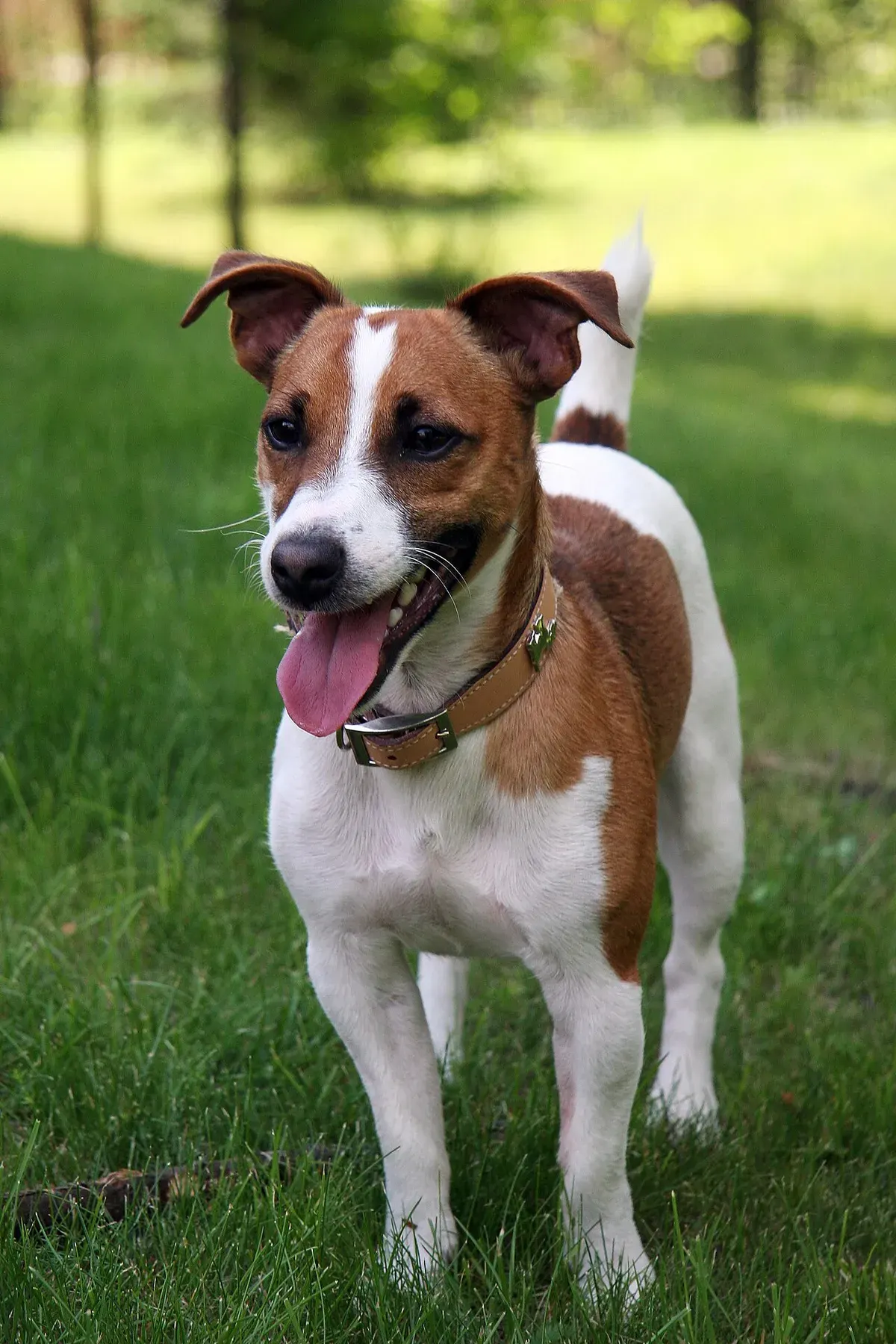
The FCI breed standard describes a strong, active, lithe working terrier of great character, with a flexible body of medium length, longer than tall. The coat may be smooth, rough or broken.
The Royal Kennel Club lists white with black, tan, or black and tan markings.
- Height at the withers: 25–30 cm.
- Weight: about 1 kg for every 5 cm of height (about 5 kg at 25 cm, 6 kg at 30 cm).
Temperament
Energetic, curious and brave, the Jack Russell is a cheerful companion very attached to its family. It has a strong hunting instinct and can be stubborn.
It needs consistent, playful training and plenty to do to avoid barking and destruction.
With children and other pets
The standard describes a lively, alert and active terrier, bold and fearless, friendly but quietly confident. It rates 3 out of 5 with children and 2 out of 5 with other dogs in our ratings.
- It is a lively companion for active families.
- Its hunting instinct is strong: be careful with small animals.
Training tips
According to the standard, the breed began in 19th-century England with the Reverend John Russell, who developed a strain of Fox Terriers to run with his foxhounds and go to ground; two types evolved, the taller Parson Russell and the shorter, slightly longer Jack Russell. The Royal Kennel Club notes that it was developed as a show dog in Australia. It rates 3 out of 5 for trainability in our ratings.
- Use short, varied, reward-based sessions.
- It rates 5 out of 5 for energy: it needs plenty of exercise and games.
Health
This is a robust, long-lived breed. Kneecap luxation, some inherited eye diseases and deafness should be monitored.
Genetic tests exist for some conditions.
Common health issues in detail
The Royal Kennel Club recommends as a minimum for breeding dogs a DNA test for primary lens luxation (PLL), and as best practice DNA tests for late-onset ataxia (LOA) and spinocerebellar ataxia (SCA), and eye testing.
A Japanese study of 792 Jack Russell Terriers found that 1.9% carried an APC gene variant linked to hereditary gastrointestinal polyps, a dominant condition; the carriers had or had had such polyps, and some of their ancestors came from Australia or New Zealand, suggesting carriers may exist elsewhere.
This is general information. For any question about your dog's health, consult a veterinarian.
Feeding
Food for small active dogs, in portions matched to its energy use, suits it.
Avoid too many treats.
Exercise
It needs at least an hour of intense activity a day: running, ball games, agility and scent games.
Its hunting instinct means a lead outside fenced areas.
It can live in an apartment as long as it gets plenty of exercise every day. Watch out for cats and small animals in the neighbourhood.
Grooming
Whether smooth or rough-coated, it needs weekly brushing. It sheds all year round.
Rough-coated dogs can be hand-stripped twice a year.
Choosing a puppy
Choose a breeder who does the PLL, LOA and SCA DNA tests and eye-tests the parents.
- Ask for the parents' DNA and eye results.
- Meet the mother: she should be friendly and confident.
Our guide on how to recognise a responsible breeder explains what to ask.
Similar breeds
The Parson Russell Terrier is its taller relative. The Smooth Fox Terrier, Wire Fox Terrier and Border Terrier are other working terriers.