An elegant little dog, hairless or long-coated (Powder Puff), the Chinese Crested is affectionate, cheerful and devoted to its owners.
History and origins
Despite its name, the Chinese Crested's exact origin is debated; small hairless dogs of this type are thought to have travelled aboard trading ships. The breed was developed in Europe and the United States in the 20th century.
It comes in two varieties: hairless (hair only on the head, tail and feet) and 'Powder Puff', fully coated.
Appearance and colours
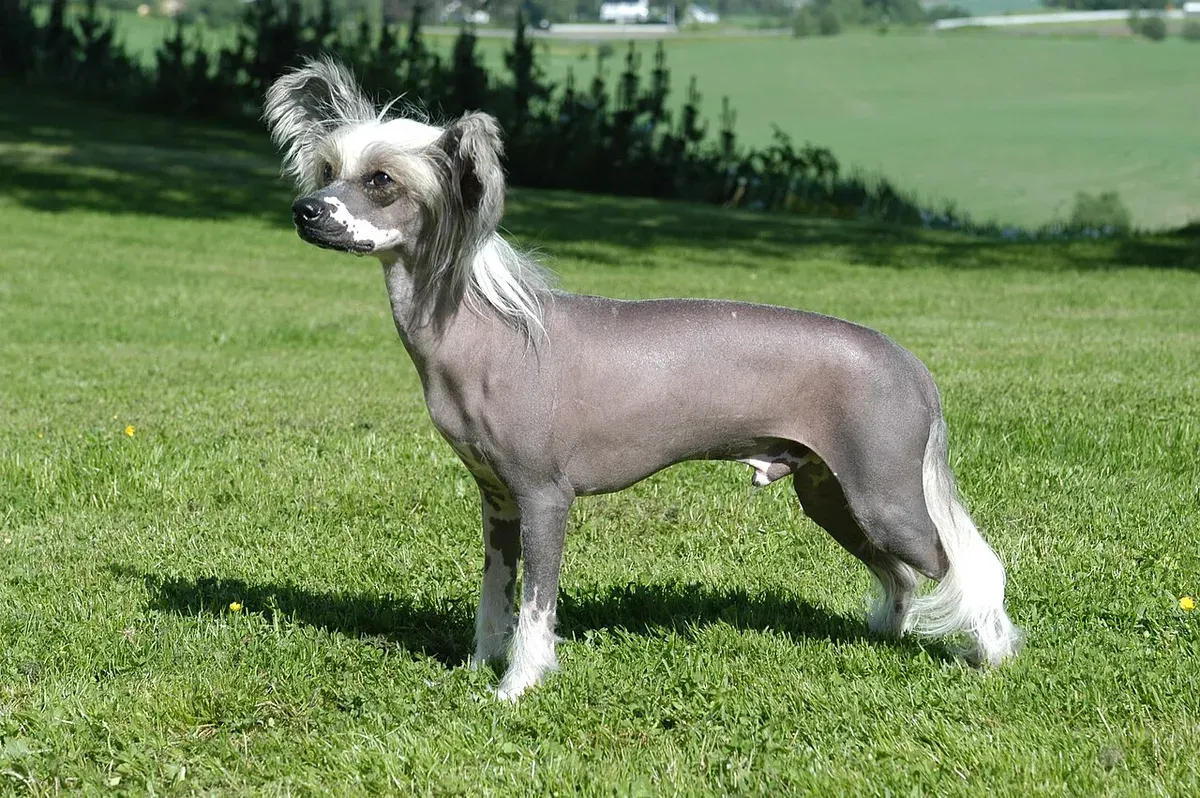
The FCI breed standard describes a small, active and graceful dog in two varieties. The Hairless has a crest of hair on the head extending part way down the neck, "socks" on the toes and a plume on the tail, with the rest of the body hairless. The Powder Puff is entirely covered with a veil of long, soft hair. The standard also distinguishes two types: the racy, fine-boned "deer" type and the heavier "cobby" type.
Any colour or combination is accepted, except merle.
- Ideal height at the withers: 28–33 cm for males, 23–30 cm for females.
Temperament
Affectionate, merry and sensitive, it is very attached to its family and dislikes being left alone. It can be reserved with strangers.
It learns with gentle, patient training.
With children and other pets
The standard describes a happy dog, never vicious. It rates 3 out of 5 with children and 4 out of 5 with other dogs in our ratings.
- It is small and delicate: teach children to handle it gently.
Training tips
According to the standard, the breed is said to have been owned by families of the Han Dynasty in China, as guardians of treasure houses and, in a larger form, as hunting dogs; it was shown in America from 1885 to 1926, then rarely seen for about fifty years. It rates 3 out of 5 for trainability in our ratings.
- Use short, gentle, reward-based sessions.
- Daily walks and play meet its needs.
Health
The hairless variety often has incomplete teeth and sensitive skin (sunburn, acne). Some inherited eye diseases and kneecap luxation should also be monitored.
Regular veterinary follow-up is recommended.
Common health issues in detail
The Royal Kennel Club recommends as best practice for breeding dogs DNA tests for primary lens luxation (PLL), in which the lens of the eye moves out of place, and for progressive retinal atrophy (prcd-PRA). It also notes that the breed can be affected by conformational concerns.
We found no large population study of health in the Chinese Crested.
This is general information. For any question about your dog's health, consult a veterinarian.
Feeding
Food for very small dogs suits it; dogs with missing teeth may need smaller or softened kibble.
Avoid excess weight.
Exercise
Daily walks and play are enough. It is agile and playful.
It loves to snuggle somewhere warm.
It is perfectly suited to apartments and suits households that want almost no dog hair.
Grooming
The hairless variety needs skin care: gentle cleansing, moisturiser and sun protection. The Powder Puff needs brushing several times a week.
Remember dental care.
Choosing a puppy
Choose a breeder who carries out the PLL and PRA DNA tests.
- Ask for the parents' DNA results.
- Ask how the breeder cares for the skin of hairless dogs.
- Meet the mother: she should be happy and confident.
Our guide on how to recognise a responsible breeder explains what to ask.
Similar breeds
The Xoloitzcuintle is another hairless breed. The Chihuahua, Italian Greyhound and Papillon are other small, fine-boned companions.