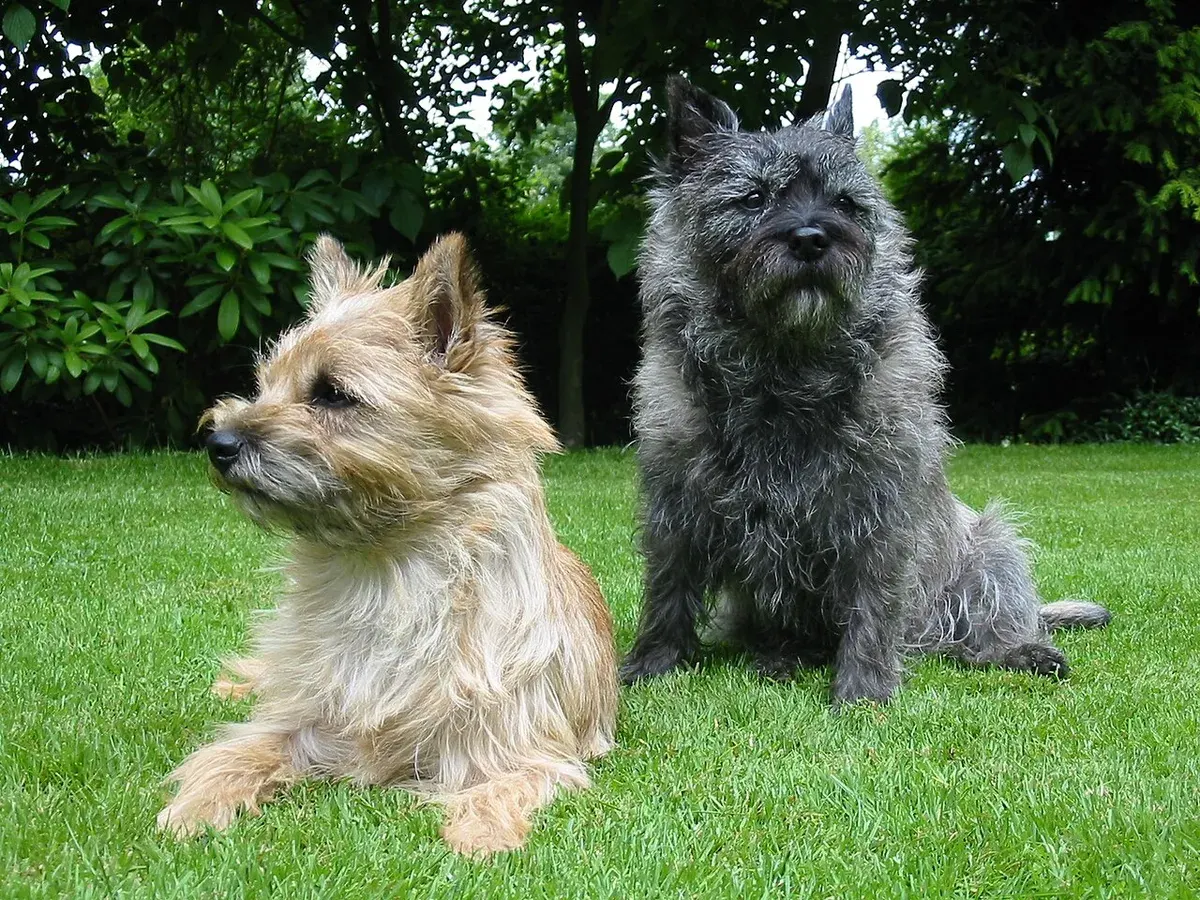
A hardy, cheerful little Scottish terrier, the Cairn is curious, sturdy and affectionate, a good companion for active families.
History and origins
The Cairn Terrier comes from western Scotland, where it hunted foxes and rodents hiding in the 'cairns', the piles of stones found across the Highlands.
A Cairn played Toto in the 1939 film 'The Wizard of Oz'.
Appearance and colours
The FCI breed standard describes an agile, alert terrier of workmanlike, natural appearance, standing well forward on its forepaws, with strong hindquarters, deep ribs and very free movement. The coat is very important: weather-resistant and double, with a profuse, harsh but not coarse outer coat and a short, soft, close undercoat.
Colours are cream, wheaten, red, grey or nearly black, all of which may be brindled; solid black, white and black and tan are not allowed. Dark points such as the ears and muzzle are very typical.
- Height at the withers: about 28–31 cm.
- Weight: ideally 6–7.5 kg.
Temperament
Cheerful, curious and full of energy, the Cairn is an affectionate companion, usually good with children. It keeps a terrier's nature: it digs, chases and barks readily.
It learns well with positive, patient training.
With children and other pets
The standard describes an active, game and hardy dog with a fearless and cheerful disposition, assertive but not aggressive. The Royal Kennel Club calls it a fearless, assertive and hardworking Scottish native. It rates 4 out of 5 with children and 3 out of 5 with other dogs in our ratings.
- It is sturdy and playful with sensible children.
- It may chase small animals and dig in the garden.
- Give it daily walks and games such as digging boxes and searching games: it rates 4 out of 5 for energy in our ratings.
Health
This is a robust, often long-lived breed. Kneecap luxation, some eye diseases and a liver disorder (shunt) should be monitored.
Regular veterinary follow-up is recommended.
Common health issues in detail
Ocular melanosis. In this eye disease, pigment builds up inside the eye and can lead to glaucoma. A UK study examined 93 adult Cairn Terriers and found ocular melanosis in about 10%, more than half of them of breeding age. Because early stages can go unnoticed, the authors recommend a detailed eye examination, including gonioscopy, before breeding and regular re-checks of breeding dogs.
Health tests. The Royal Kennel Club recommends eye testing as best practice for breeding dogs.
This is general information. For any question about your dog's health, consult a veterinarian.
Feeding
Food for small active dogs in measured portions suits it.
Avoid excess weight.
Exercise
It needs about an hour of daily activity, with walks and search games.
Keep it on a lead outside safe areas: it happily follows a scent.
Its harsh coat also shields it from the sun. It lives well in an apartment if walked and stimulated every day.
Grooming
Its harsh, weatherproof coat needs weekly brushing and light stripping a few times a year. It sheds little.
Avoid over-frequent bathing.
Choosing a puppy
Choose a breeder who has the parents' eyes examined regularly, including before breeding.
- Ask for the parents' recent eye certificates.
- Meet the mother: she should be confident and cheerful.
Our guide on how to recognise a responsible breeder explains what to ask.
Similar breeds
The West Highland White Terrier and Scottish Terrier are other small Scottish terriers. The Norwich Terrier and Border Terrier are small working terriers of similar size.