A hardy little terrier with an otter-like head, the Border Terrier is affectionate, sociable and easier to live with than many terriers.
History and origins
The Border Terrier comes from the border country between England and Scotland, where it ran with foxhound packs and horses to bolt foxes.
It had to be small enough to go to ground and tough enough to keep up with the riders.
Appearance and colours
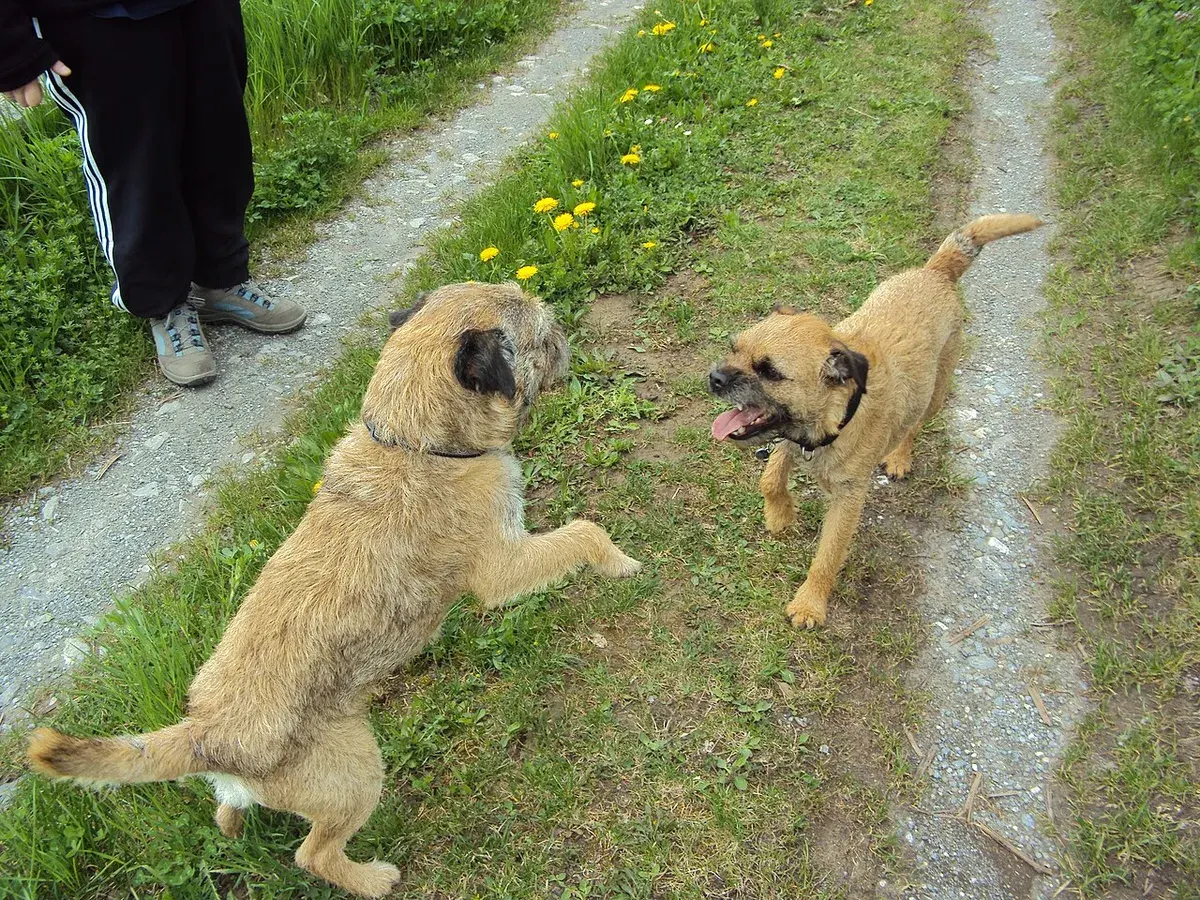
The FCI breed standard describes essentially a working terrier, capable of following a horse, with a head "like that of an otter", a moderately broad skull and a short, strong muzzle.
The coat is harsh and dense with a close undercoat. Accepted colours are red, wheaten, grizzle and tan, or blue and tan.
- Weight: 5.9–7.1 kg for males and 5.1–6.4 kg for females.
Temperament
Cheerful, affectionate and sociable, the Border Terrier usually gets on well with children and other dogs. It is still a hunter, though, and small animals can trigger its instinct.
It learns well with positive training.
With children and other pets
The standard describes a terrier that combines activity with gameness. The Royal Kennel Club calls it an active, game and adaptable working terrier. It rates 4 out of 5 with children and 4 out of 5 with other dogs in our ratings.
- It is sturdy and cheerful with sensible children.
- It may chase small animals and cats it does not know.
- Give it daily walks and games, and work on recall early: it rates 4 out of 5 for energy in our ratings.
Health
This is a robust breed. Hip dysplasia, some heart and eye diseases and a rare neurological disorder (paroxysmal dyskinesia) should be monitored.
Regular veterinary check-ups are usually enough.
Common health issues in detail
Epileptoid cramping syndrome. Border Terriers can suffer episodes of difficulty walking, mild trembling and abnormal muscle contractions, usually starting before three years of age and lasting from a few minutes to half an hour. In a study of 29 affected dogs, some also had digestive signs, and about half of the owners who changed their dog's diet reported fewer episodes. If your dog has such episodes, film one and see your vet.
Spongiform leucoencephalomyelopathy (SLEM). This inherited disease causes "shaking puppy" signs, with unsteadiness and severe tremors starting at about three weeks of age. The Royal Kennel Club recommends a DNA test for SLEM for breeding dogs as a minimum.
This is general information. For any question about your dog's health, consult a veterinarian.
Feeding
It loves food: small-breed food for active dogs, in measured portions, suits it.
Watch its weight.
Exercise
It needs about an hour of daily activity: walks, games, tracking or agility.
Keep it on a lead outside safe areas.
It lives well in an apartment if it gets enough exercise.
Grooming
Its wiry coat needs weekly brushing and hand-stripping twice a year. It sheds little.
Avoid clipping, which spoils the coat texture.
Choosing a puppy
Choose a breeder who DNA-tests the parents for SLEM and is open about cramping episodes in their lines.
- Ask for the parents' SLEM results.
- Ask whether any relatives have had cramping episodes or seizures.
- Meet the mother: she should be active, friendly and confident.
Our guide on how to recognise a responsible breeder explains what to ask.
Similar breeds
The Norwich Terrier and Cairn Terrier are other small, harsh-coated working terriers. The Jack Russell Terrier is a lively terrier of similar size.