Compact, muscular and overflowing with affection for people, the 'Staffie' is a cheerful, brave dog that needs serious training.
History and origins
The Staffordshire Bull Terrier was developed in 19th-century England, in Staffordshire, from bulldog and terrier crosses. Once used for fights that are now banned, it was later bred as a companion dog.
It was recognised by the British Kennel Club in 1935.
Appearance and colours
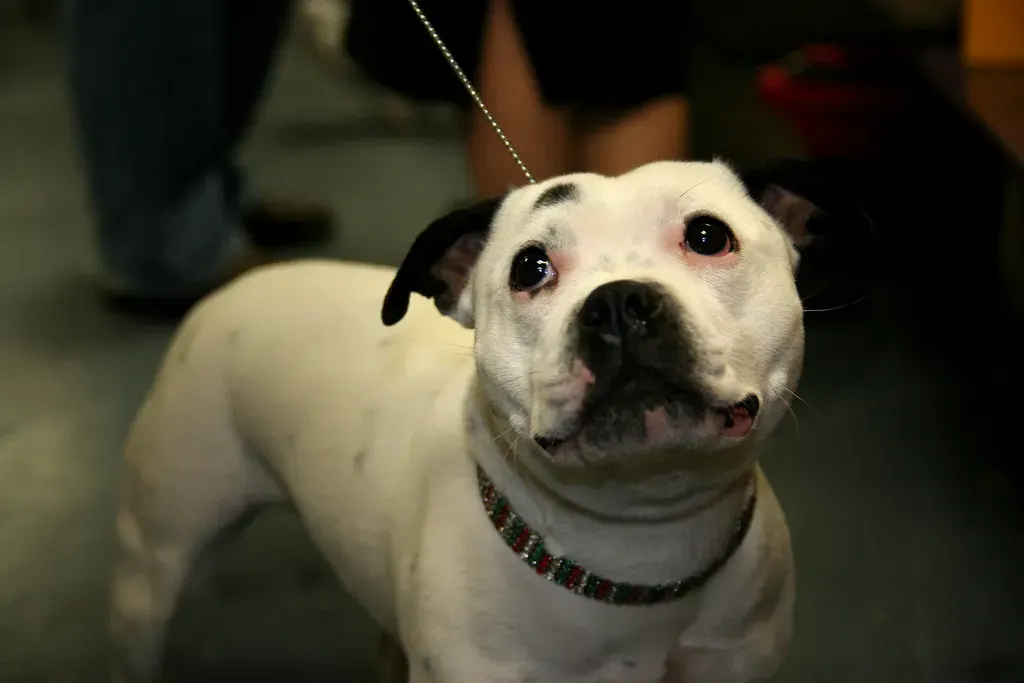
The FCI breed standard describes a smooth-coated, well-balanced dog of great strength for its size, muscular, active and agile, with a short head. The coat is smooth, short and close.
Colours are red, fawn, white, black or blue, or any of these with white, and any shade of brindle, with or without white.
- Height at the withers: 35.5–40.5 cm.
- Weight: 12.7–17 kg for males, 11–15.4 kg for females.
Temperament
Cheerful, tenacious and very people-oriented, the Staffie adores its family and is often very patient with children. It may, however, be intolerant of other dogs.
Its strength and energy call for consistent training, early socialisation and good lead handling.
Some regions restrict ownership of this breed; check your local regulations.
With children and other pets
The standard describes a dog of traditionally indomitable courage and tenacity, highly intelligent and affectionate, especially with children; bold, fearless and totally reliable. It rates 4 out of 5 with children and 2 out of 5 with other dogs in our ratings.
- It is an affectionate family dog.
- Introduce it carefully to other dogs.
Training tips
The Royal Kennel Club notes that the breed shares its ancestry with the Bull Terrier, developed in the 1860s by crossing Bulldogs with terriers for vermin control and blood sports, and that it is traditionally shown in a broad leather collar bearing the Staffordshire Knot as a tribute to its origins. It rates 3 out of 5 for trainability in our ratings.
- Use consistent, reward-based training and early socialisation.
- It rates 4 out of 5 for energy: give it daily exercise and games.
Health
This is a fairly robust breed. Inherited eye diseases (cataracts), a metabolic condition and skin allergies have been reported; genetic tests exist.
Regular veterinary follow-up is recommended.
Common health issues in detail
Distichiasis, extra eyelashes growing from the edge of the eyelid, is the most frequently recorded eye disorder in Norwegian Staffordshire Bull Terriers. In 4,177 dogs examined, it affected 2.9% of puppies checked at about eight weeks but 18.7% of dogs examined after one year, and its heritability was medium to high, so the authors recommend a second eye examination after one year.
The Royal Kennel Club recommends as best practice for breeding dogs DNA tests for hereditary cataract (HC-HSF4) and L-2-hydroxyglutaric aciduria (L-2-HGA), elbow scoring and eye testing; it notes that the breed has a breed club health scheme and can be affected by conformation-related problems.
This is general information. For any question about your dog's health, consult a veterinarian.
Feeding
Food-loving, it gains weight easily: measure portions and limit treats.
Good-quality, protein-rich food supports its muscles.
Exercise
It needs about an hour of daily activity, with games, brisk walks and obedience.
Keep it on a lead around other dogs.
It lives well in an apartment if it gets enough exercise.
Grooming
Its short, smooth coat needs weekly brushing.
Watch its sometimes sensitive skin.
Choosing a puppy
Choose a breeder who does the HC and L-2-HGA DNA tests, elbow scoring and adult eye testing.
- Ask for the parents' DNA, elbow and recent eye results.
- Meet the mother: she should be friendly and relaxed with people.
- Check whether local rules apply to this breed where you live.
Our guide on how to recognise a responsible breeder explains what to ask.
Similar breeds
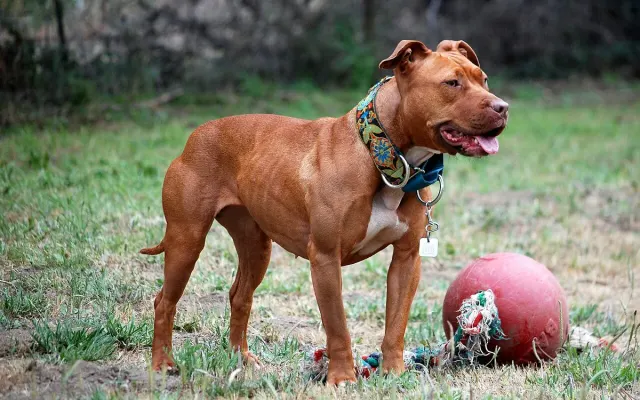
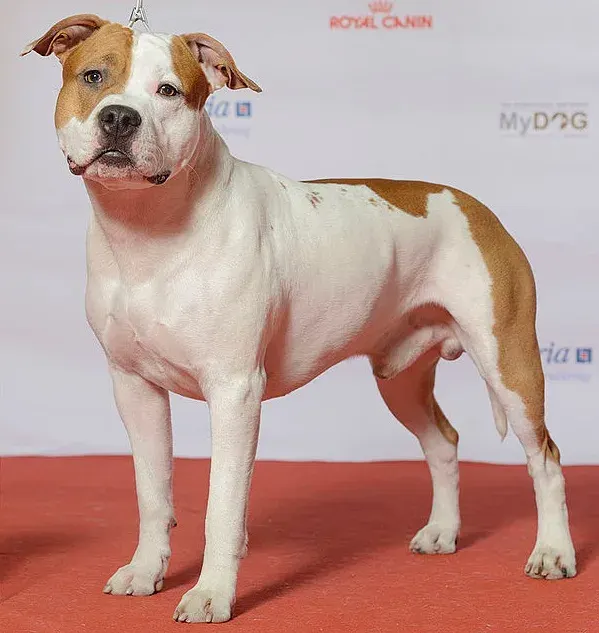
The American Staffordshire Terrier, Bull Terrier and American Pit Bull Terrier are related bull-type terriers. The Boxer is another muscular, people-loving dog.