A primitive-type dog from the Near East, the Canaan Dog is alert, intelligent and remarkably well suited to hot, dry climates.
History and origins
The Canaan Dog descends from semi-feral dogs that have lived in the Near East for thousands of years. In the 1930s, cynologist Rudolphina Menzel selected these dogs to create a guard and working dog.
The breed is recognised by the Fédération Cynologique Internationale.
Appearance and colours
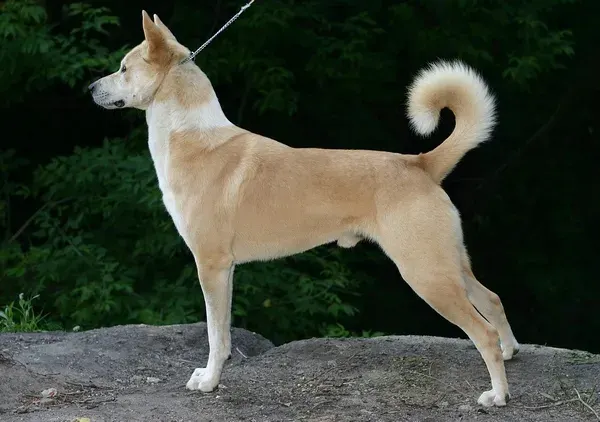
The FCI breed standard describes a medium-sized, well-balanced, strong and square dog resembling the wild dog type, with a strong distinction between the sexes and a head shaped like a blunt wedge. The Royal Kennel Club calls it a Middle East native and the national breed of Israel.
The outer coat is dense, harsh and straight, of short to medium length, over a close, profuse undercoat. Colours range from sand to red-brown, white, black or spotted, with or without a symmetrical mask; white markings are allowed, and desert colours (sand, gold, red and cream) are the most typical. Grey, brindle, black and tan and tricolour are not accepted.
- Height at the withers: 50–60 cm; males can be considerably larger than females.
- Weight: 18–25 kg.
Temperament
Alert, intelligent and very attached to its family, the Canaan Dog is wary of strangers and barks to signal any intrusion. It can be territorial with other dogs.
It learns quickly with positive training but gets bored with repetition.
With children and other pets
The standard describes an alert dog, quick to react and distrustful of strangers, strongly defensive but not naturally aggressive, vigilant towards people and other animals, and extraordinarily devoted. It rates 3 out of 5 with children and 2 out of 5 with other dogs in our ratings.
- It is a natural watchdog: socialise it early with visitors and other dogs.
- It is devoted to its own family.
Training tips
The FCI classifies the Canaan Dog as a primitive-type watch and security dog. The standard describes it as amenable to training. It rates 3 out of 5 for trainability in our ratings.
- Use calm, consistent, reward-based training.
- Give it daily exercise and things to do; it copes well with heat, rating 5 out of 5 for heat tolerance.
Health
This is a very hardy breed with few known inherited problems. Hip dysplasia and some eye conditions are monitored.
Regular veterinary check-ups are usually enough.
Common health issues in detail
The Royal Kennel Club recommends eye testing and hip scoring as best practice for breeding dogs.
We found no large population study of health in the Canaan Dog.
This is general information. For any question about your dog's health, consult a veterinarian.
Feeding
Good-quality food matched to its activity suits it.
Avoid excess weight.
Exercise
It needs an hour or more of daily activity: walks, games, agility and tracking.
It likes to dig and patrol.
It is a good guardian for a house with a garden; its barking makes apartment life difficult.
Grooming
Its short double coat needs weekly brushing, more during moults.
It is clean and has little odour.
Choosing a puppy
Choose a breeder who eye-tests and hip-scores the parents.
- Ask for the parents' eye and hip results.
- Meet the mother: she should be alert and devoted, wary but not aggressive.
Our guide on how to recognise a responsible breeder explains what to ask.
Similar breeds
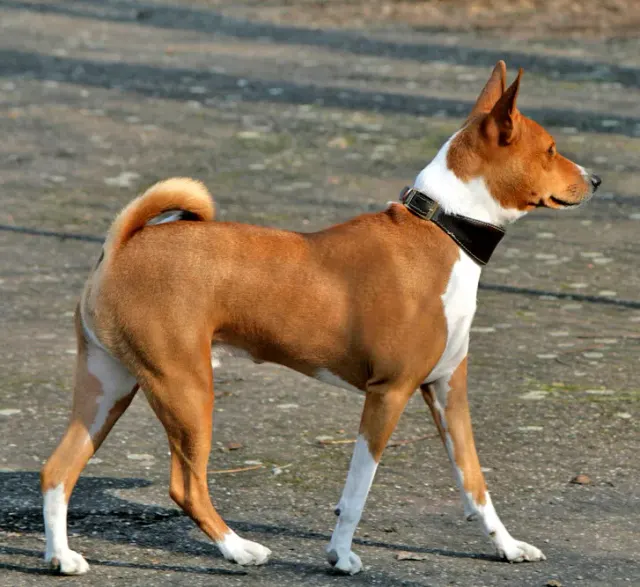
The Basenji, Pharaoh Hound and Cirneco dell'Etna are other primitive-type breeds. The Shiba Inu is a small spitz with a similar independence.