A sturdy little terrier with a generous ruff, the Australian Terrier is lively, loyal and well suited to warm climates.
History and origins
The Australian Terrier was developed in 19th-century Australia from British terriers brought by settlers. It hunted rodents and snakes and guarded farms.
It is one of the first breeds developed in Australia.
Appearance and colours
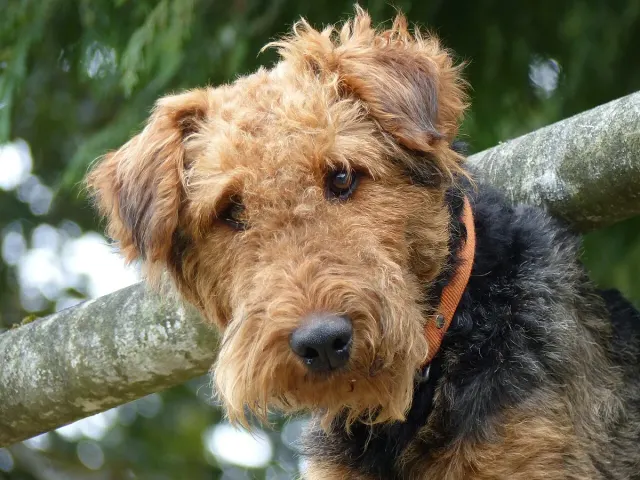
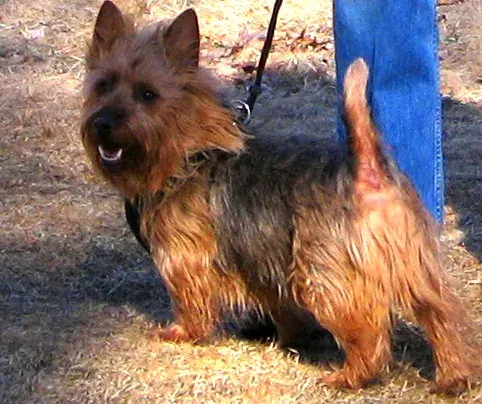
The FCI breed standard describes a sturdy, low-set dog, rather long for its height, with strong terrier character. Its untrimmed, harsh coat, a definite ruff around the neck extending to the breastbone and a long, strong head give it a rugged, "hard-bitten" look.
The harsh, straight, dense top coat is about 6 cm long, over a short, soft undercoat, with short hair on the muzzle, lower legs and feet. The standard accepts two colour groups: blue, steel blue or dark grey-blue with rich tan, with a blue, silver or lighter topknot; and clear sandy or red.
- Height at the withers: about 25 cm, females slightly less.
- Weight: about 6.5 kg for males, females slightly less.
Temperament
Lively, confident and very attached to its family, the Australian Terrier is a good watchdog. It is often calmer than other terriers but keeps a strong hunting instinct.
Positive, regular training suits it well.
With children and other pets
The standard describes an essentially working terrier whose loyalty and even disposition make it equally suitable as a companion. It rates 4 out of 5 with children and 3 out of 5 with other dogs in our ratings.
- It is sturdy enough for family life with sensible children.
- It may chase small animals, so introduce pets carefully.
Training tips
According to the standard, the Australian Terrier was the first breed developed in Australia and one of the few terriers developed outside the United Kingdom, from broken-coated terriers in Tasmania, New South Wales and Victoria thought to descend from Skye, Scottish and Dandie Dinmont Terriers, with occasional Yorkshire Terrier crosses. It was bred to be one of the smallest working terriers, a helper and companion in rough times and terrain. It rates 3 out of 5 for trainability in our ratings.
- Use reward-based training and plenty of variety.
- Give it outlets: digging, searching and chasing games.
Health
This is a robust breed. Kneecap luxation, diabetes and some allergies should be monitored.
Regular veterinary follow-up is recommended.
This is general information. For any question about your dog's health, consult a veterinarian.
Feeding
Small-breed food in measured portions suits it.
Watch its weight.
Exercise
Daily walks and play, about an hour a day, are enough.
Keep it on a lead outside fenced areas.
It lives very well in an apartment if walked every day.
Grooming
Its harsh coat needs weekly brushing and occasional light stripping. It sheds very little.
Keep the hair around the eyes clear.
Choosing a puppy
The FCI standard states that only healthy dogs with breed-typical conformation should be used for breeding.
- Meet the mother and check that she is confident and even-tempered.
- Ask about the health of the parents and older relatives.
Our guide on how to recognise a responsible breeder explains what to ask.
Similar breeds
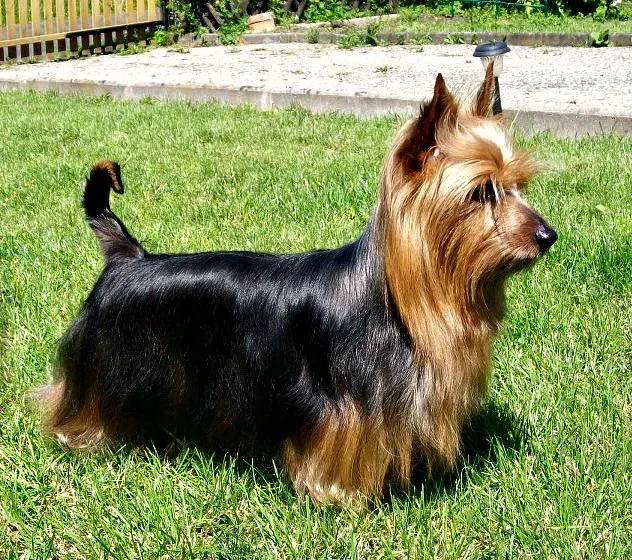
The Australian Silky Terrier shares the same ancestry but has a long, silky coat. The Cairn Terrier and Norwich Terrier are other small, harsh-coated terriers. The Yorkshire Terrier was occasionally crossed into the breed.