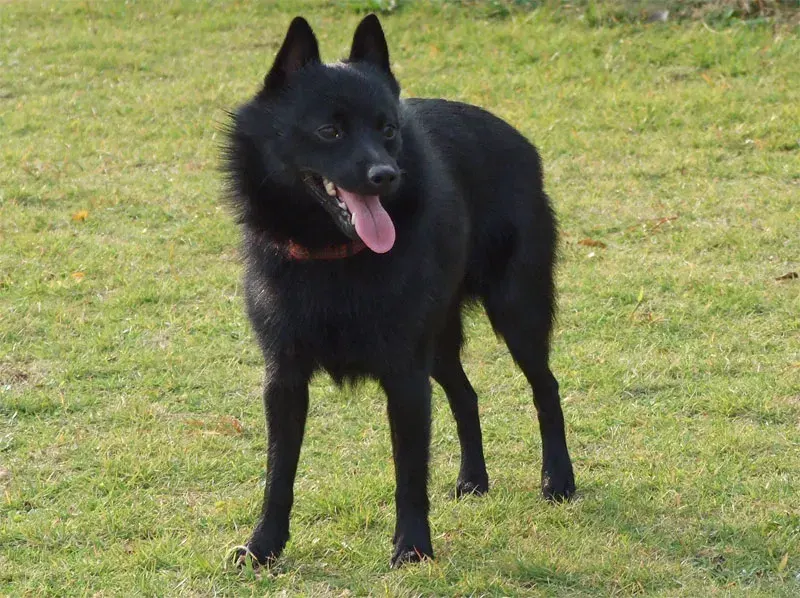
A small black Belgian dog with a strong personality, the Schipperke is curious, watchful and full of energy.
History and origins
The Schipperke is a small Belgian breed long associated with the craftsmen of Brussels and Antwerp and with the boatmen of the Flemish canals, where it caught rats and guarded the barges.
The Fédération Cynologique Internationale classes it among the sheepdogs.
Appearance and colours
The FCI breed standard describes a small but very solidly built sheepdog of wolf-like type, with a wedge-shaped head, a short, broad, stocky body and fine-boned legs. The coat is abundant, thick, straight and harsh over a soft undercoat, forming a very typical ruff, mane, frill and culottes.
The colour is entirely black.
- Weight: 3–9 kg, ideally 4–7 kg.
Temperament
Curious, quick and very watchful, the Schipperke notices everything and raises the alarm readily. It is affectionate with its family and rather reserved with strangers.
Independent, it needs consistent, patient training.
With children and other pets
The standard describes an excellent small guard and alarm dog, bubbling with vitality, aloof with strangers, active, tireless and always curious, inclined to snap at anyone approaching objects it guards, and very gentle with children. It rates 4 out of 5 with children and 3 out of 5 with other dogs in our ratings.
- It is a lively family dog and a keen watchdog.
- Expect it to announce every visitor.
Training tips
According to the standard, "Schipperke" means "little shepherd" in Flemish, and it probably shares an ancestor, a small black sheepdog called the Leuvenaar, with the Belgian Shepherds; around 1690 it was the favourite dog of the working people of Brussels. The Royal Kennel Club notes that it kept down vermin on Belgian barges, translating its name as "little skipper". It rates 3 out of 5 for trainability in our ratings.
- Use short, varied, reward-based sessions.
- It rates 4 out of 5 for energy: give it daily activity.
Health
This is a robust, often long-lived breed. Some rare inherited conditions (a metabolic disease, eye disorders) have been described, so ask the breeder for test results.
Also keep an eye on its teeth and weight.
Common health issues in detail
Mucopolysaccharidosis IIIB (MPS IIIB) is an inherited storage disease that causes progressive neurological signs. Of 3,219 Schipperkes DNA-tested between 2003 and 2019, 1.5% were affected and 23.6% were healthy carriers; the numbers of affected dogs and carriers fell quickly once screening began.
The Royal Kennel Club recommends as best practice for breeding dogs DNA tests for MPS IIIB and for the T-box (bobtail) gene.
This is general information. For any question about your dog's health, consult a veterinarian.
Feeding
It tends to put on weight if overfed, so measure portions of food for small active dogs.
Limit treats.
Exercise
It needs daily walks and play. Its rodent-hunting instinct can make it run off.
Keep it on a lead outside fenced areas.
It lives well in an apartment if it gets enough exercise, but its alert barking should be channelled early.
Grooming
Its black coat, longer around the neck (the ruff), needs brushing once a week, more during the moult.
Remember nails and teeth.
Choosing a puppy
Choose a breeder who does the MPS IIIB and T-box DNA tests.
- Ask for the parents' MPS IIIB and T-box results.
- Meet the mother: she should be lively and confident.
Our guide on how to recognise a responsible breeder explains what to ask.
Similar breeds
The Belgian Groenendael is a larger black Belgian sheepdog. The German Spitz, Miniature Pinscher and Affenpinscher are other small, lively watchdogs.