Tough, tireless and utterly loyal, the Australian Cattle Dog is a working dog built for heat and wide open spaces.
History and origins
The Australian Cattle Dog was developed in 19th-century Australia to drive large herds of cattle over long distances in a hot, dry climate. Crosses with the dingo gave it stamina and resilience.
It comes in blue or red speckled coats and remains a highly valued farm dog.
Appearance and colours
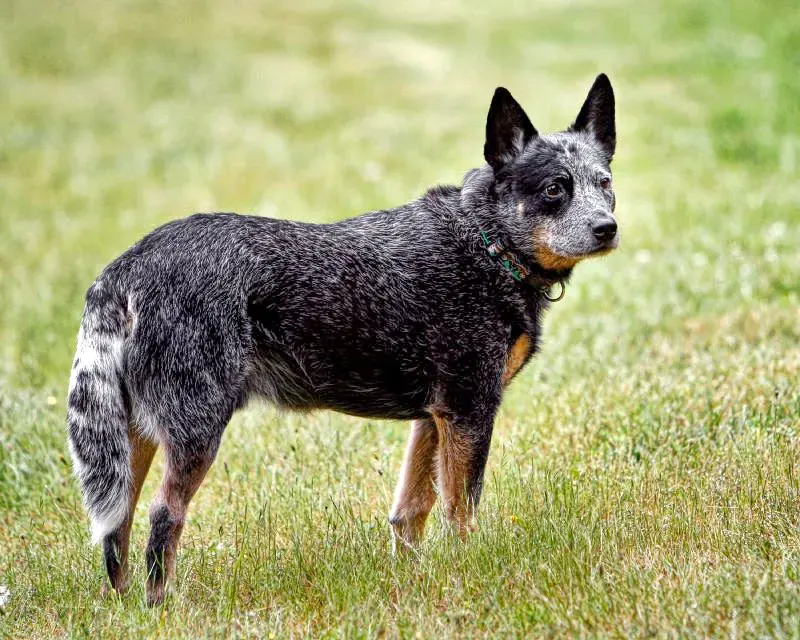
The FCI breed standard describes a strong, compact, symmetrically built working dog whose substance, power and hard muscle convey great agility, strength and endurance. The body is slightly longer than tall (10:9).
The double coat has a short, dense undercoat and a close, straight, hard outer coat that lies flat and resists rain, about 2.5–4 cm long on the body. The standard recognises two colours: blue (blue, blue mottled or blue speckled, with or without black, blue or tan markings) and red speckled, with or without darker red markings on the head. The Royal Kennel Club lists blue and tan, red and red and tan among non-standard colours.
- Height at the withers: 46–51 cm for males, 43–48 cm for females.
Temperament
Intelligent, brave and strongly attached to one person, the Cattle Dog is wary of strangers and may be intolerant of other dogs.
Its instinct leads it to nip heels, so early and consistent training is essential, especially around children.
With children and other pets
According to the standard, the Cattle Dog's loyalty and protective instincts make it a self-appointed guardian of the stockman, the herd and the property; it is naturally suspicious of strangers but must accept handling. It rates 3 out of 5 with children and 2 out of 5 with other dogs in our ratings.
- Bred as a biting cattle dog, it may nip when excited: redirect it to toys.
- Socialise it early with visitors and other dogs.
Training tips
The standard explains that the breed was developed to help establish the cattle industry in early Australia, where properties were unfenced: settlers needed a strong biting dog with great stamina, able to muster and move wild cattle. The standard describes the breed as always alert, extremely intelligent, watchful, courageous and trustworthy. The Royal Kennel Club describes it as strong, fast and tireless, perhaps with some Dingo ancestry. It rates 4 out of 5 for trainability and 5 out of 5 for energy in our ratings.
- It needs hard physical exercise and real mental work every day: herding, agility, obedience or scent work.
- Teach it an "off switch" and calm behaviour at home.
Health
This is a robust breed. Congenital deafness and progressive retinal atrophy are the main inherited problems, so a hearing test and genetic tests are recommended.
Regular veterinary follow-up completes these precautions.
Common health issues in detail
Deafness. The breed is predisposed to congenital sensorineural deafness, present from birth. In a UK study of 524 puppies tested between 4 and 10 weeks of age, 9.7% were deaf in one ear and 1.7% in both, 11.4% in total; puppies with a pigmented face patch had a lower risk. An Australian study found that ten years of hearing tests (BAER) in breeding kennels did not substantially reduce deafness, and concluded that breeding only from dogs whose parents and all four grandparents have tested normal should reduce it most over the long term.
Health tests. The Royal Kennel Club recommends as best practice for breeding dogs:
- hearing testing (BAER), including litter screening
- a DNA test for progressive retinal atrophy (prcd-PRA) and eye testing
- hip scoring and elbow grading
This is general information. For any question about your dog's health, consult a veterinarian.
Feeding
Good-quality food matched to its often high activity suits it.
Water should always be available, especially on outings.
Exercise
It needs at least two hours of daily activity, ideally a real job: herding, dog sports, running or puzzle games.
Without occupation it quickly becomes destructive.
It is an excellent dog for farms and agricultural holdings, but completely unsuited to city apartment life.
Grooming
Its short, weather-resistant coat needs weekly brushing. It sheds heavily once or twice a year.
Check paw pads and look for ticks after countryside outings.
Choosing a puppy
Choose a breeder who hearing-tests every litter and can show you the hearing results of the parents and, ideally, the grandparents.
- Ask for the puppy's own BAER result before you take it home.
- Ask for the parents' PRA, eye, hip and elbow results.
- Meet the mother: she should be watchful but accept handling calmly.
Our guide on how to recognise a responsible breeder explains what to ask.
Similar breeds
The Australian Kelpie is the other Australian working dog, bred for sheep. The Border Collie and Australian Shepherd are other high-energy herding dogs. The Pembroke Welsh Corgi is a small cattle-driving breed.